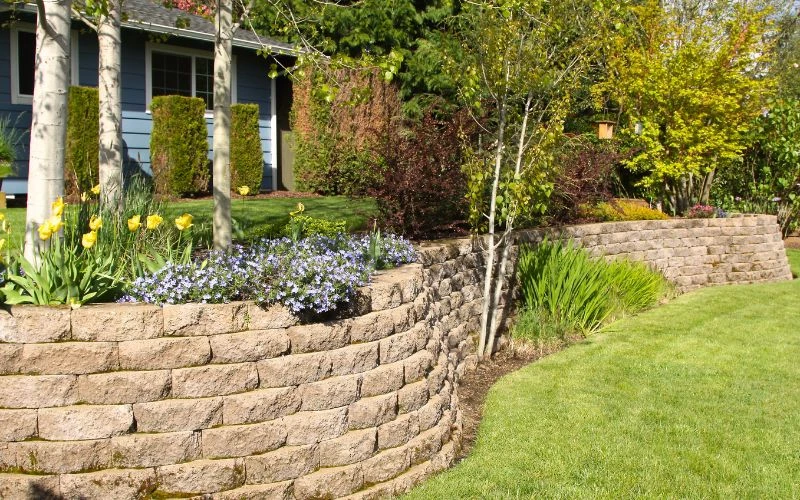
Mature trees add serious value to a property. In fact, studies suggest well-maintained trees can increase property value by up to 10–15%. Meanwhile, sloping blocks across many Melbourne suburbs mean retaining walls are often necessary for stability and usable space.
But here’s the catch.
Build a retaining wall the wrong way near an established tree, and you may slowly damage the very feature you’re trying to preserve. Leaves thin out. Growth slows. Roots destabilise. And months later, the tree begins to decline.
So what exactly are homeowners getting wrong?
Can You Build a Retaining Wall Near an Established Tree?
Yes — but it requires careful planning.
Trees rely on wide, shallow root systems. Contrary to popular belief, most structural roots sit within the top 300–600mm of soil. When soil levels change abruptly due to retaining walls, those roots can become stressed.
The biggest mistake? Treating a tree like a fence post — assuming it won’t react to ground changes nearby.
Think of roots like a network of veins. Disrupt them, compact them, or bury them too deeply, and the tree struggles to breathe.
What Happens If Soil Is Raised Around a Tree?
This is one of the most common issues.
When soil is built up against an existing trunk:
- Oxygen flow to the roots reduces
- Moisture balance changes
- Root rot risk increases
- Tree stability may weaken
Even raising the soil by 150–300mm can impact root health if not managed correctly.
In well-planned landscape design in Brighton projects, professionals often design retaining walls to avoid burying root zones unnecessarily — sometimes incorporating aeration systems or root bridges.
Do Tree Roots Damage Retaining Walls?
They can — but usually only if space is restricted.
Roots grow towards moisture and oxygen. If a retaining wall traps water or alters drainage, roots may push towards the structure.
Common mistakes include:
- Building walls too close to the trunk
- Ignoring drainage behind the wall
- Cutting major structural roots during excavation
- Failing to account for future root expansion
An easy rule of thumb? Avoid disturbing the critical root zone, which generally extends as far as the tree canopy (and sometimes beyond).
How Close Can a Retaining Wall Be to a Tree?
There’s no one-size-fits-all answer. It depends on:
- Tree species
- Age and size
- Soil type
- Wall height
However, maintaining as much of the root system intact as possible is key.
For larger trees, consulting an arborist before construction is often wise. For landscaping in Mornington projects, integrating arborist advice early can prevent costly corrections later.
What’s the Correct Way to Build Around Trees?
Here’s a practical step-by-step approach:
✔ Step 1: Assess Tree Health
Look for signs of stress before construction begins.
✔ Step 2: Map the Root Zone
Identify major roots and avoid cutting them where possible.
✔ Step 3: Design With Space in Mind
Consider curved or offset walls instead of straight lines pressed tightly against roots.
✔ Step 4: Install Proper Drainage
Poor drainage suffocates roots and increases pressure on walls.
✔ Step 5: Avoid Soil Compaction
Heavy machinery can compress soil, limiting oxygen access.
✔ Step 6: Monitor Post-Construction
Watch for leaf thinning, branch dieback, or soil settling.
Planning before digging prevents regret later.
Are Tiered Retaining Walls Better Around Trees?
Often, yes.
Instead of one tall wall that drastically changes soil height, tiered walls create gradual transitions. This reduces shock to the root system and maintains more natural soil levels.
Meanwhile, tiered systems can also improve drainage flow and visual appeal.
Can a Tree Recover After Poor Retaining Wall Installation?
Sometimes — but recovery depends on damage severity.
If roots were severely cut or buried, long-term decline is possible. Early intervention helps:
- Improve aeration
- Adjust drainage
- Reduce soil compaction
- Consult a qualified arborist
Trees are resilient. But they do have limits.
Conclusion: How to Protect Trees While Installing Retaining Walls
Before starting any retaining wall near an established tree, pause and review this checklist:
✔ Avoid raising soil directly against the trunk
✔ Protect the critical root zone
✔ Install effective drainage behind walls
✔ Consider tiered designs
✔ Limit heavy machinery near roots
✔ Seek arborist input for mature trees
Retaining walls and trees don’t have to compete. With thoughtful design and proper planning, you can stabilise your yard while preserving the natural character that makes it special.
Because once a mature tree is lost, it can’t simply be rebuilt.