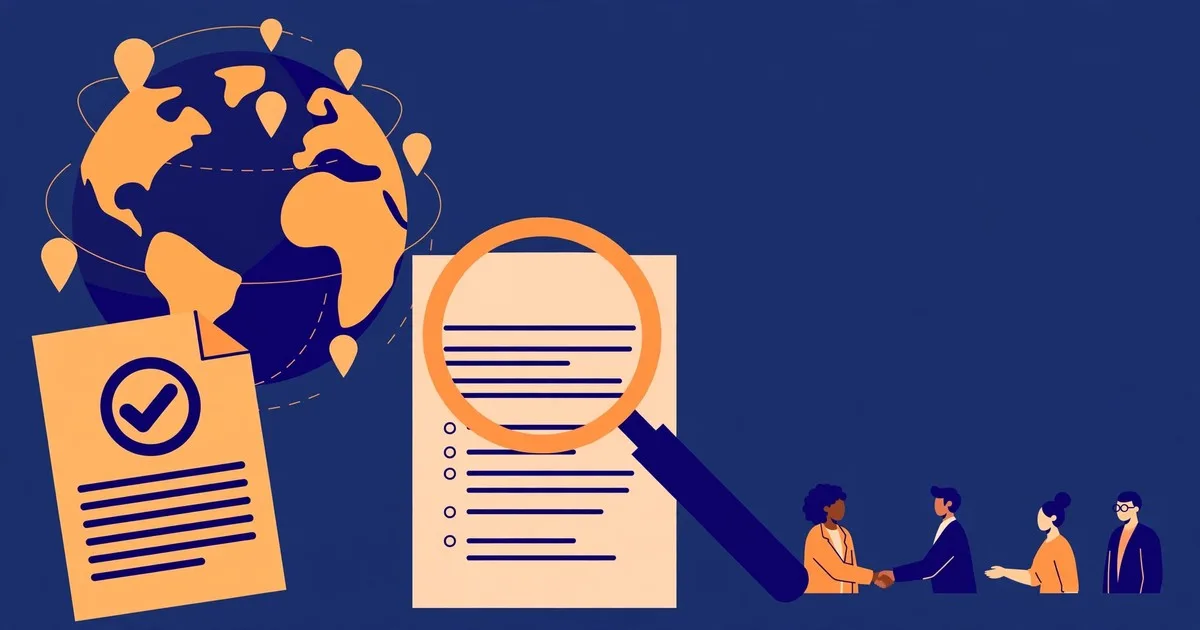
Hiring across borders adds a verification problem that domestic hiring rarely faces. The degree is real, but the university is one you have never heard of, in a system you do not know, with documents in a format you cannot judge. The candidate's last employer is genuine — probably — but operates in another language and another time zone, and may answer email slowly or not at all. Skipping verification because it is awkward is how companies hire people whose credentials dissolve on contact. Doing it badly — slowly, inconsistently, or intrusively — is how they lose good candidates to faster competitors. Here is how to do it properly.
Verify the credential, not the paper
A scanned certificate proves someone possesses a scanned certificate. What you actually need to know is narrower and more checkable:
- Was the qualification actually awarded to this person, by this institution, in this year?
- Is the institution real and recognised as a degree-granting body in its own country?
- Does the qualification correspond to the level the role assumes — a three-year diploma and a four-year degree can share a name and not a meaning.
For most regulated professions and many degree checks, third-party credential evaluation and verification services exist precisely for this: they confirm awards directly with issuing institutions and translate foreign qualifications into your local framework's terms. In regulated fields — healthcare, engineering sign-off, teaching, law — verification is not an HR preference; licensing bodies require it, and “the candidate seemed qualified” is not a defence.
References across borders: what actually works
Reference checks fail internationally for mundane reasons: phone numbers in unfamiliar formats, referees who have left the company, work cultures where a former manager will not speak critically — or at all — to a stranger. Adjust the method, not the standard.
- Ask the candidate to brief the referee. A referee who expects your call, in a language you share, with a time window agreed in advance, answers. A cold call across nine time zones does not.
- Use written references where phone checks are culturally unlikely, but verify them: contact the referee through the company's official channels, not only through contact details the candidate supplied.
- Ask narrower questions. Abroad, broad questions ("was she a good employee?") collect politeness. Specific ones ("did he manage the migration project in 2023, and how large was the team?") collect facts you can compare against the CV.
- Expect different norms, not lower honesty. Some countries restrict what employers may say about former staff; some candidates come from markets where reference letters are formal documents rather than conversations. A missing phone reference is not automatically a red flag — an unverifiable employment history is.
Employment history: confirm the outline
You do not need to reconstruct a candidate's entire career. You need the outline to be true: the employers existed, the candidate worked there in roughly the roles and periods claimed, and there are no gaps that change the story. Payslips, employment letters on verifiable letterhead, tax or social-insurance records where candidates can share them, and professional-registry entries all help. Where documents come from systems you cannot read, a certified translation of the key document is cheaper than a bad hire.
Build it into the process, in the open
Verification that appears late feels like an accusation. Verification announced in the job ad feels like standards. State in the posting that qualifications and employment history will be verified, by whom, and at what stage. Get the candidate's consent in writing before contacting current employers — in most jurisdictions you need it, and in all of them you need the trust. Keep the checks proportionate: the depth that suits a surgeon is theatre for a warehouse role.
Sequencing matters too. Run verification in parallel with final interviews rather than after the offer, and tell the candidate where things stand. International candidates are often managing notice periods, visas, and relocations on your timeline; silence reads as rejection.
The red flags worth acting on
- Qualifications from institutions that cannot be found in any official register of their home country.
- Employment claims that shift between the CV, the interview, and the application form.
- Referees reachable only through the candidate's personal channels, never through the employer's.
- Pressure to skip checks “because the visa deadline is tight.” Deadlines are exactly when verification earns its keep.
None of this requires suspicion as a management style. Companies that hire internationally at any volume — including employers on Top Notch Spot
, where companies and listings are reviewed before they go live — treat verification as plumbing: unglamorous, standardised, and done the same way for everyone. That consistency is what makes it both fair and fast.
Key takeaways
- Verify that the qualification was awarded by a real, recognised institution — not merely that the candidate holds a convincing document.
- Adapt reference checks to time zones, languages, and local norms, but confirm referees through official channels and ask specific, checkable questions.
- Confirm the outline of employment history with documents; translate key ones rather than guessing.
- Announce verification in the job ad, get consent, and run it in parallel with final interviews instead of after the offer.
- Consistency is the safeguard: the same proportionate checks for every international hire, every time.