Most blockages don’t start with a dramatic overflow.
They start as a sink that drains a bit slower than usual, a shower that “sometimes” pools, or a toilet that needs a second flush more often than it should.
If it keeps happening, it’s rarely bad luck. It’s usually a repeatable cause that’s been sitting in the line for a while, often the point where calling a expert help for blocked drains stops the cycle of temporary fixes.
Sydney homes are especially good at hiding these problems until the timing is awful.
The hidden cost of “quick fixes”
A plunger can be fine. So can a quick clean of the trap.
But when the same drain blocks again and again, a quick fix can turn into a habit that delays the real solution.
Some methods just punch a small channel through the blockage. Water moves again, so it feels “fixed”. Meanwhile the buildup stays, waiting for the next load of hair, grease, or sludge.
Other approaches push material further down the pipe, where it grabs at a bend or a junction and becomes harder to clear later.
Chemical drain cleaners are the big one people reach for. They can seem like they worked if the water level drops, but they don’t remove tree roots, they don’t straighten a sagging section, and they don’t repair a cracked joint.
What usually causes repeat blockages in Sydney properties
A recurring blockage normally lands in one of a few categories.
Kitchen lines often suffer from grease and food residue. Grease doesn’t just vanish. It cools, sticks, and gradually narrows the pipe until everything starts catching.
Bathrooms are the hair-and-soap combo. It builds slowly, then suddenly becomes “today’s problem” when it clumps up.
Toilets get blamed for everything, but repeat toilet issues can be downstream. If multiple fixtures start acting up, it’s not the toilet. It’s the line.
Stormwater is its own mess: leaves, silt, and organic debris. A windy week followed by heavy rain can turn a “fine yesterday” line into a blocked one overnight.
Then there are tree roots. Sydney is full of mature trees, and roots will chase moisture through tiny gaps in joints and hairline cracks. Once they find it, they keep coming.
Finally, pipe condition matters. Older sections can be rough inside, misaligned at joints, or sagged so solids settle. A line can still “work” like that, until it doesn’t.
Common mistakes people make (and why they backfire)
The first mistake is assuming every blockage is basically the same thing.
A slow sink is not the same as a gurgling toilet. An overflowing gully outside is not the same as hair in a shower trap. The symptoms point to different locations.
The second is overdoing chemicals.
Apart from the safety and handling issues, chemicals can make later work riskier, and they can give a false sense of progress when the problem is structural or root-related.
The third is waiting because it “comes and goes”.
Intermittent blockages are often a sign the pipe is narrowing, shifting, or catching debris at a damaged joint. The line clears just enough to cope… until the next time.
The fourth is not tracking the pattern at all.
Which fixtures? Which time of day? Worse after rain? Any outside overflow? Those details are more useful than most people think.
Decision factors that actually help you choose the right fix
There’s no single “best” method for blockages. The right approach depends on what’s happening in the pipe.
Is it one fixture or multiple?
One fixture points to a branch line. Multiple fixtures often means the restriction is further downstream.
Does weather matter?
If it’s worse after rain, stormwater is a likely suspect. But rain can also reveal compromised sewer lines in certain conditions, especially where old joints let groundwater in.
What kind of pipe are we dealing with?
Older materials and older joints behave differently than newer PVC. Rough interiors catch more. Misaligned joints catch more. Shifts happen over time.
Do you need a “clear” or a “clean”?
A fast clear restores flow. A proper clean removes the wall buildup that causes repeat issues. If it returns quickly, the pipe probably wasn’t cleaned properly, or the cause is something else.
How much certainty do you need right now?
A basic mechanical clear can be fine for a first-time blockage. But if it’s repeating, certainty starts to matter more than speed.
What to expect when a professional handles a recurring blockage
A good call-out usually starts with questions, not tools.
Which fixtures? How often? Any link to rain? What’s already been tried?
From there, the plumber should narrow down whether it’s local or in the main run, then choose a method that matches the likely cause.
Mechanical clearing can work well for soft blockages.
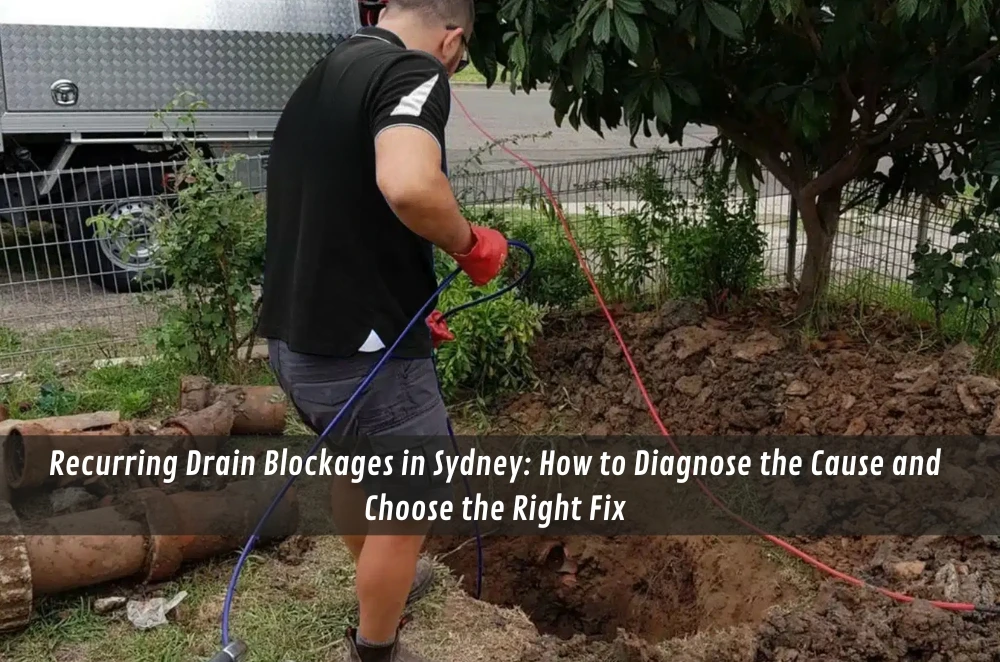
Hydro jetting can be better when there’s grease, sludge, or fine root mass stuck along the pipe walls. It’s not always the answer, though. If the line is already fragile or partially collapsed, it needs care.
CCTV inspection is the turning point when a problem keeps coming back. If the camera shows roots, offsets, cracks, or sagging, the conversation changes from “clear it again” to “why it keeps happening”.
If the issue repeats, it helps to have a quick timeline ready before the visit, this Sydney Blocked Drain Service booking guide shows what details to gather so the inspection starts in the right place.
Operator experience moment
The fastest jobs aren’t always the ones where someone rushes in and starts clearing.
The most useful moments usually happen before tools come out, when the symptoms are pinned down properly.
“Only the ensuite,” “worse at night,” “after storms,” “the gully outside overflowed once” , those little notes are often what stop a repeat call-out.
A simple 7–14 day plan that reduces repeat dramas
Day 1–2: Write down what’s happening.
Which drains are slow? Any gurgling? Any outside overflow points? Put it in plain language.
Day 3–5: Stop feeding the problem.
Kitchen: don’t send oils and greasy scraps down the sink.
Bathroom: use hair catchers and clean them. It’s boring, but it works.
Day 6–9: Check obvious outdoor choke points.
Clear debris around stormwater grates and pits, especially after wind. If a downpipe empties near a grate, keep that area clear.
Day 10–14: Decide if it’s time to investigate properly.
If it’s blocked more than once in a short period, or multiple fixtures are affected, plan a professional assessment instead of another “try something and hope” attempt.
For property managers, turn this into a simple internal checklist so every report comes with usable details.
Local SMB mini-walkthrough (Sydney, NSW)
A small strata block gets reports of slow drains and occasional smells on the lower level.
The manager notices it’s worse after heavy rain and the same units keep reporting it.
A quick clear improves flow, but the issue comes back within weeks.
A CCTV inspection shows early root intrusion and a problem joint where debris catches.
The plan shifts to proper cleaning and a targeted repair, rather than repeat clear-outs.
Outdoor grates and shared stormwater points get a basic maintenance rhythm.
Practical opinions
If it’s coming back quickly, spend effort on the cause, not the symptom.
If rain changes things, treat stormwater and pipe condition as real suspects.
If multiple fixtures are affected, assume it’s downstream until proven otherwise.
Key Takeaways
- Repeat blockages usually mean buildup, roots, or pipe condition, not random bad luck.
- The pattern (which fixtures, timing, weather) often reveals the location of the problem.
- Clearing flow and cleaning pipe walls are different outcomes, and recurrence depends on which happened.
- CCTV inspection is most helpful when it repeats, affects multiple fixtures, or damage/roots are likely.
- A short observation + prevention plan can reduce emergency call-outs.
Common questions we hear from businesses in Sydney, NSW, Australia
Q1) How can you tell if it’s just one drain or the main line?
Usually the giveaway is how many fixtures are affected and whether an outside overflow point is involved. Next step: list which fixtures are slow and check whether any gully/inspection point shows signs of surcharge. In Sydney, older mixed systems can blur the symptoms unless you record them.
Q2) When is CCTV inspection worth paying for?
In most cases it’s worth considering once the same line blocks more than once in a short period or multiple fixtures are involved. Next step: note the frequency (dates help) and ask for a diagnostic-first approach. In Sydney, root intrusion around older joints is common enough that seeing the inside of the line can prevent repeated spend.
Q3) Should you try chemical cleaners before calling someone out?
It depends, sometimes they appear to help with minor slow drains, but they can create safety risks and don’t solve roots or damaged pipework. Next step: don’t mix products, and if the problem repeats, stop chemical use and tell the plumber what was used. In NSW, plenty of properties have older pipework where harsh products can be more trouble than they’re worth.
Q4) What should a property manager record to avoid repeat visits?
Usually the most helpful info is: which unit/fixture, when it happens, whether rain changes it, and what’s already been tried. Next step: keep a simple log (date, location, symptom, weather, outcome) and share it when booking. In Sydney strata settings, shared lines and access constraints mean better notes can reduce disruption.