Hiring is one of the biggest challenges small businesses face. Unlike large corporations, small companies often operate with limited HR staff, tight budgets, and constant time pressure. Managers may handle recruitment along with sales, operations, or finance. This makes the hiring process stressful and sometimes rushed.
When resumes start piling up in emails and spreadsheets, it becomes difficult to stay organized. Important applications get missed. Follow-ups are delayed. Interviews take longer to schedule. Over time, poor hiring decisions can cost more than expected.
This is where Recruitment Management Software enters the picture. But is it really worth the investment for small businesses? Let’s explore the answer in a balanced and practical way.
What Is Recruitment Management Software?
Recruitment Management Software is a digital system that helps businesses manage the entire hiring process in one place. Instead of using emails, spreadsheets, and manual tracking, companies use a centralized platform to handle everything from job posting to onboarding.
At its core, Recruitment Management Software acts like an applicant tracking system. It collects applications, stores candidate data, and organizes communication.
Most modern solutions include:
- Resume screening software to filter applications quickly
- Interview scheduling software to coordinate meetings
- Candidate management system for tracking progress
- Recruitment analytics and reporting tools
- Integration with job portals and HR systems
- Basic employee onboarding system features
Many tools are cloud-based recruitment platforms, meaning you can access them from anywhere. This is especially useful for small teams working remotely or across locations.
In simple terms, Recruitment Management Software replaces scattered hiring methods with a structured and automated process.
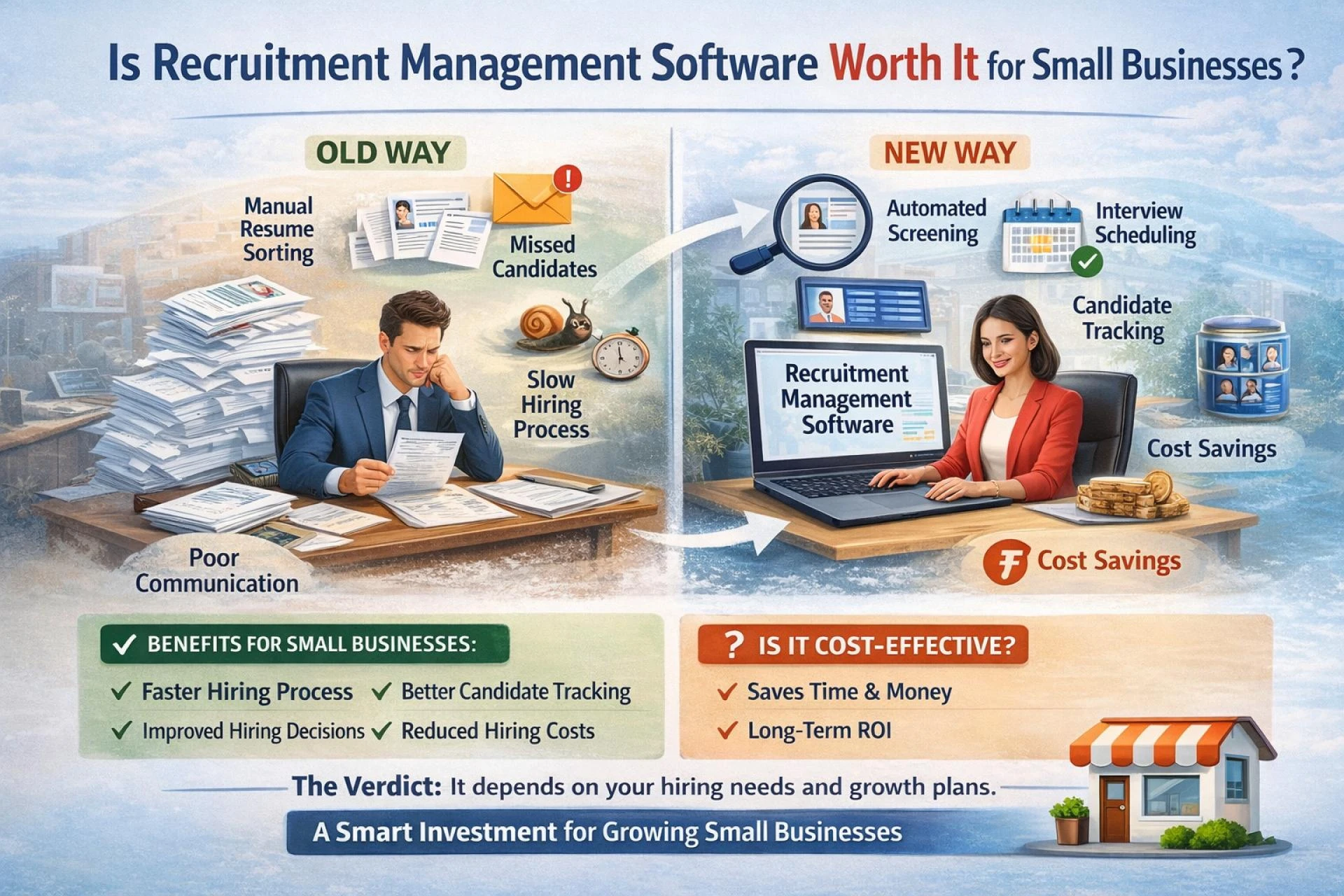
Key Problems Small Businesses Face Without It
Small businesses often try to manage hiring manually. While this may work in the beginning, it becomes inefficient as the company grows.
Here are some common issues:
1. Manual Resume Sorting
Going through hundreds of resumes one by one takes hours. Without resume screening software, shortlisting becomes slow and inconsistent.
2. Missed Qualified Candidates
Important emails may get buried. Attachments may be overlooked. A strong candidate can easily slip through the cracks.
3. Slow Hiring Cycles
Without recruitment workflow automation, each step depends on manual follow-ups. This delays interview scheduling and decision-making.
4. Poor Candidate Communication
Candidates expect timely responses. Delays or lack of updates can damage your company’s reputation.
5. High Recruitment Costs
Long hiring cycles increase costs. Vacant roles reduce productivity. Wrong hires lead to repeat recruitment.
Over time, these small inefficiencies add up. That’s when Recruitment Management Software starts to look like a necessary tool rather than a luxury.
Benefits of Recruitment Management Software for Small Businesses
For growing companies, the advantages of using Recruitment Management Software can be significant.
1. Faster Hiring Process
Automation reduces repetitive tasks. Applications are sorted automatically. Interview scheduling software sends calendar invites. This shortens the hiring cycle.
2. Automated Candidate Tracking
A structured candidate management system allows you to:
- Track every applicant’s stage
- Store notes and feedback
- Compare candidates easily
This improves coordination between hiring managers.
3. Better Organization of Applicant Data
Instead of scattered emails, everything is stored in one place. A cloud-based recruitment platform ensures secure and centralized access.
4. Improved Hiring Decisions
With recruitment analytics and reporting, small businesses can measure:
- Time to hire
- Source of best candidates
- Interview-to-offer ratio
Data-driven decisions reduce hiring risks.
5. Cost Savings Over Time
While there is an upfront investment, Recruitment Management Software can support hiring cost reduction by:
- Reducing time spent on manual tasks
- Avoiding repeated job postings
- Lowering the risk of bad hires
For businesses planning steady growth, these savings can outweigh the subscription cost.
Is It Cost-Effective for Small Businesses?
This is the most important question.
At first glance, Recruitment Management Software may seem expensive for a small company. However, cost should not be viewed only as the subscription fee.
Consider the hidden costs of manual hiring:
- Manager time spent reviewing resumes
- Delayed hiring leading to lost revenue
- Poor hiring decisions requiring replacements
- External recruiter fees
Now compare that with an automated system that includes hiring automation tools and recruitment workflow automation.
Even saving 5–10 hours per week can justify the investment. For example:
- If a manager earns ₹1,000 per hour and spends 10 hours per hire manually, that’s ₹10,000 in time cost alone.
- A structured system may cut that in half.
Over multiple hires per year, the return on investment (ROI) becomes clearer.
However, the key is choosing small business recruitment solutions designed for smaller teams. Large enterprise tools may include features you do not need, increasing unnecessary costs.
When Small Businesses May Not Need It
Recruitment Management Software is not essential for every small business.
You may not need it if:
- You hire only once or twice a year
- Your team has fewer than five employees
- Hiring is done informally through referrals
- You are not ready to adopt digital tools
For very small or early-stage businesses, spreadsheets and email may still be manageable.
But once hiring becomes frequent or complex, manual systems often become inefficient. That is usually the turning point where talent acquisition software becomes valuable.
How to Choose the Right Recruitment Management Software
Not all systems are created equal. Small businesses should look for practical and scalable solutions.
Here are key factors to consider:
1. Scalability
Choose Recruitment Management Software that grows with your business. It should support increasing job roles and users without major upgrades.
2. Ease of Use
If the system is too complex, your team will avoid using it. A simple dashboard and clear workflow are essential.
3. Cloud-Based Access
A cloud-based recruitment platform allows remote access and automatic updates. This reduces IT maintenance.
4. Integration Capability
Ensure the software integrates with:
- Job portals
- Email systems
- HR payroll tools
- Employee onboarding system
Smooth integration prevents data duplication.
5. Data Security
Candidate data is sensitive. The system must provide secure storage, controlled access, and compliance with data protection standards.
6. Transparent Pricing
Look for clear subscription plans without hidden costs. Some providers offer tiered pricing for small business recruitment solutions.
By evaluating these factors carefully, small businesses can avoid overpaying or choosing the wrong system.
Real-World Perspective: Practical Value
From an operational standpoint, many small businesses initially resist investing in Recruitment Management Software. They assume it is only for large enterprises.
However, hiring challenges are not limited to big companies. Even small teams struggle with:
- Tracking multiple candidates
- Managing communication
- Coordinating interview schedules
As hiring volumes grow, manual processes create bottlenecks.
Recruitment Management Software does not replace human judgment. Instead, it supports decision-making by organizing information and automating routine tasks.
The result is a smoother hiring experience for both employers and candidates.
Balanced Conclusion: Is It Worth It?
So, is Recruitment Management Software worth it for small businesses?
The honest answer is: it depends.
If your company hires rarely and operates on a very small scale, manual methods may still work. In that case, investing in a full system may not be urgent.
However, if you:
- Plan to grow
- Hire multiple employees each year
- Struggle with slow hiring cycles
- Want better hiring cost reduction
- Need improved organization and reporting
Then Recruitment Management Software can be a smart and practical investment.
It helps small businesses move from reactive hiring to structured talent management. Over time, this structure improves efficiency, reduces risk, and supports sustainable growth.
Rather than seeing it as an expense, growing businesses should view Recruitment Management Software as a long-term operational tool. When chosen wisely and used consistently, it can deliver real value without unnecessary complexity.
In the end, the decision should align with your hiring frequency, growth plans, and operational readiness. For many expanding small businesses, the right system is not just helpful—it becomes a strategic advantage.