The global investment landscape is undergoing a structural transformation. Traditional financial systems that once dictated how capital moved across borders are being redefined by blockchain infrastructure and digital asset innovation. At the center of this shift are Real World Asset Tokenization Offerings, a model that is reshaping ownership, liquidity, and access to assets that were historically constrained by geography, regulation, and capital intensity.
As investors increasingly seek diversified exposure beyond domestic markets, tokenized real world assets are emerging as the foundation for a new era of borderless investing. These offerings enable physical and financial assets to be represented as blockchain based tokens, allowing fractional ownership, programmable compliance, and near real time settlement. What was once accessible only to institutions or ultra high net worth individuals is now being redesigned for global participation.
This evolution is not simply a technological upgrade. It represents a fundamental change in how value is created, transferred, and preserved across borders. Real World Asset Tokenization Offerings are laying the groundwork for a more inclusive, liquid, and globally connected investment ecosystem.
Understanding Real World Asset Tokenization Offerings
Real World Asset Tokenization Offerings refer to the process of converting tangible or off chain financial assets into digital tokens recorded on a blockchain. These tokens represent economic rights such as ownership, income streams, or usage rights tied to the underlying asset.
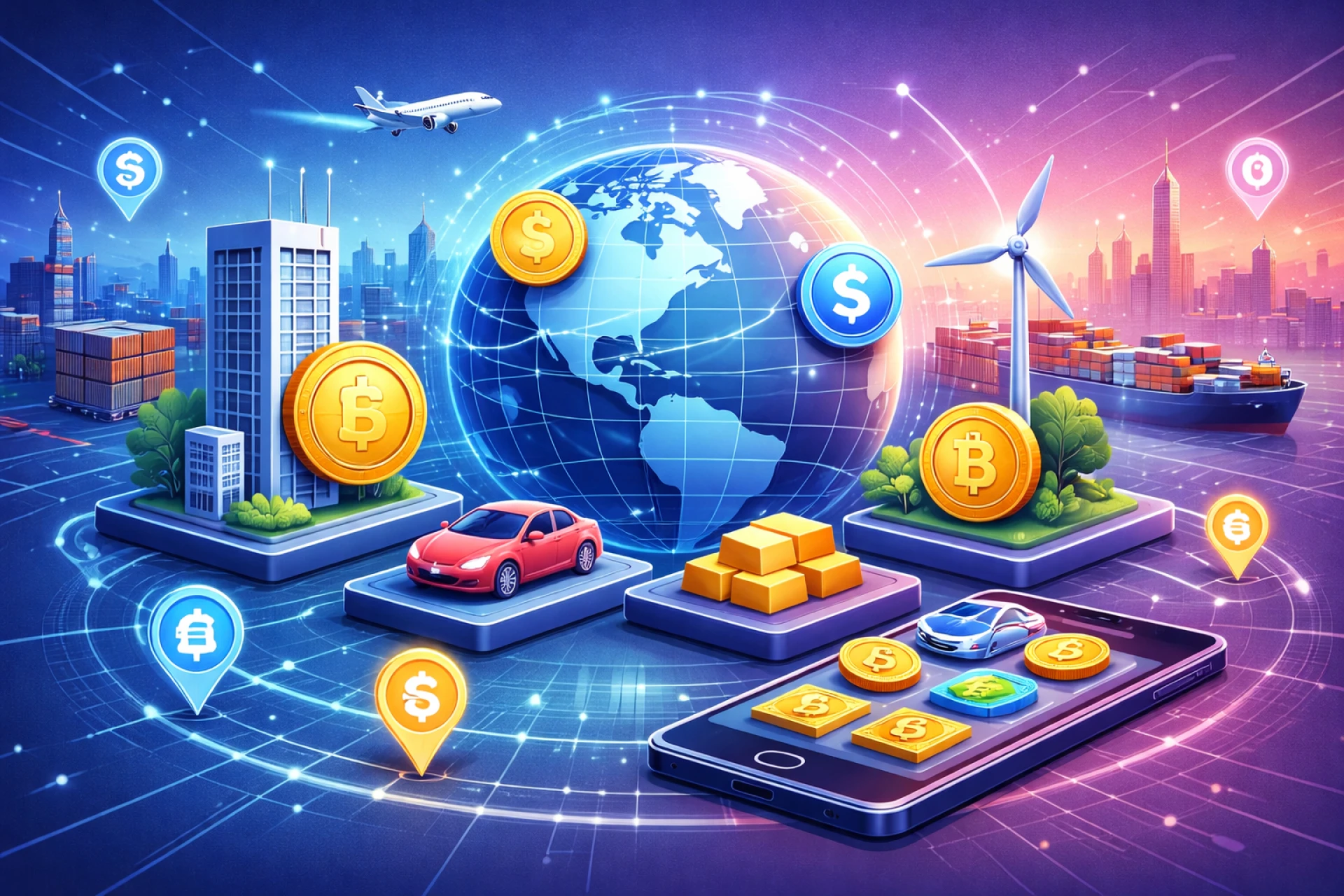
Tokenized assets can include real estate, infrastructure, commodities, private credit, carbon credits, art, collectibles, and even future revenue streams. Each token is backed by a legally structured claim on the underlying asset, ensuring that digital ownership aligns with real world enforceability.
What differentiates tokenization offerings from traditional securitization is their flexibility and efficiency. Blockchain infrastructure enables fractionalization, automated compliance, transparent record keeping, and programmable distribution of returns. This creates a more dynamic investment vehicle that can be accessed globally with fewer intermediaries.
As regulatory frameworks mature and institutional participation increases, tokenization offerings are moving from experimental pilots to scalable financial products designed for cross border capital flow.
The Limitations of Traditional Cross Border Investing
Borderless investing has long been an aspiration rather than a reality. While global markets exist, accessing them has historically been complex, costly, and restrictive.
Traditional cross border investing is burdened by regulatory fragmentation, currency conversion costs, settlement delays, and reliance on intermediaries. Investors often face high minimum investment thresholds, limited transparency, and operational inefficiencies that reduce returns.
For asset owners, raising capital internationally involves navigating multiple legal systems, compliance regimes, and distribution networks. This complexity limits global capital formation and reinforces regional silos.
These structural limitations have created a fragmented global investment environment where capital mobility is constrained despite technological advancements in other sectors.
Real World Asset Tokenization Offerings address these inefficiencies by creating a unified digital layer that enables assets to be issued, managed, and traded across borders with greater efficiency and trust.
How Tokenization Enables Borderless Investing
At its core, borderless investing requires three essential capabilities. Universal accessibility, trusted ownership verification, and efficient value transfer. Blockchain based tokenization delivers all three.
Tokenized assets exist on distributed ledgers that are accessible globally. Investors can participate using digital wallets without relying on region specific custodians or settlement systems. Ownership records are immutable and transparent, reducing counterparty risk and enhancing trust across jurisdictions.
Smart contracts automate processes such as dividend distribution, interest payments, and compliance checks. This reduces operational friction and allows assets to be managed seamlessly regardless of investor location.
Most importantly, tokenization enables fractional ownership. Investors are no longer constrained by large capital requirements or geographic barriers. A single asset can be divided into thousands of tokens, allowing participation from a global investor base.
These capabilities collectively transform investing from a location dependent activity into a border agnostic financial experience.
Democratizing Access to Previously Illiquid Assets
One of the most profound impacts of Real World Asset Tokenization Offerings is the democratization of access to traditionally illiquid asset classes.
Assets such as commercial real estate, infrastructure projects, private equity, and private debt have historically been accessible only to institutional investors. High minimums, long lock in periods, and opaque structures excluded retail and emerging market participants.
Tokenization breaks down these barriers by enabling fractional ownership and secondary market liquidity. Investors can allocate smaller amounts of capital across diversified assets while maintaining the ability to exit positions more efficiently.
This shift is particularly significant for investors in emerging markets who previously lacked access to stable, income generating global assets. Tokenization allows them to participate in international opportunities without relying on complex cross border financial arrangements.
By expanding access, tokenization is not only increasing participation but also redistributing global investment opportunities more equitably.
The Role of Compliance in Global Tokenization Offerings
Borderless investing does not mean regulation free investing. In fact, regulatory alignment is critical to the success of Real World Asset Tokenization Offerings.
Modern tokenization platforms are designed with compliance embedded at the protocol level. Investor verification, jurisdiction based restrictions, and transfer rules can be encoded into smart contracts. This ensures that assets remain compliant even as they move across borders.
Rather than relying on manual oversight, compliance becomes automated and auditable. Regulators gain greater transparency into asset ownership and transaction history, while investors benefit from enhanced security and legal clarity.
This approach allows tokenized assets to operate within existing legal frameworks while still enabling global participation. As regulatory clarity improves across regions, tokenization offerings are becoming increasingly attractive to institutional investors seeking compliant exposure to global markets.
Institutional Adoption and Market Maturity
The future of borderless investing through tokenization is closely tied to institutional adoption. Financial institutions, asset managers, and custodians play a critical role in scaling tokenization offerings.
Institutions bring credibility, capital, and operational expertise. Their involvement signals market maturity and accelerates regulatory acceptance. As more institutions launch or participate in tokenized asset offerings, confidence in the ecosystem continues to grow.
Institutional grade custody solutions, risk management frameworks, and reporting standards are being adapted for tokenized assets. This integration bridges the gap between traditional finance and blockchain based infrastructure.
As institutional participation increases, liquidity deepens, secondary markets expand, and tokenized assets become a core component of diversified investment portfolios.
Redefining Liquidity in a Global Context
Liquidity has traditionally been tied to centralized exchanges and regional market hours. Tokenization challenges this paradigm by enabling continuous, global liquidity.
Tokenized assets can be traded on digital platforms that operate beyond traditional market constraints. This allows investors from different time zones and jurisdictions to interact with the same assets without delay.
While liquidity varies by asset class and platform maturity, the long term trajectory points toward more dynamic and responsive markets. As secondary trading infrastructure evolves, tokenized assets are expected to offer liquidity profiles that rival or exceed traditional instruments.
This redefinition of liquidity enhances capital efficiency and empowers investors to manage risk more effectively across borders.
The Impact on Capital Formation and Asset Issuers
For asset issuers, Real World Asset Tokenization Offerings unlock new avenues for capital formation.
By accessing a global investor base, issuers can diversify funding sources and reduce reliance on local markets. Tokenization enables faster issuance, lower distribution costs, and greater transparency throughout the asset lifecycle.
Small and mid sized asset owners benefit particularly from this model. Projects that were previously too small or complex for traditional capital markets can now attract global investment through tokenized structures.
This democratization of capital formation fosters innovation, supports economic development, and enables more efficient allocation of global capital.
Risks and Challenges in Borderless Tokenization
Despite its promise, the path to fully borderless investing through tokenization is not without challenges.
Regulatory fragmentation remains a key hurdle. Different jurisdictions apply varying standards to digital assets, creating complexity for global offerings. Harmonization efforts are ongoing but progress is uneven.
Technology risks such as smart contract vulnerabilities, custody security, and infrastructure scalability must also be addressed. As tokenization platforms mature, robust security and governance frameworks are essential.
Market education is another challenge. Investors and issuers must understand the mechanics, risks, and legal implications of tokenized assets. Without proper education, adoption may be slowed by uncertainty or misinformation.
Addressing these challenges requires collaboration between regulators, technologists, financial institutions, and market participants.
The Long Term Vision of Borderless Investing
The long term vision for Real World Asset Tokenization Offerings extends beyond incremental improvements. It points toward a unified global investment layer where assets move seamlessly across borders with minimal friction.
In this future, investors can build diversified portfolios that span geographies and asset classes without navigating complex intermediaries. Asset ownership becomes more transparent, inclusive, and efficient.
Tokenization also enables programmable finance. Assets can be designed with dynamic features such as automated yield adjustments, performance based incentives, and real time governance participation.
As digital identity, compliance, and settlement systems continue to evolve, borderless investing will transition from a competitive advantage to a baseline expectation.
Conclusion
Real World Asset Tokenization Offerings are redefining the future of borderless investing by removing structural barriers that have long constrained global capital flow. Through fractional ownership, programmable compliance, and blockchain based infrastructure, these offerings are creating a more inclusive and efficient investment ecosystem.
While challenges remain, the momentum behind tokenization is undeniable. Institutional adoption, regulatory progress, and technological innovation are converging to accelerate this transformation.
As global investors seek diversification, transparency, and access beyond traditional boundaries, tokenized real world assets are positioned to become a cornerstone of modern finance.
The future of investing is not confined by borders. It is defined by connectivity, accessibility, and trust. Real World Asset Tokenization Offerings are building that future today.