Machine Learning is no longer limited to research labs or academic studies. Today, it plays a critical role in solving real-world business problems across industries such as healthcare, finance, e-commerce, and technology. Understanding real-time industry case studies is essential for anyone who wants to move beyond theory and gain practical, job-ready skills.
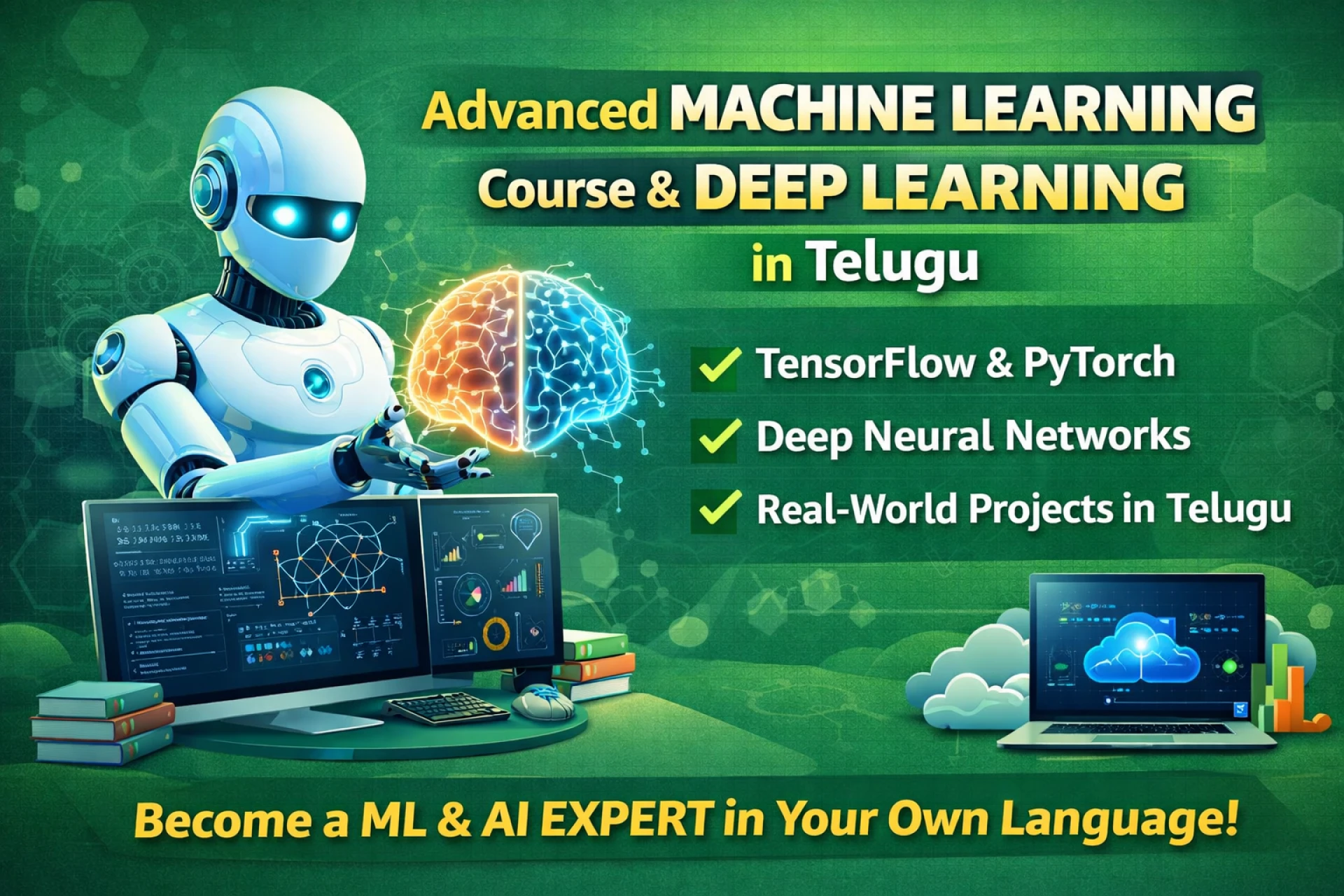
The Advanced ML & DL Course in Telugu is designed to bridge the gap between theoretical knowledge and real-world implementation. With clear explanations in Telugu and hands-on examples, this course helps learners understand how Machine Learning is applied in real industry scenarios.
Importance of Real-Time Case Studies in Machine Learning
Learning algorithms and concepts is important, but applying them to real-world problems is what truly matters. Case studies help learners:
- Understand how businesses use Machine Learning
- Learn problem-solving approaches
- Gain practical experience with real datasets
- Build confidence for interviews and projects
This course focuses on industry-relevant case studies that reflect real challenges faced by companies.
End-to-End Problem Solving Approach
Each case study in the course follows a structured Machine Learning pipeline:
- Understanding the business problem
- Data collection and preprocessing
- Feature engineering
- Model selection and training
- Evaluation and optimization
- Deployment considerations
This approach helps learners think like industry professionals and solve problems systematically.
Case Study 1: Customer Churn Prediction
Customer churn prediction is widely used in telecom and subscription-based businesses. The goal is to identify customers who are likely to stop using a service.
Key Learnings:
- Data preprocessing and feature selection
- Classification algorithms
- Model evaluation using accuracy and recall
This case study helps learners understand how companies retain customers and improve revenue.
Case Study 2: Fraud Detection in Finance
Fraud detection is a critical application of Machine Learning in banking and financial services. The objective is to detect unusual transactions and prevent fraud.
Key Learnings:
- Handling imbalanced datasets
- Anomaly detection techniques
- Precision and recall optimization
This case study highlights the importance of accuracy and reliability in sensitive applications.
Case Study 3: Recommendation Systems
Recommendation systems are used by e-commerce and streaming platforms to suggest products or content.
Key Learnings:
- Collaborative filtering
- Content-based filtering
- User behavior analysis
Learners will understand how personalized recommendations improve user experience and business growth.
Case Study 4: Sales Forecasting
Sales forecasting helps businesses predict future demand and plan inventory accordingly.
Key Learnings:
- Time series analysis
- Trend and seasonality detection
- Forecasting models
This case study demonstrates how Machine Learning supports business decision-making.
Case Study 5: Image Classification in Healthcare
Machine Learning is widely used in healthcare for diagnosing diseases through medical images.
Key Learnings:
- Convolutional Neural Networks (CNNs)
- Image preprocessing
- Model evaluation for accuracy
This case study shows how AI can contribute to life-saving solutions.
Tools and Technologies Covered
The course uses industry-standard tools to implement these case studies:
- Python programming
- Pandas and NumPy for data processing
- Scikit-learn for Machine Learning models
- TensorFlow and Keras for Deep Learning
- Matplotlib for visualization
These tools ensure that learners gain practical, job-ready skills.
Hands-On Learning Experience
The course emphasizes practical learning through real datasets and coding exercises. Learners will:
- Work on real-world problems
- Build and train models
- Evaluate performance
- Optimize models for better results
This hands-on approach ensures a deep understanding of Machine Learning concepts.
Who Should Take This Course?
This course is ideal for:
- Students with basic Machine Learning knowledge
- Data analysts and aspiring data scientists
- Software developers transitioning to AI
- Learners who prefer Telugu explanations
The Telugu language support makes complex industry concepts easier to understand.
Career Opportunities After Learning Case Studies
Understanding real-world case studies gives you a strong advantage in the job market. After completing this course, you can pursue roles such as:
- Data Scientist
- Machine Learning Engineer
- AI Engineer
- Business Analyst
Employers prefer candidates who can demonstrate practical problem-solving skills.
Real-World Impact of Machine Learning
Machine Learning is transforming industries by:
- Improving customer experience
- Reducing operational costs
- Enhancing decision-making
- Automating complex processes
By learning from real-time case studies, you gain the ability to create impactful solutions.
Advantages of Learning in Telugu
Learning complex topics in Telugu provides several benefits:
- Better conceptual clarity
- Faster learning and retention
- Increased confidence in implementation
- Comfortable learning experience
It allows learners to focus on practical skills without language barriers.
Certification and Career Growth
Upon completing the course, learners receive a certification that validates their expertise in Machine Learning and real-world applications. This certification enhances your resume and increases your chances of getting hired.
Final Thoughts
The Real-Time Industry ML Case Studies: Advanced ML & DL Course in Telugu is a powerful program for anyone who wants to gain practical experience in Machine Learning. By working on real-world problems, learners develop the skills needed to succeed in the industry.