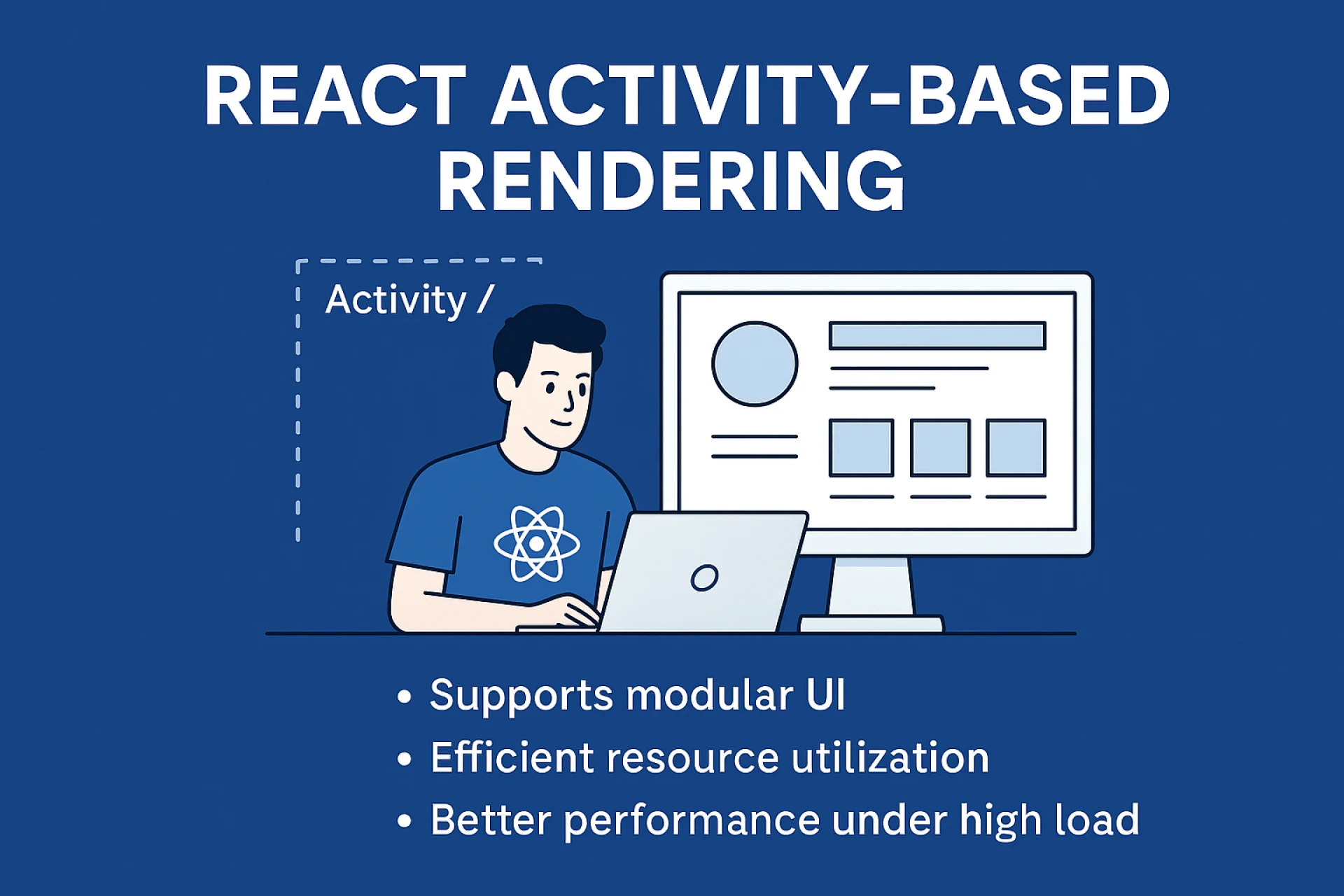
React’s rendering model has evolved significantly over the years. Early versions relied on synchronous rendering, where updates were processed in a single, blocking operation. While predictable, this approach often led to UI lag in complex applications.
With the introduction of Concurrent Rendering in React 18, the framework shifted toward a more flexible model—allowing rendering work to be interrupted, prioritized, and scheduled more intelligently. This evolution paved the way for emerging paradigms like Activity-Based Rendering, which further refine how UI updates are handled.
At the center of this concept is the experimental <Activity /> component. It enables developers to define and manage UI work based on user activity and priority, ensuring that critical interactions remain responsive while non-essential updates are handled in the background.
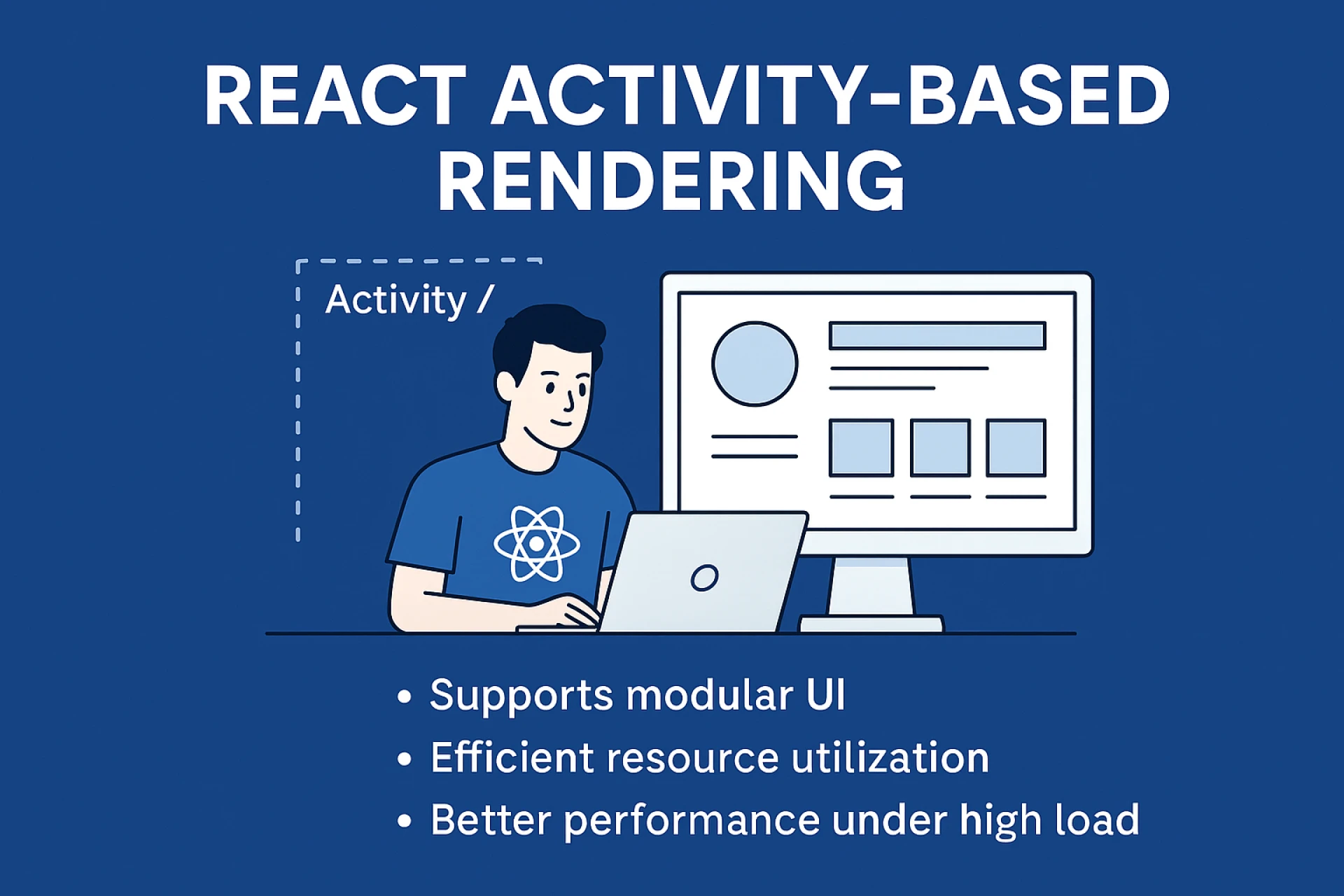
Technical Deep Dive: How Activity-Based Rendering Works
Understanding Activity-Based Rendering
Activity-Based Rendering builds on React’s concurrent capabilities by introducing a more structured and intentional way to prioritize UI updates. Rather than treating every rendering task with equal importance, this approach allows developers to group related work into distinct “activities” and assign each group an appropriate priority based on user impact. At the center of this model is the <Activity /> component, which acts as a clear boundary for a unit of UI work. Within this boundary, React can intelligently decide what should render immediately and what can be deferred, ensuring that critical user interactions stay responsive. By managing background rendering without blocking the main thread, the <Activity /> component enables smoother transitions, reduces unnecessary rendering pressure, and delivers a more fluid user experience—especially in complex, data-heavy interfaces.
UI Prioritization in Practice
In traditional rendering models, a large update—such as re-rendering a dashboard—could block the entire UI. Activity-Based Rendering changes this by:
- Prioritizing user-triggered interactions (clicks, typing, navigation)
- Deferring non-critical updates (data refreshes, analytics, background computations)
- Allowing React to pause and resume rendering work dynamically
This ensures that the most important parts of the UI remain responsive, even under heavy load.
Background Rendering States
One of the most powerful aspects of Activity-Based Rendering is its ability to efficiently manage background rendering states without disrupting the user experience. With this approach, resource‑intensive or data‑heavy components can begin rendering quietly in the background while users continue to interact smoothly with other parts of the interface. Instead of forcing the UI to wait for complex computations or data resolution, React intelligently defers this work until the right moment. Once the background activity is complete and ready to be displayed, the updated component is seamlessly revealed, creating a fluid transition that feels instantaneous to the user. This capability is especially valuable in modern, dynamic applications where performance, responsiveness, and uninterrupted interaction are critical.
This approach significantly improves user-perceived performance, even if the total rendering time remains the same.
Practical Use Cases
1. Data-Intensive Dashboards
Enterprise dashboards often involve multiple data sources and visualizations.
With Activity-Based Rendering:
- Critical widgets (e.g., KPIs) render first
- Secondary charts load progressively in the background
- UI remains responsive during data processing
2. Large Single-Page Applications (SPAs)
In complex SPAs:
- Navigation updates are prioritized
- Non-visible components render lazily
- Background updates don’t block user actions
3. Real-Time Applications
Applications like trading platforms or collaboration tools benefit from:
- Immediate response to user inputs
- Deferred updates for less critical data streams
- Smooth handling of frequent UI changes
Business & Performance Impact
Reduced UI Jank
Reduced UI jank is one of the most immediate and noticeable benefits of Activity‑Based Rendering. UI “jank” typically occurs when heavy processing blocks the main thread, causing interactions to feel laggy or unresponsive. By breaking rendering work into smaller, manageable units, Activity‑Based Rendering allows React to schedule updates more intelligently. Visible and interactive elements are given higher priority, ensuring that user actions such as clicks, scrolling, or typing remain smooth, while non‑essential updates are deferred to the background. This prioritization prevents expensive rendering tasks from overwhelming the UI and helps maintain consistent responsiveness even in complex applications.
This rendering strategy directly contributes to an improved user experience by aligning performance with user perception. Applications feel faster when interactions respond instantly, content loads progressively instead of all at once, and the interface remains visually stable during updates. Activity‑Based Rendering enables these qualities by allowing React to show meaningful UI as soon as possible while completing additional work behind the scenes. As a result, users experience fewer disruptions and smoother transitions, which has a measurable impact on retention, engagement, and overall satisfaction—particularly in customer‑facing applications where performance is closely tied to business outcomes.
Scalability for Modern Applications
Scalability is a critical requirement for modern applications, and as systems grow in size and complexity, traditional rendering approaches often struggle to maintain consistent performance. Activity‑Based Rendering is designed to address these challenges by supporting modular UI architectures, where application interfaces are broken into well‑defined, independent units of work. This modularity allows teams to scale features incrementally without introducing unnecessary rendering overhead or performance bottlenecks. By optimizing how and when UI updates occur, React can also make more efficient use of available resources, ensuring that processing power is focused on what matters most to the user at any given moment.
In high‑load scenarios—such as enterprise dashboards, real‑time analytics platforms, or consumer applications with large user bases—Activity‑Based Rendering helps maintain responsiveness even under pressure. By prioritizing critical UI paths and deferring non‑essential updates, applications remain stable and performant as demand increases. For both enterprises and startups, this approach enables the creation of scalable frontend systems that can evolve alongside business needs, supporting rapid growth, feature expansion, and long‑term maintainability without sacrificing user experience.
Talent & Hiring Perspective
Why Skilled Reactjs Developers Matter
While Activity-Based Rendering offers powerful capabilities, implementing it correctly requires deep expertise in React’s concurrent features.
Experienced Reactjs Developers understand:
- How to structure components for optimal prioritization
- When to defer rendering vs. prioritize updates
- How to avoid pitfalls like unnecessary re-renders or state inconsistencies
Without this expertise, the benefits of Activity-Based Rendering can be difficult to realize.
Role of React JS Team Augmentation
For many organizations, building this expertise in-house can take time. This is where react js team augmentation becomes valuable.
By augmenting existing teams with experienced developers, companies can:
- Accelerate adoption of advanced React patterns
- Reduce implementation risks
- Maintain development velocity
This approach is particularly useful for enterprises modernizing large applications or startups scaling rapidly.
Dedicated React Development Teams for Complex Projects
For long-term initiatives, a dedicated react development team provides:
- Consistent expertise across the project lifecycle
- Better alignment with architectural goals
- Faster iteration and optimization
Such teams are well-equipped to handle the complexities of Activity-Based Rendering and other advanced frontend strategies.
Impact on Cost to Hire React Developer
As React evolves, the demand for developers skilled in modern features continues to rise. Expertise in areas like concurrent rendering and Activity-Based Rendering can influence the cost to hire react developer.
Key factors include:
- Experience with React 18+ features
- Understanding of performance optimization techniques
- Ability to design scalable frontend architectures
While highly skilled developers may come at a premium, they deliver greater long-term value by building efficient, future-ready applications.
Conclusion
Activity-Based Rendering represents the next step in React’s evolution toward smarter, more efficient UI management. By leveraging the emerging <Activity /> component, developers can prioritize critical interactions, manage background rendering seamlessly, and significantly improve user experience.
For businesses, this translates into:
- Faster, more responsive applications
- Scalable frontend architectures
- Improved user satisfaction and engagement
However, unlocking these benefits requires more than just adopting new features—it demands the expertise of skilled Reactjs Developers who understand how to implement them effectively.
As frontend complexity continues to grow, investing in the right talent—whether through react js team augmentation or a dedicated react development team—becomes essential. It not only ensures successful adoption of modern React paradigms but also positions organizations to stay ahead in an increasingly competitive digital landscape.
In the end, Activity-Based Rendering is not just a technical upgrade—it’s a strategic advantage for businesses ready to embrace the future of frontend development.