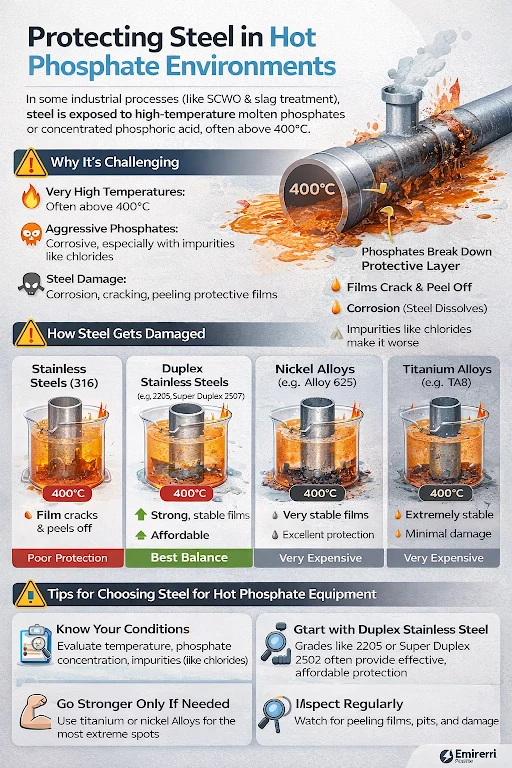
In some advanced factories, steel equipment faces very high temperatures often above 400°C while in contact with molten phosphates or strong phosphoric acid. This happens in processes like Supercritical Water Oxidation (SCWO), which treats tough waste using very hot, pressurized water, and high-temperature slag treatments, used in steelmaking or phosphorus recovery from waste slag.
At these temperatures, phosphates attack steel quickly. They can cause corrosion, peeling of protective films, and even dissolve the metal. If there are impurities like chlorides, damage happens even faster, which can lead to leaks or equipment failure.
Why Steel Gets Damaged
Steel naturally forms a thin protective layer that slows corrosion. Hot phosphates break down this layer, making rusting faster. This can lead to small holes in the steel surface (pitting), cracks or peeling of protective films, and in severe cases, complete metal breakdown.
How Different Metals React
Regular stainless steels, like 316, do not perform well. They form protective phosphate films quickly, but these films crack and fall off easily, causing rapid corrosion.
Nickel-based alloys, such as Alloy 625, perform better. They create strong, stable protective films that stick well and resist peeling, but these alloys are very expensive.
Titanium alloys, like TA8, are often the strongest against hot phosphates. They form excellent protective layers with minimal damage. However, titanium is costly and harder to work with.
Duplex stainless steels, such as 2205 (UNS S32205) or super duplex 2507, offer the best balance. They combine two structures (austenite and ferrite) that give strong protection even in dirty or impure phosphoric environments. Duplex steels are twice as strong as regular stainless steel, resist pitting and cracking, and cost much less than nickel or titanium alloys. The chromium, molybdenum, and nitrogen in duplex steels help form tough, stable phosphate films that block further attack.
Tips for Choosing Steel for Hot Phosphate Equipment
Know your conditions – Check the temperature, phosphate concentration, impurities like chlorides, and oxygen levels. Testing steel samples under real-like conditions is ideal.
Start with duplex stainless steel – Grades like 2205 or super duplex 2507 usually provide strong, reliable protection at a reasonable cost.
Go stronger only if needed – For the toughest spots, such as very hot molten phosphates or extreme SCWO, super duplex steels work well. Titanium or nickel alloys should be reserved for the most extreme conditions.
Design carefully – Consider thermal expansion, ease of welding (duplex steels weld well if done properly), and avoid long-term exposure above ~300°C to prevent brittleness.
Inspect regularly – Watch for peeling films or small pits. Good protective films can shield steel if maintained properly.
Duplex stainless steel is often the best choice because it provides strong, reliable, and cost-effective protection in hot phosphate environments.