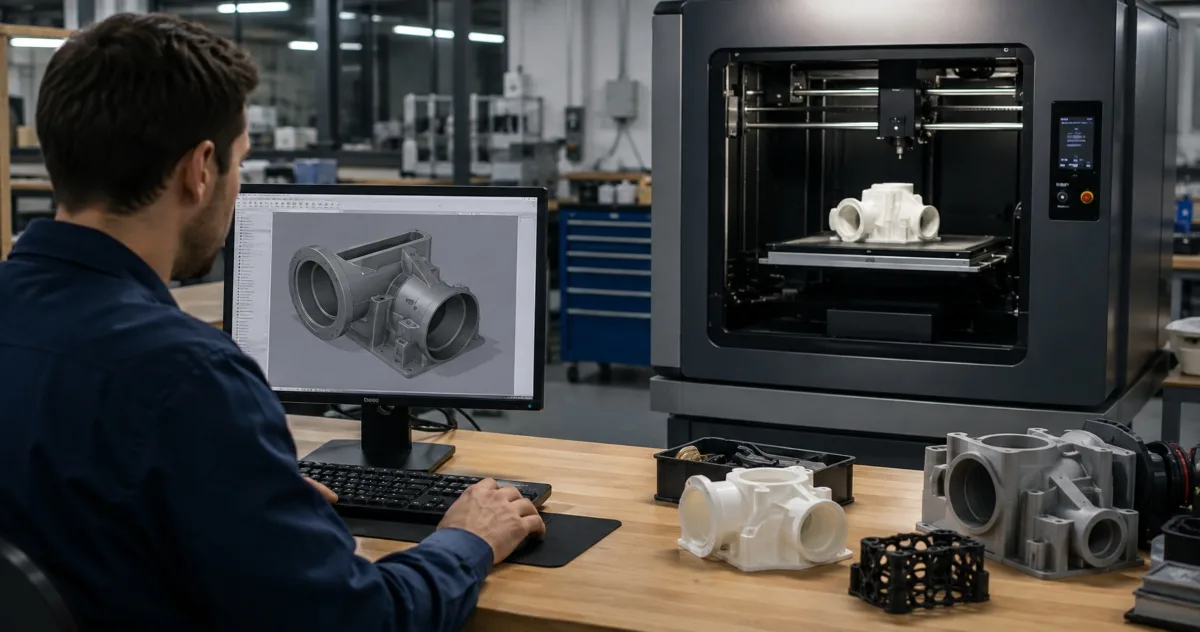
Additive manufacturing has moved well beyond hobbyist desktop printers. For product designers, manufacturers, and small business owners across Queensland, 3d printing in Brisbane now offers industrial-grade accuracy, a wide range of engineering materials, and turnaround times that rival traditional prototyping methods. This guide breaks down what you need to know before commissioning your first professional print run.
Why Brisbane Is Becoming a Hub for Additive Manufacturing
Brisbane's manufacturing sector has grown steadily as local businesses look for faster, more cost-effective ways to prototype and produce parts without relying on overseas suppliers. Brisbane 3d printing providers now support everything from rapid concept models to functional end-use components, giving local industries — aerospace, medical devices, automotive, and consumer products — a genuine domestic alternative to traditional CNC machining or injection moulding for low-volume runs.
This shift is part of a broader trend in 3d printing Australia, where investment in industrial-grade printers, certified materials, and quality-controlled workflows has made additive manufacturing a viable production method rather than just a prototyping novelty.
Step 1: Define Your Application and Tolerances
Before contacting a 3d printing service Brisbane provider, clarify:
- Purpose of the part — visual prototype, functional test piece, jig/fixture, or end-use production component
- Mechanical requirements — load-bearing capacity, thermal resistance, flexibility, or chemical exposure
- Tolerance requirements — most FDM processes hold ±0.2–0.5mm, while SLA/SLS and metal processes can achieve tighter tolerances
- Production volume — one-off prototypes versus batch runs of 50–500 units
Having this information ready allows a technical team to recommend the correct printing technology and material rather than defaulting to a generic option that may not meet your engineering specifications.
Step 2: Choose the Right Printing Technology
Professional providers typically offer multiple processes, each suited to different use cases:
Fused Deposition Modelling (FDM)
Cost-effective for functional prototypes and low-stress components. Common materials include ABS, PETG, and engineering-grade nylon.
Stereolithography (SLA) and Digital Light Processing (DLP)
Delivers high-resolution surface finish and fine detail — ideal for design verification models, jewellery patterns, and dental applications.
Selective Laser Sintering (SLS)
Produces strong, isotropic nylon parts without support structures, well suited to complex geometries and short-run production.
Metal 3D Printing
For applications demanding structural strength, heat resistance, or direct-to-production tooling, metal 3d printing using processes like Direct Metal Laser Sintering (DMLS) or Selective Laser Melting (SLM) allows parts to be printed in stainless steel, titanium, and aluminium alloys. This is particularly relevant for manufacturing businesses producing brackets, housings, tooling inserts, or replacement parts that must withstand mechanical load and thermal cycling.
Step 3: Select Your Material
Material selection directly affects part performance. Common categories include:
- Standard thermoplastics (PLA, ABS) — prototyping and low-load applications
- Engineering polymers (Nylon, PC, PETG) — improved strength, impact resistance, and thermal stability
- Composite-reinforced filaments (carbon fibre, glass-fibre nylon) — added stiffness for functional parts
- Photopolymer resins — fine detail and smooth surface finish
- Metal powders (stainless steel 316L, titanium Ti6Al4V, aluminium AlSi10Mg) — production-grade strength for metal 3d printing applications
A qualified provider offering 3d printing service Brisbane wide should be able to advise on material datasheets, including tensile strength, heat deflection temperature, and post-processing compatibility.
Step 4: Prepare and Submit Your CAD Files
Most providers accept STL, STEP, or OBJ file formats. To avoid delays:
- Ensure your model is manifold (watertight) with no non-planar surfaces
- Include wall thickness appropriate to your chosen process (typically 1–2mm minimum for FDM/SLS, thinner for SLA)
- Flag critical dimensions and tolerances directly on the file or in an accompanying specification sheet
- Request a Design for Additive Manufacturing (DfAM) review if this is your first production part — this identifies overhangs, support requirements, and orientation issues before printing begins
Step 5: Understand Post-Processing Requirements
Professional-grade parts rarely come straight off the printer ready for use. Common post-processing steps include:
- Support removal and sanding for FDM and resin parts
- Bead blasting or tumbling for SLS nylon components
- Heat treatment and stress relieving for metal parts, critical to reducing residual stress from the layer-by-layer melting process
- CNC finishing on critical mating surfaces where tighter tolerances are required
- Surface coating or anodising for corrosion resistance or aesthetic finish
Discuss these requirements upfront, as they affect both lead time and final unit cost.
Step 6: Evaluate Providers on Technical Capability, Not Just Price
When comparing options for 3d printing in Brisbane, look beyond hourly rates or per-gram pricing. Assess:
- Range of printing technologies and build volumes available in-house
- Material certifications (particularly important for metal 3d printing in regulated industries like aerospace or medical)
- Quality control processes — dimensional inspection reports, material traceability
- Turnaround time for both prototyping and production runs
- Design support and engineering consultation availability
Getting Started
Whether you're a product designer validating a new concept, a manufacturing business sourcing low-volume production parts, or a small business owner needing a custom replacement component, professional additive manufacturing removes many of the cost and lead-time barriers associated with traditional tooling. By defining your requirements clearly, selecting the appropriate technology and material, and partnering with an experienced 3d printing service Brisbane provider, you can move from concept to functional part with confidence — backed by the growing capability of 3d printing Australia has to offer.