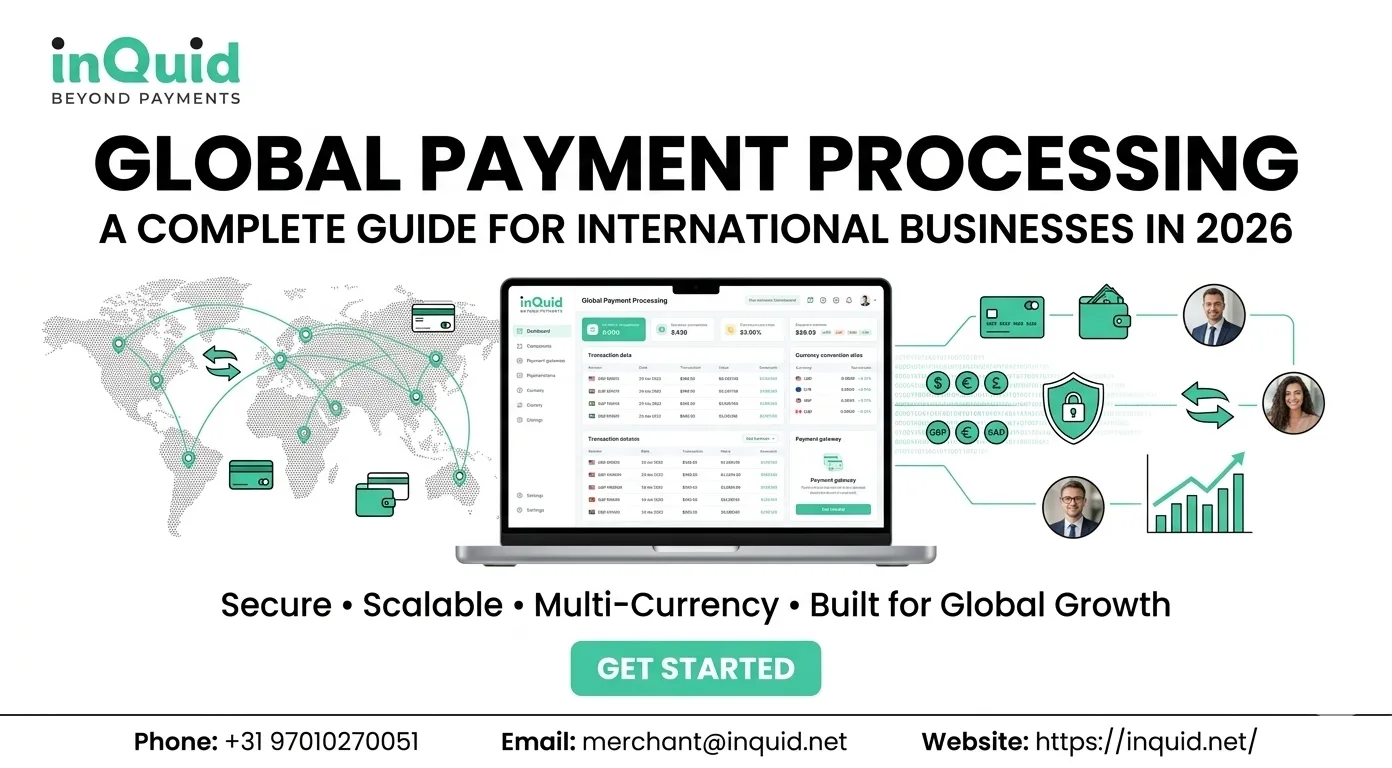
Going global is exciting. Getting paid globally can be complicated.
When a business expands beyond its home market, payment processing quickly becomes more than a checkout button. Customers may expect local currencies, familiar payment methods, fast confirmation, secure transactions, and a seamless checkout experience. Behind the scenes, the business must also manage cross-border payments, foreign exchange, fraud prevention, chargebacks, settlement, compliance, and reconciliation.
That is where global payment processing becomes critical.
The right payment infrastructure can help an international business accept more customers, simplify payment operations, improve checkout flexibility, and support expansion into new markets. The wrong setup can result in unnecessary fees, declined transactions, delayed settlements, and operational headaches.
This guide explains how global payment processing works, what businesses should look for in an international payment processing solution, how currencies and local payment methods affect costs, and how to build a payment infrastructure that can scale with international growth.
What Is Global Payment Processing?
Global payment processing refers to the infrastructure that enables a business to accept, process, route, convert, and settle payments across multiple countries and currencies.
It can include:
- Credit and debit card processing
- Payment gateways
- Merchant accounts
- Alternative payment methods
- Digital wallets
- Bank transfers
- Currency conversion
- Fraud prevention
- Chargeback management
- International settlements
- Payouts and reconciliation
A simplified payment flow looks like this:
Customer → Checkout → Global Payment Gateway → Processor/Acquirer → Payment Network → Issuing Bank → Settlement
Additional risk, authentication, currency, and reporting systems can operate alongside that flow.
The difference between domestic and international payments becomes particularly noticeable when a company starts accepting customers in several countries.
For example, a US business selling into Europe might accept EUR from customers while maintaining USD as its primary operating currency. The payment infrastructure needs to handle the customer's payment method, currency, authorization, conversion, settlement, and reporting without creating unnecessary friction.
Why Global Payment Processing Matters
International growth can create revenue opportunities, but payment friction can quickly become a growth barrier.
1. Customers want familiar ways to pay
A customer may hesitate when a checkout only supports payment methods that are unfamiliar in their country.
Different markets have different preferences for cards, wallets, bank payments, direct debits, and other alternative payment methods.
A global payment strategy should therefore be built around the customer, not just the merchant.
2. Customers expect local currencies
Showing prices in a familiar currency can make international transactions easier to understand.
For example:
- US customers may expect USD
- UK customers may expect GBP
- Eurozone customers may expect EUR
- Canadian customers may expect CAD
- Australian customers may expect AUD
Modern payment platforms can support local-currency presentation and multi-currency management. Stripe currently advertises payment acceptance in 195 countries and 135+ currencies, alongside more than 100 payment methods and local acquiring coverage in 46 markets.
3. Payment costs affect profit margins
International transactions can involve more than a standard processing fee.
The actual cost may include:
Processing fee + cross-border fee + FX cost + payment-method fee + chargeback cost + refund cost
For high-volume businesses, even a small difference in effective cost can have a meaningful impact on margins.
4. Payment failures can mean lost revenue
A customer can reach the final checkout step and still abandon the purchase because of:
- Unsupported payment method
- Currency mismatch
- Authentication failure
- Card decline
- Fraud filters
- Technical errors
That makes payment performance an important part of the overall customer experience.
Global Payment Processing vs. Cross-Border Payments
These terms are closely related, but they are not the same.
- Cross-border payments
A cross-border payment occurs when money moves between parties in different countries.
- Global payment processing
Global payment processing is broader. It includes the technology and operational infrastructure used to accept, authorize, route, convert, settle, and reconcile payments across multiple markets.
For example, imagine a UK customer buying from a US ecommerce company.
The transaction may involve:
- A GBP customer checkout
- A card issued in the UK
- A payment gateway
- An acquiring relationship
- Fraud screening
- GBP-to-USD conversion
- USD settlement
- Cross-border reporting
The entire structure represents part of the merchant's global payment infrastructure.
How Does Global Payment Processing Work?
A typical transaction can move through several stages.
Step 1: Customer chooses a payment method
The buyer selects a card, digital wallet, bank transfer, or local payment method.
Step 2: Payment data enters the gateway
A global payment gateway securely transfers relevant transaction information to the payment-processing infrastructure.
Step 3: The transaction is authorized
The processor and relevant financial institutions determine whether the payment can be authorized.
Step 4: Risk checks are applied
Depending on the setup, fraud detection and authentication tools may evaluate the transaction.
Step 5: Currency conversion occurs
The payment may need to be converted from the customer's currency into the merchant's settlement currency.
Step 6: Settlement takes place
The merchant receives the funds based on the provider's payout and settlement arrangements.
Step 7: The transaction is reconciled
The business records the transaction, fees, currency conversion, refunds, and any relevant adjustments.
To the customer, this may take only seconds.
For the business, it can involve a much larger financial and technical infrastructure.
The Main Components of Global Payment Infrastructure
Payment Gateway
A payment gateway connects the merchant's checkout experience to payment-processing infrastructure.
A modern international payment gateway may support:
- Hosted checkout
- APIs
- Digital wallets
- Card payments
- Local payment methods
- Recurring billing
- Payment links
Payment Processor
A processor handles transaction communication and processing between merchants, acquirers, networks, and other financial institutions.
Merchant Account
A merchant account is used within card-payment infrastructure to receive and process card transaction proceeds.
Businesses with international or specialized requirements may need to evaluate international merchant accounts in addition to gateway technology.
Acquirer
An acquiring institution processes card payments for the merchant and connects the merchant to payment networks.
Local or regional acquiring can sometimes improve payment performance and reduce cross-border complexity.
Payment Networks
Major card networks include:
- Visa
- Mastercard
- American Express
- Regional networks
Visa continues to expand global payment infrastructure while also investing in stablecoin capabilities and other digital-payment technologies. In July 2026, Visa announced its Visa Stablecoin Platform for financial institutions, fintechs, and crypto-native businesses.
Alternative Payment Methods
Global merchants may also support:
- Digital wallets
- Bank transfers
- Direct debit
- Open banking
- Buy now, pay later
- Local payment methods
Choosing the right combination matters more than simply offering the largest possible number of payment options.
Multi-Currency Payment Processing Explained
Multi-currency payment processing helps merchants manage transactions involving more than one currency.
There are three concepts businesses should distinguish.
Currency presentation
The currency the customer sees during checkout.
Currency conversion
The process of exchanging one currency for another.
Currency settlement
The currency the merchant ultimately receives.
These do not always have to be the same.
For example, a business may:
Display EUR → Accept EUR → Convert to USD → Settle in USD
Or:
Display EUR → Accept EUR → Settle in EUR
The better option depends on the company's banking structure, treasury strategy, customer base, and operating costs.
Stripe currently promotes multi-currency settlement and local-currency presentation as part of its global payments platform.
Why Local Payment Methods Matter
Global customers do not all use cards in the same way.
A customer may prefer a bank transfer, wallet, or local payment method that is common in their market.
That is why international payment solutions should be localized.
For example, a merchant serving European customers may consider methods such as:
- SEPA
- iDEAL
- Bancontact
- Klarna
Other markets may have their own dominant wallets, bank-payment systems, or real-time payment rails.
The goal is not to add every available option.
The goal is to offer the payment methods customers want to use.
Foreign Exchange and International Payments
FX can have a major effect on international payment economics.
Consider a merchant selling a product for €500.
A customer pays €500.
The merchant wants USD.
The effective result may depend on:
- Exchange rate
- FX markup
- Processing fee
- Cross-border fee
- Settlement fee
This means businesses should compare the effective landed payment cost, not just the headline processing percentage.
A simple comparison
Provider A
2.5% processing + competitive FX
Provider B
2.0% processing + higher FX spread
Provider B may look cheaper.
But after currency conversion, Provider A could produce the lower total cost.
That is why global payment processing costs should always be evaluated holistically.
Fraud Prevention for Global Businesses
International payments can create additional fraud-management challenges.
Businesses should evaluate whether their provider supports:
- 3D Secure
Additional authentication can help protect certain online card transactions.
- Tokenization
Tokenization can reduce the exposure of sensitive payment information.
- Fraud detection
Modern payment platforms can use transaction patterns, device information, customer behavior, and other signals to detect suspicious activity.
- Transaction monitoring
Businesses can monitor unusual payment behavior and establish rules around transaction frequency, geography, amount, and other factors.
- Chargeback management
Fraud and disputes can affect revenue, operating costs, and merchant risk profiles.
A good payment processing provider should therefore provide appropriate risk-management tools rather than treating fraud as an afterthought.
Security and Compliance
Global payment processing involves security and regulatory responsibilities.
PCI DSS
Businesses handling cardholder data need to understand the requirements applicable to their payment environment.
The PCI Security Standards Council currently lists PCI DSS v4.0.1 in its document library.
The exact responsibilities can depend on how payment data flows through the merchant's technology stack.
Regulatory requirements
Payment regulations differ across jurisdictions.
Businesses should verify:
- Provider authorization
- Legal entity
- Payment-service permissions
- Contracting entity
- Settlement structure
- Customer-data requirements
For businesses operating in or expanding into the UK, the FCA provides public information about regulated firms and its developing cryptoasset framework. The FCA says its new cryptoasset regime is expected to come into force on 25 October 2027.
The important lesson is simple:
Never assume that a payment provider's authorization in one country automatically covers its activities in another.
Global Payment Processing for Different Business Models
Ecommerce businesses
Ecommerce merchants often need:
- Global payment gateway access
- Local currencies
- Cards
- Wallets
- Alternative payment methods
- Fraud protection
- Refunds
- Chargeback management
The goal is a checkout experience that feels local even when the business operates globally.
SaaS businesses
SaaS companies often prioritize:
- Recurring payments
- Subscription billing
- Tokenization
- Multiple currencies
- Automated invoicing
- Customer lifecycle management
Payment infrastructure must support both acquisition and recurring revenue.
Marketplaces
Marketplaces have more complex requirements.
They may need:
- Seller onboarding
- Split payments
- KYC
- Payouts
- Refunds
- Multi-party settlements
- Risk management
International B2B businesses
B2B businesses can have different priorities.
They may care more about:
- Bank transfers
- Invoicing
- Multi-currency accounts
- FX management
- International payouts
- Reconciliation
High-risk businesses
Some industries may face stricter underwriting requirements or payment restrictions.
These merchants need to evaluate:
- Industry eligibility
- Acquiring relationships
- Reserve requirements
- Chargeback thresholds
- Settlement terms
- Compliance procedures
A payment solution should never be selected solely because it promises easy approval.
Global Payment Processing for US Businesses
For a US company expanding internationally, the payment journey might look like this:
US Business → Global Payment Gateway → Customer in Europe → EUR Payment → Currency Conversion → USD Settlement
The business may need to support:
- EUR
- GBP
- CAD
- AUD
- USD
- Local payment methods
- International cards
- Digital wallets
- Bank payments
The challenge is making all this work without creating a fragmented payment stack.
A centralized global payment solution can simplify payment reporting and operational management.
However, businesses should still evaluate whether local acquiring, multiple processors, or payment orchestration would be beneficial as transaction volume grows.
Payment Orchestration and Global Growth
A growing international business may eventually work with multiple payment service providers.
That is where payment orchestration can become useful.
An orchestration layer can connect multiple processors or acquirers and route transactions according to criteria such as:
- Country
- Currency
- Payment method
- Processor availability
- Transaction performance
- Risk
- Cost
For example:
Customer → Payment Orchestration Layer → Processor A / Processor B / Processor C
This can give larger merchants more flexibility.
It can also increase technical and operational complexity.
For smaller businesses, a single well-suited international payment provider may be enough.
For larger businesses, diversification can reduce dependence on one payment route.
How to Choose a Global Payment Processing Provider
Choosing a provider should be a structured process.
1. Define your target countries
Create a list of your current and planned markets.
Confirm whether the provider supports:
- Merchant onboarding
- Customer transactions
- Local acquiring
- Local currencies
- Payment methods
- Settlements
2. Identify customer payment preferences
Do not choose payment methods based only on the provider's feature list.
Research what customers use.
3. Calculate the real cost
Review:
Processing + FX + Cross-Border + Payment Method + Refund + Chargeback + Reserve Costs
4. Review settlement terms
Ask:
- How often are funds settled?
- In which currencies?
- Are reserves required?
- What can trigger a payment hold?
- How are refunds deducted?
5. Evaluate fraud tools
Check:
- 3D Secure
- Tokenization
- Fraud screening
- Risk scoring
- Transaction monitoring
6. Review integrations
Look for:
- API
- SDK
- Hosted checkout
- Plugins
- Payment links
- Webhooks
- Reporting tools
- Reconciliation
7. Verify the provider
Check:
- Legal entity
- Company registration
- Applicable licensing
- Acquiring relationships
- Customer references
- Contract terms
A technically impressive platform is not enough if you do not understand who ultimately handles your funds.
How to Reduce Global Payment Processing Costs
International payment costs can be controlled through several strategies.
Local acquiring
Using local acquiring where appropriate can reduce unnecessary cross-border complexity.
Better payment localization
Offering the payment methods customers prefer can reduce failed or abandoned transactions.
Smarter currency management
Avoid unnecessary currency conversions where possible.
Authorization optimization
Better transaction routing and authentication can improve payment performance.
Provider diversification
High-volume businesses may benefit from multiple payment routes rather than relying on one processor.
Regular fee reviews
International payment economics change as transaction volume grows. Negotiate pricing when your processing volume increases.
Common Global Payment Processing Mistakes
Focusing only on transaction fees
The lowest advertised rate is not necessarily the lowest total cost.
Ignoring local payment methods
A customer may abandon a checkout simply because a familiar payment option is unavailable.
Assuming all countries work the same
Payment methods, regulations, currencies, and customer behavior differ across markets.
Overlooking settlement
Fast customer checkout does not guarantee fast merchant settlement.
Neglecting fraud prevention
International growth can bring additional transaction risk if controls are not scaled alongside volume.
Choosing an inflexible provider
A payment setup that works in one country may become difficult to manage after international expansion.
Forgetting provider due diligence
Businesses investigate customers and transactions. They should also investigate the company processing their payments.
Global Payment Processing Trends in 2026
- Stablecoins are moving deeper into payment infrastructure
Stablecoins are increasingly being discussed not only as cryptocurrency assets but also as settlement and payment infrastructure.
Visa announced its Visa Stablecoin Platform in July 2026 for financial institutions, fintechs, and other payment providers.
Mastercard also announced expanded settlement capabilities involving regulated stablecoins and on-chain settlement options in June 2026.
This suggests digital-asset infrastructure is increasingly becoming part of the broader global payments conversation.
- Local payment methods are becoming more important
Global checkout is becoming increasingly localized.
Businesses need to think about how customers pay in each market instead of assuming that card acceptance alone is sufficient.
- Payment orchestration is gaining importance
Larger merchants are looking for greater routing flexibility and resilience.
- Fraud systems are becoming more intelligent
Payment providers increasingly use automated risk analysis and behavioral signals to identify suspicious transactions and improve authorization performance.
- Payment infrastructure is becoming more unified
Businesses increasingly want online payments, in-person payments, payouts, reconciliation, and financial reporting connected through fewer systems.
Pros and Cons of Global Payment Processing
Pros
Global customer reach: Sell to customers in more countries.
Local payment flexibility: Support regional payment preferences.
Multi-currency capabilities: Accept and manage different currencies.
Operational scalability: Centralize payment infrastructure as your business grows.
Better checkout experience: Present customers with familiar payment methods and currencies.
Potentially improved payment performance: Better routing, authentication, and fraud controls can reduce unnecessary declines.
Cons
Higher complexity: More countries mean more operational and regulatory requirements.
FX exposure: Currency conversion can reduce margins.
Fraud and chargebacks: International transactions can create additional risk.
Settlement challenges: Reserves and delayed payouts can affect cash flow.
Integration requirements: Global payment systems can require significant technical work.
FAQs About Global Payment Processing
- What is global payment processing?
Global payment processing is the infrastructure used by businesses to accept, process, route, convert, and settle payments across different countries, currencies, and payment methods.
- What is an international payment gateway?
An international payment gateway connects a business's online checkout with payment-processing infrastructure capable of handling customers across different markets.
- What is the difference between a payment gateway and a payment processor?
A payment gateway primarily connects the customer checkout to the payment-processing environment, while processing involves the authorization and transaction flow through the relevant financial infrastructure. Many modern PSPs combine both functions.
- Why is multi-currency payment processing important?
Multi-currency payment processing allows businesses to accept or present prices in currencies relevant to customers in different markets while managing conversion and settlement requirements.
- What are local payment methods?
Local payment methods are payment options that are particularly common or preferred in specific countries or regions, such as regional bank-payment systems, wallets, direct debits, or other alternative payment methods.
- How can a business reduce international payment costs?
Compare the complete cost of processing, including transaction fees, foreign-exchange costs, cross-border charges, payment-method fees, refunds, chargebacks, and reserves.
- Is global payment processing secure?
It can be, provided the payment environment uses appropriate security controls, authentication, fraud prevention, and applicable compliance standards such as PCI DSS where card data is involved.
- Does every global payment provider support every country?
No. A provider may operate internationally but still have restrictions on specific merchant countries, currencies, payment methods, industries, settlement currencies, or products.
- What should businesses ask a global payment provider before onboarding?
Ask about supported countries, currencies, payment methods, fees, FX rates, settlement periods, reserves, fraud controls, refunds, chargebacks, integrations, legal entity, licensing, and acquiring partners.
Conclusion
Global growth requires more than a website that accepts international visitors.
It requires payment infrastructure that can turn those visitors into customers.
A strong global payment processing strategy brings together international payment processing, local payment methods, multi-currency payment processing, international payment gateways, fraud prevention, currency conversion, settlement, compliance, and scalable technology.
The right solution depends on your business.
An ecommerce company may prioritize local payment methods and checkout conversion.
A SaaS company may care more about subscriptions, recurring payments, and automated billing.
A marketplace may require seller onboarding, split payments, and payouts.
A multinational enterprise may need payment orchestration, local acquiring, multi-currency settlement, and multiple payment providers.
The most important point is that there is no universal payment setup for every international business.
Start with your customers and markets. Understand how they prefer to pay. Calculate the complete cost of processing. Review settlement and reserve conditions. Evaluate fraud and security. Then verify the provider itself.
The strongest global payment solution is the one that supports your business today while giving you the flexibility to expand tomorrow.
As payment infrastructure continues to evolve—with greater localization, smarter routing, broader payment methods, and increasing institutional interest in stablecoin settlement—businesses that treat payments as part of their growth strategy will be better positioned to compete internationally. Visa and Mastercard's 2026 stablecoin initiatives are examples of how digital-asset capabilities are increasingly becoming part of broader payment infrastructure.
Ready to strengthen your global payment infrastructure? Contact Inquid to discuss your international payment requirements, target markets, currencies, payment methods, and business goals.