
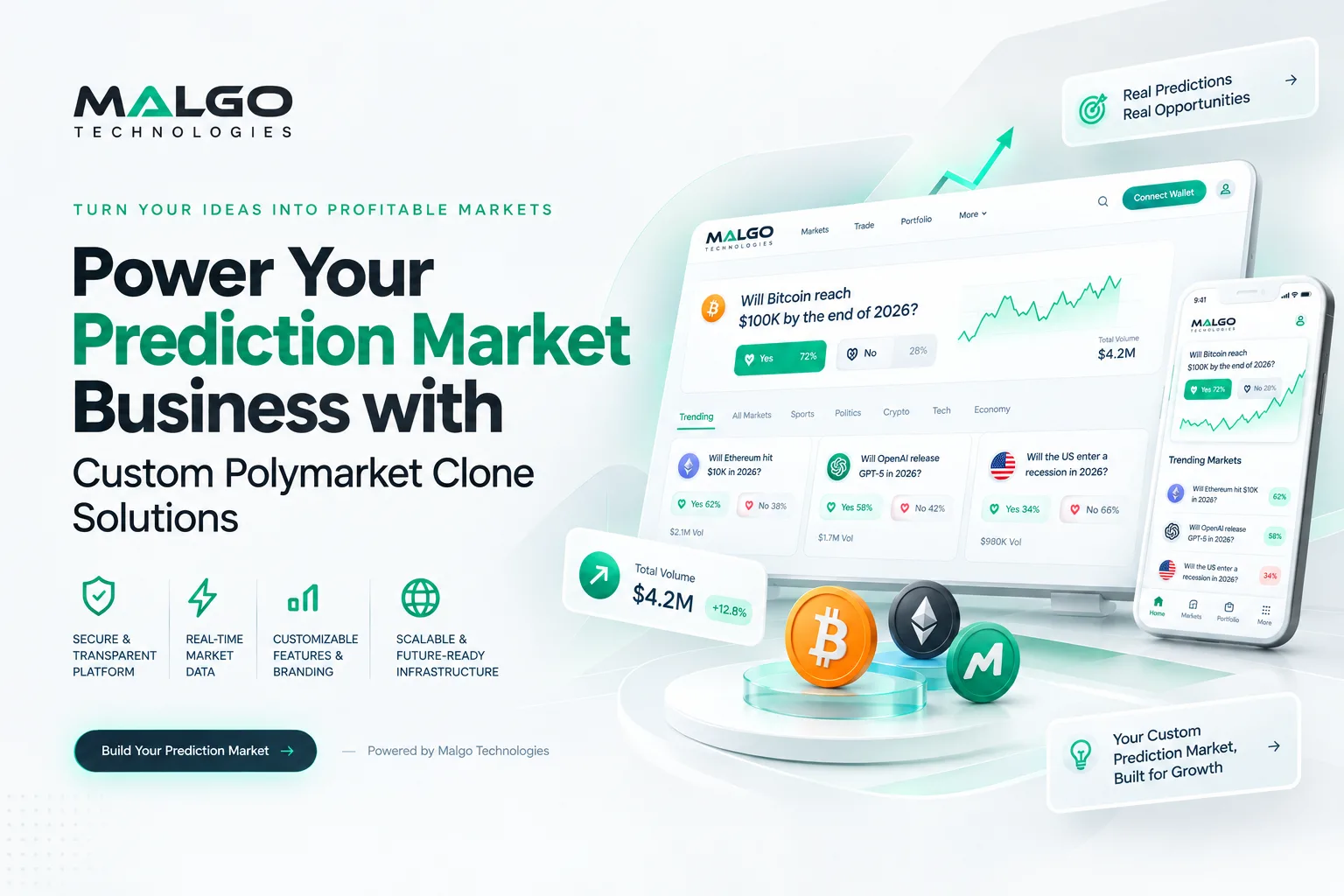
The prediction market industry is gaining attention as users look for new ways to participate in real-world events, forecast outcomes, and trade on collective opinions. From political elections and cryptocurrency movements to sports competitions and economic developments, prediction markets are transforming how people interact with information. Platforms like Polymarket have demonstrated how blockchain technology can support transparent, decentralized prediction trading.
For entrepreneurs, startups, and established businesses, this growing interest creates an opportunity to enter the prediction market ecosystem through Polymarket clone development. However, building a platform is only one part of the equation. Long-term success depends on revenue generation, user engagement, market liquidity, regulatory compliance, and risk management.
Understanding the potential return on investment (ROI), business opportunities, and operational challenges is essential before launching a prediction market platform.
Understanding Polymarket Clone Development
Polymarket clone development involves creating a prediction market platform inspired by the functionality and trading experience of Polymarket. It allows users to participate in event-based markets by purchasing outcome shares and trading based on their expectations of future events.
Unlike conventional betting platforms, prediction markets use market-driven probabilities to represent collective expectations. Users can analyze available information, evaluate possible outcomes, and make trading decisions.
A well-developed Polymarket clone typically includes:
- User registration and authentication: Secure onboarding, profile management, and identity verification.
- Prediction market creation: Tools for creating markets around politics, sports, finance, technology, and global events.
- Trading engine: Infrastructure supporting order execution, share purchases, and position management.
- Smart contract integration: Blockchain-based mechanisms for transparent transactions and settlement.
- Wallet integration: Support for connecting cryptocurrency wallets and managing digital assets.
- Oracle integration: Reliable external data feeds for verifying real-world event outcomes.
- Admin dashboard: Market moderation, user management, dispute handling, and platform monitoring.
These components create the foundation for a scalable prediction market business.
Understanding ROI in Polymarket Clone Development
ROI is an important business metric for evaluating whether a prediction market platform can generate sustainable financial returns. However, profitability does not come automatically from launching a feature-rich application.
The financial performance of a Polymarket clone depends on how effectively the platform attracts participants, maintains trading activity, and converts engagement into recurring revenue.
Several factors influence ROI:
1. User Acquisition and Retention
A growing user base creates opportunities for increased trading activity. However, attracting users is not enough. The platform must provide intuitive navigation, accurate market information, reliable transactions, and a consistent trading experience.
Referral programs, educational content, community engagement, and targeted marketing can support organic growth.
2. Trading Volume
Trading volume is one of the most important performance indicators for prediction markets. Higher participation across different event categories can create more active markets and improve platform engagement.
A diverse market selection helps prevent dependence on a single category or event.
3. Revenue Generation
A Polymarket clone can explore multiple monetization strategies, including:
- Trading commissions on eligible transactions.
- Market creation or listing-related service fees, where permitted.
- Premium analytical tools and advanced market insights.
- Subscription-based access to additional platform features.
- Business partnerships and API-based services.
The appropriate revenue model depends on the target audience, jurisdiction, platform structure, and applicable regulations.
4. Platform Scalability
A scalable technical architecture helps accommodate increasing users, transactions, and market activity without compromising performance. Efficient infrastructure also supports long-term operational stability.
Business Opportunities in the Prediction Market Industry
Prediction markets offer opportunities across several industries. Businesses entering this space can differentiate themselves by focusing on specific audiences and market categories.
Political and Election Prediction Markets
Political events attract considerable public interest. Users may participate in markets related to election outcomes, government decisions, policy developments, and geopolitical events.
These markets can attract strong engagement during major political developments, although operators must carefully evaluate jurisdiction-specific restrictions.
Cryptocurrency and Financial Markets
Crypto-focused prediction markets allow users to express expectations about token performance, blockchain developments, regulatory announcements, and market milestones.
As digital asset adoption expands, specialized prediction platforms can attract traders interested in combining market research with event-based trading.
Sports Prediction Markets
Sports-related markets provide opportunities to engage communities interested in tournaments, match outcomes, player performance, and championship results.
However, sports-related prediction products may fall under gambling or betting regulations in certain jurisdictions. Legal classification must be established before launch.
Technology and Entertainment Markets
Technology launches, artificial intelligence developments, entertainment awards, and product announcements offer additional market categories.
These niches can help platforms reach communities beyond traditional financial traders.
Key Risks of Launching a Polymarket Clone
Despite its commercial potential, prediction market development involves several risks that directly influence business sustainability.
1. Regulatory Uncertainty
Regulation is among the most significant challenges. Prediction markets may be classified differently depending on their structure, underlying events, settlement mechanisms, and operating jurisdiction.
Licensing, financial regulations, gambling restrictions, consumer protection requirements, and KYC/AML obligations may apply.
Businesses should obtain qualified legal advice before accepting users or facilitating transactions.
2. Liquidity Challenges
A prediction market requires sufficient buyers and sellers to support meaningful trading activity. New platforms often struggle to establish liquidity because users prefer markets with active participation.
Liquidity incentives, market-making arrangements, and carefully selected launch categories can help address this challenge.
3. Smart Contract Vulnerabilities
Smart contracts manage important platform operations, including transactions and settlement. Coding errors, security weaknesses, and integration failures can expose users and businesses to financial losses.
Independent security audits, penetration testing, continuous monitoring, and secure development practices are essential.
4. Oracle and Settlement Risks
Prediction markets depend on accurate information to determine event outcomes. Incorrect, delayed, or manipulated external data can create settlement disputes.
Reliable oracle infrastructure and clearly documented resolution criteria help improve transparency and user confidence.
5. Market Manipulation and User Trust
Low-liquidity markets may be vulnerable to manipulation, suspicious trading activity, and misleading information.
Effective monitoring, transparent market rules, dispute-resolution procedures, and responsible moderation help protect platform integrity.
Strategies to Improve Polymarket Clone ROI
Building a sustainable prediction market requires more than replicating an existing platform's interface. Businesses should prioritize long-term operational performance.
- Choose a focused niche: Start with specific market categories instead of launching hundreds of inactive markets.
- Prioritize user experience: Simplify onboarding, market discovery, trading, and portfolio management.
- Build liquidity strategically: Encourage genuine participation and establish appropriate market-making mechanisms.
- Invest in security: Conduct regular audits and strengthen wallet, smart contract, and infrastructure protection.
- Adopt transparent market rules: Clearly communicate trading conditions, settlement criteria, and dispute procedures.
- Use data-driven marketing: Analyze user behavior, retention, trading activity, and conversion performance to improve growth strategies.
These practices help create a stronger foundation for sustainable business performance.
Conclusion
Polymarket clone development presents an interesting opportunity for entrepreneurs exploring blockchain-based prediction markets. Its potential extends across politics, cryptocurrency, sports, technology, and entertainment, creating multiple possibilities for audience acquisition and revenue generation.
However, long-term ROI depends on much more than technical development. Regulatory compliance, liquidity management, smart contract security, reliable event resolution, and user trust are equally important.
Businesses that approach prediction market development with a clear monetization strategy, scalable architecture, and responsible operating practices can establish a competitive position in this evolving industry.
The real opportunity is not simply to build another Polymarket-inspired platform. It is to create a transparent, secure, and user-focused prediction market ecosystem that delivers lasting value to its participants.