
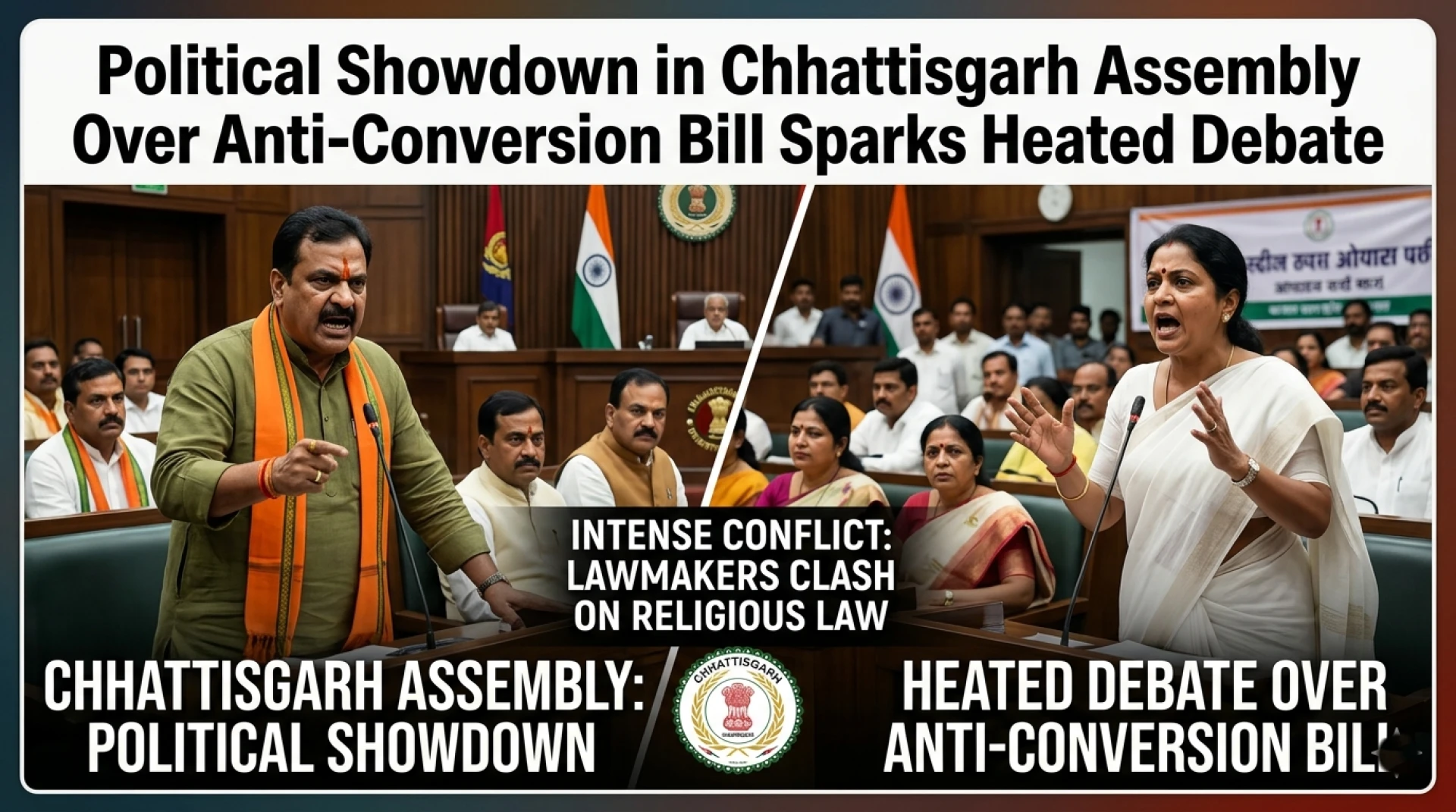
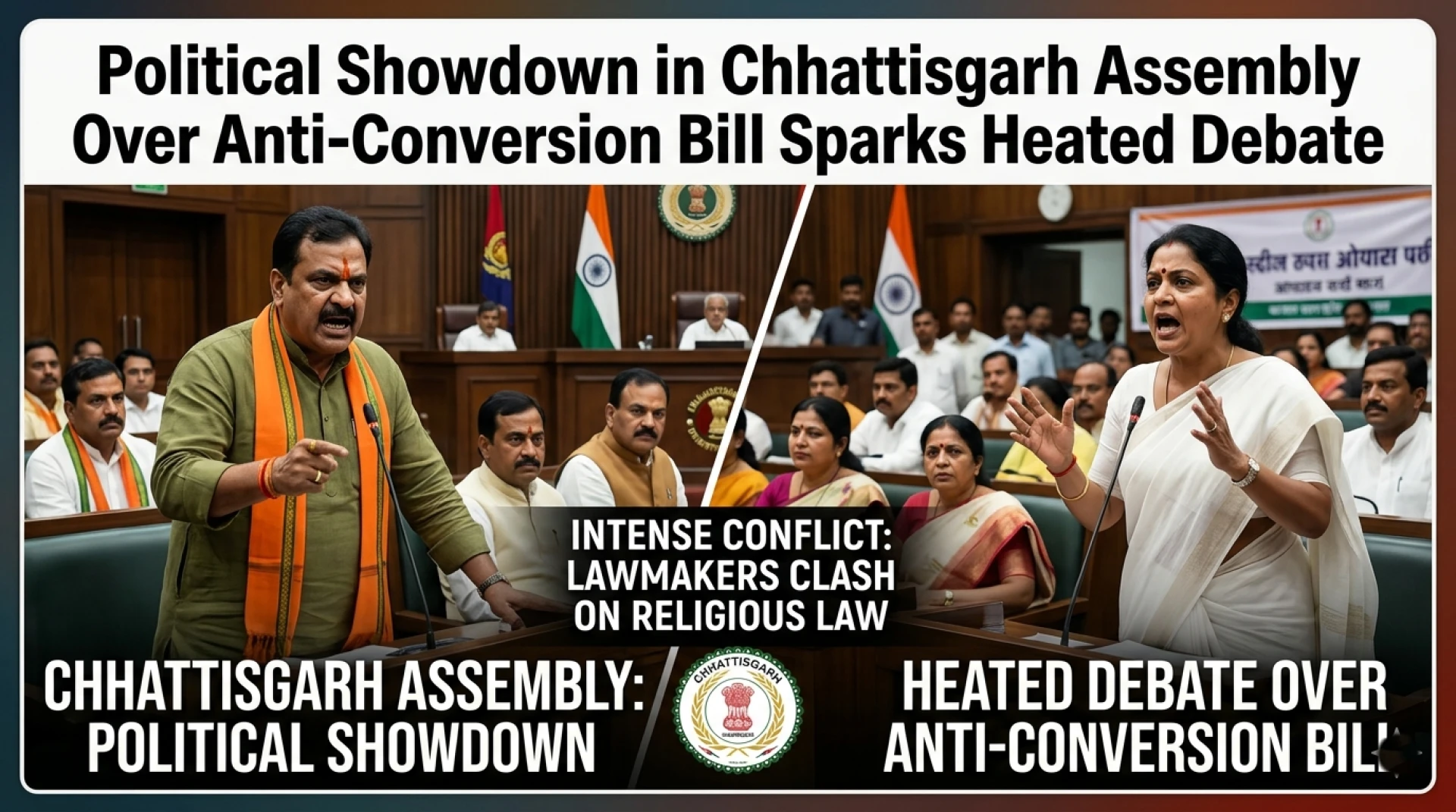
A major political confrontation unfolded in the Chhattisgarh Legislative Assembly as the proposed Freedom of Religion Bill, 2026, ignited intense debate between the ruling BJP and the Opposition Congress. What began as a legislative discussion soon escalated into a high-voltage clash, marked by strong arguments, loud protests, and ultimately a walkout by Congress members.
The Bill, introduced by Home Minister Vijay Sharma, has been presented by the government as a step toward safeguarding tribal identity and maintaining social harmony. However, the opposition has strongly criticized it, calling the proposal unconstitutional and politically driven.
Opposition Demands Deeper Review
The controversy began when Leader of the Opposition Charandas Mahant raised objections to the bill. He pointed out that similar anti-conversion laws enacted in other states are already under scrutiny in the Supreme Court, suggesting that the issue is legally sensitive and requires careful examination.
Mahant demanded that the bill be referred to a select committee for detailed analysis before being passed. According to him, such a significant piece of legislation should not be rushed through without proper discussion and review.
However, the chair rejected this demand, leading to a sharp reaction from Congress legislators. In protest, party MLAs staged a walkout from the Assembly and continued their demonstration outside, accusing the government of ignoring democratic procedures.
BJP Defends the Legislation
The ruling BJP responded strongly to the Opposition’s stance. Senior MLA Ajay Chandrakar defended the bill, stating that it is legally sound and falls well within the constitutional powers of the state government.
Home Minister Vijay Sharma also dismissed concerns raised by Congress, asserting that there is currently no stay by the Supreme Court on such laws. He accused the Opposition of engaging in “vote-bank politics” and avoiding meaningful debate on a sensitive issue.
According to the ruling party, the bill is designed to prevent forced or fraudulent religious conversions and to maintain law and order, especially in tribal regions.
Heated Exchanges Inside the House
The Assembly witnessed intense arguments from both sides. Congress MLA Ramkumar Yadav described the bill as being against the core principles of the Constitution. He argued that it could infringe upon individuals’ fundamental rights, particularly the freedom to practice and choose one’s religion.
On the other hand, BJP leaders countered these claims with strong statements. MLA Bhavna Bohra alleged that the Congress had historically supported religious conversions for political gain.
Adding to the controversy, Kondagaon MLA Nilkanth Tekam made a striking remark, claiming that religious conversions in Bastar are “more dangerous than cancer.” Such statements further intensified the already charged atmosphere in the Assembly.
Key Provisions of the Proposed Law
The Freedom of Religion Bill, 2026, includes several strict provisions aimed at regulating religious conversions.
The law seeks to criminalize conversions carried out through force, coercion, inducement, or misrepresentation. This includes activities conducted both offline and through digital platforms or social media.
One of the most notable aspects of the bill is the requirement for individuals intending to convert voluntarily to inform the district magistrate in advance. This must be followed by a 30-day public notice period, during which objections can be raised.
Strict Penalties Introduced
The bill proposes some of the toughest penalties seen in such legislation across the country.
- Illegal religious conversions could lead to imprisonment ranging from 7 to 10 years, along with a minimum fine of ₹5 lakh.
- If the affected individual is a minor, a woman, or belongs to SC/ST/OBC communities, the punishment could extend to 10–20 years, with a fine of up to ₹10 lakh.
- In cases of mass conversion, the penalty could be even more severe, including 10 years to life imprisonment and fines reaching ₹25 lakh.
Additionally, all offenses under this law are proposed to be cognizable and non-bailable, meaning arrests can be made without a warrant and bail would not be easily granted. Special courts are also expected to handle such cases for faster resolution.
Government Cites Rising Concerns
Explaining the urgency behind the bill, Home Minister Vijay Sharma referred to data from districts such as Bastar and Dantewada. He claimed that religious conversions in these areas have led to social tensions that, in some cases, are more challenging than issues like Maoism.
He also raised concerns about demographic changes and alleged infiltration, stating that Special Task Forces have been set up in every district to monitor such activities.
According to the government, these steps are necessary to preserve cultural identity and maintain stability in sensitive regions.
Opposition Raises Constitutional Questions
Despite the government’s justification, the opposition continues to question the intent and impact of the bill. Congress leaders argue that it may violate constitutional rights, particularly the right to freedom of religion.
They also believe that the law could be misused to target specific communities or individuals, leading to unnecessary harassment.
The demand for sending the bill to a select committee reflects the opposition's insistence on a more detailed and transparent review process.
A Broader Debate Beyond Politics
The issue has now moved beyond the Assembly and sparked wider public discussion. Many see it as part of a larger national debate around religious freedom, identity, and governance.
Topics like these often dominate religious news today, as they touch upon deeply sensitive aspects of society and law.
Clear Divide Between Government and Opposition
The events in the Assembly have clearly highlighted the sharp divide between the ruling BJP and the Congress. While the government maintains that the bill is essential for protecting tribal communities and ensuring law and order, the opposition views it as politically motivated and legally questionable.
This disagreement is unlikely to be resolved soon, and the bill is expected to remain a contentious issue in the coming days.
Conclusion
The Freedom of Religion Bill, 2026, has triggered one of the most intense political debates in Chhattisgarh in recent times. With strong arguments on both sides, the issue reflects the complexities involved in balancing religious freedom, social harmony, and political interests.
As discussions continue, platforms like New World Web play an important role in keeping the public informed about such developments. The final outcome of this legislative battle will not only impact Chhattisgarh but could also influence similar debates across the country.
For now, the Assembly showdown stands as a clear example of how deeply divided opinions can shape the course of important policy decisions.