
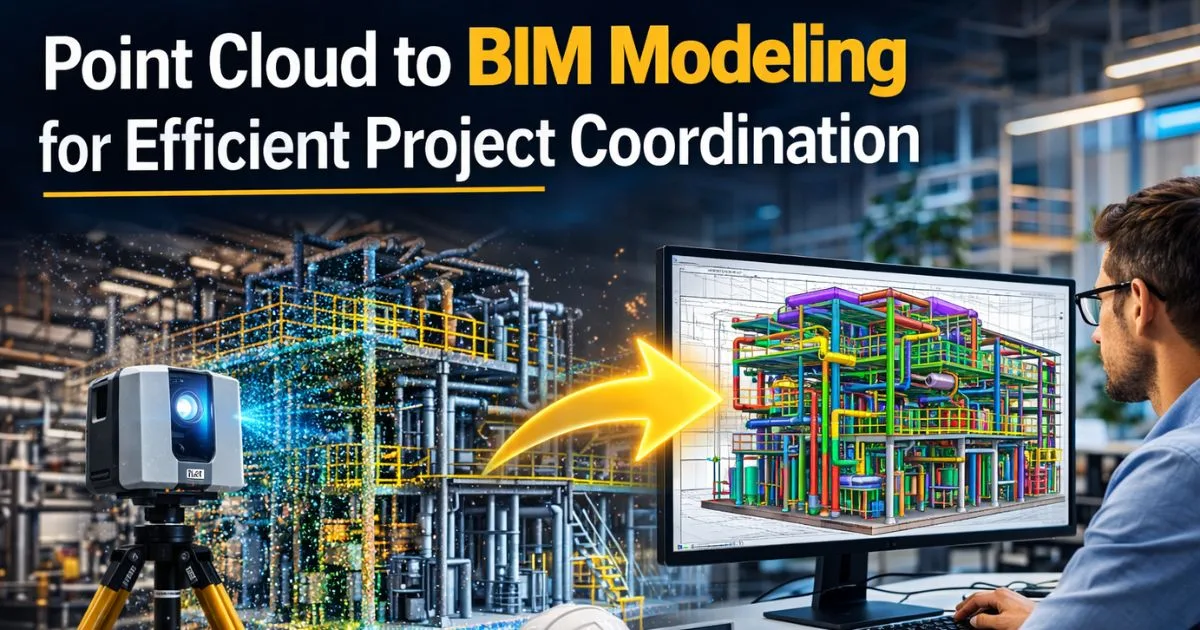
Construction projects are growing more intricate by the minute. Teams must manage overlapping schedules, complex architectural designs, and tight budgets while minimizing errors. Relying solely on traditional surveying methods or outdated 2D drawings often leads to costly mistakes and extended timelines. Teams need a better way to capture existing conditions and translate them into usable, highly accurate digital formats.
This is exactly where point cloud to bim modeling steps in as a transformative solution. By bridging the gap between physical spaces and digital representations, this process offers a reliable foundation for enhanced project coordination. Instead of guessing about structural dimensions or hidden MEP (mechanical, electrical, and plumbing) elements, project managers can rely on millimeter-accurate data.
Ultimately, converting raw scanning data into an intelligent 3D model streamlines daily workflows. It drastically improves accuracy across the board and facilitates much better collaboration among architects, engineers, and contractors.
Understanding Point Cloud Data
Before diving into the conversion process, it helps to understand the raw material. Point cloud data is a massive collection of data points positioned in a three-dimensional coordinate system. These points represent the external surfaces of objects or physical spaces, effectively creating a highly accurate digital twin of a real-world environment.
How is it Captured?
Professionals capture this data using advanced 3D scanning technologies. Light Detection and Ranging (LiDAR) scanners emit laser pulses that bounce off surfaces and return to the scanner, measuring the exact distance. Photogrammetry is another popular method, which stitches together thousands of high-resolution overlapping photographs to create a dense 3D point cloud.
Benefits of Point Cloud Data in Construction
The primary benefit of point cloud data is absolute as-built accuracy. It captures the existing conditions of a site exactly as they are, including structural sags, uneven floors, or complex geometries. This prevents nasty surprises during the construction phase and gives designers a flawless canvas to work from.
Introduction to Building Information Modeling (BIM)
BIM is not just a 3D model. It is a highly intelligent, information-rich process that gives architecture, engineering, and construction professionals the insight and tools to plan, design, construct, and manage buildings efficiently.
What is BIM?
While a basic 3D model shows you what a building looks like, BIM tells you how it functions. Every element within a BIM environment contains embedded data. A digital wall in BIM knows its material composition, fire rating, cost, and structural load capacity.
Key Advantages of BIM in Construction
BIM offers incredible advantages throughout the project lifecycle. During the design phase, it allows for deep analysis regarding energy efficiency and structural integrity. For project coordination, its clash detection capabilities are unmatched, automatically flagging instances where a pipe might intersect with a steel beam. Finally, the data-rich model is handed over to facility managers for long-term maintenance and operations.
Bridging the Gap: Point Cloud to BIM Modeling
Raw scan data is visually impressive, but it lacks the embedded intelligence of BIM. Bridging this gap involves a specialized conversion workflow.
The Conversion Process
Converting millions of laser points into a smart model requires several distinct steps:
- Registration and Cleaning: Multiple scans from different angles are stitched together (registered) into a single, unified coordinate system. Technicians then clean the data, removing unwanted noise like people, vehicles, or scanning artifacts.
- Modeling Elements: BIM specialists use the clean point cloud as a tracing reference. They build intelligent BIM elements—like walls, columns, doors, and complex MEP networks—directly over the point cloud geometry to match the existing conditions.
- Level of Detail (LOD): Teams must define the required Level of Detail early on. Some projects only need basic geometric shapes (LOD 200), while others require highly specific, manufacturer-accurate components (LOD 400).
Tools and Software Used
This workflow relies on robust software solutions. Autodesk Revit is the industry standard for creating the final BIM, while programs like ReCap Pro, Leica Cyclone, or CloudCompare handle the heavy lifting of processing the initial point cloud data.
Enhancing Project Coordination
The real value of this workflow becomes obvious during the coordination phase of a project.
Improved Accuracy of Existing Conditions
By starting with a highly accurate digital replica of the site, teams dramatically reduce errors and rework. When new designs are integrated into the existing conditions model, clash detection software can immediately identify interferences. Fixing a pipe clash on a computer screen costs nothing compared to fixing it on a live construction site.
Streamlined Design and Construction
Accurate site data leads to faster design iterations. Architects spend less time verifying field measurements and more time refining their concepts. Project managers make better, faster decisions because they trust the underlying data driving the construction schedule.
Enhanced Collaboration Among Stakeholders
A centralized BIM model serves as a single source of truth for the entire project team. Plumbers, electricians, and builders all access the same updated information. The highly visual nature of the model also makes it much easier to communicate complex design intent to non-technical stakeholders or property owners.
Facilitating Renovation and Retrofits
This process shines brightest during renovation and retrofit projects. Older buildings rarely match their original 2D blueprints—if those blueprints even exist. Scanning the building and creating an accurate model ensures new additions fit perfectly into the existing structure.
Real-World Applications and Success
Consider a complex infrastructure project, like updating a decades-old underground subway station. Relying on manual measurements would take months and likely result in severe inaccuracies due to the complex, curved architecture. By utilizing 3D scanning, teams can capture the entire station in a few nights.
Companies like Archdraw Outsourcing frequently help project teams take these massive, complex point clouds and convert them into highly accurate BIM models. This allows the engineering teams to design new ventilation systems that snake perfectly through the existing underground infrastructure, saving millions of dollars in potential rework and keeping the project strictly on schedule.
Challenges and Considerations
While highly beneficial, this workflow does present a few challenges that teams must navigate.
Data Size and Processing Power
Point clouds are massive files, often reaching hundreds of gigabytes. Handling this data requires high-end computers with exceptional processing power, top-tier graphics cards, and massive storage solutions.
Expertise Required
Accurately tracing a point cloud requires a deep understanding of both the software and actual construction principles. Modelers must know how to interpret ambiguous scan data and turn it into structurally sound BIM elements.
Cost vs. ROI
The hardware (laser scanners) and software licenses are expensive. However, project managers must view this through a Return on Investment (ROI) perspective. The upfront cost of scanning and modeling is almost always eclipsed by the savings generated from avoiding just one major construction error.
The Future of the Industry
The technology driving these workflows continues to advance rapidly. We are already seeing the integration of Artificial Intelligence and machine learning to automate the modeling process. AI algorithms can now automatically recognize walls, pipes, and windows within a point cloud, drastically reducing manual modeling time. Furthermore, the industry is moving toward real-time scanning, where robots or drones continuously scan a site and update the BIM model as construction progresses.
Building a Foundation for Modern Construction
Point cloud to bim modeling is no longer just a neat technological trick; it is an essential workflow for managing complex construction environments. By capturing reality with laser precision and converting it into intelligent, actionable data, teams can coordinate better, build faster, and eliminate expensive errors. Embracing this technology is a necessary step for any construction firm looking to maintain a competitive edge and deliver successful projects.