
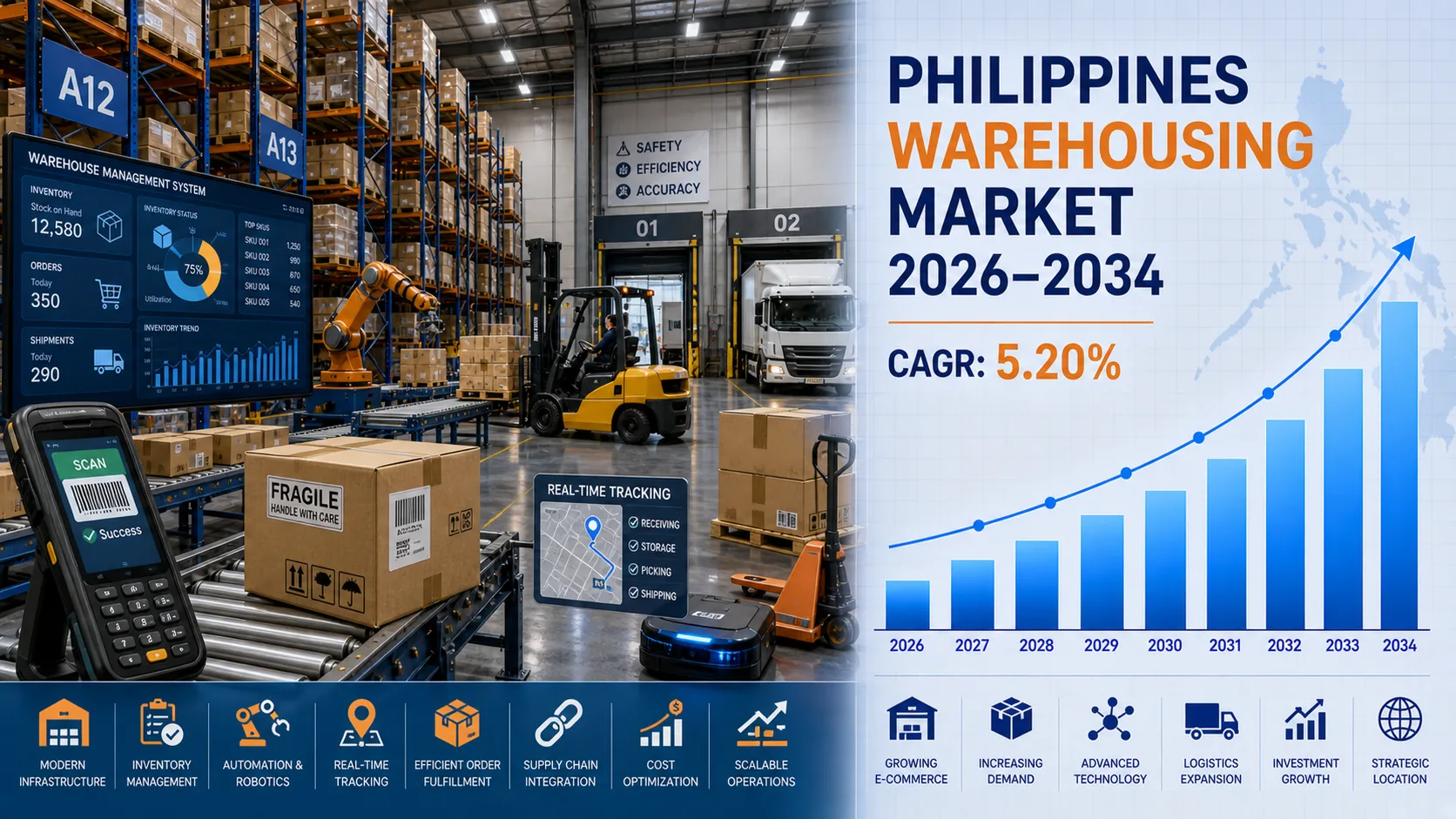
Market Overview
The Philippines warehousing market reached USD 441.7 Million in 2025 and is projected to reach USD 706.8 Million by 2034, growing at a compound annual growth rate (CAGR) of 5.20% from 2026 to 2034.
Numerous collaborations between key players, the thriving e-commerce industry, rising focus on supply chain optimization, government infrastructure investment under the Build Better More program, and growing demand for cold chain facilities to support food safety and pharmaceutical distribution are the primary growth catalysts. The market is strategically important to the Philippines' economy as it enables the nation to meet evolving logistics and supply chain needs while supporting e-commerce, food safety, pharmaceutical distribution, and industrial growth.
Request a Sample Report for In-Depth Market Insights: https://www.imarcgroup.com/philippines-warehousing-market/requestsample
Philippines Warehousing Market Summary
- The Philippines warehousing market encompasses a broad range of commercial facilities, including general warehousing, container freight stations, cold storage, agricultural storage, and specialized hazardous materials warehouses.
- These facilities are valued for their role in storing, handling, and distributing goods across the supply chain, and are used across food and beverages, chemicals and materials, electronics, pharmaceutical, consumer durables, and other end-user sectors.
- The ecosystem includes warehouse operators, logistics providers, real estate developers, technology vendors (WMS, IoT), government agencies, and end-users.
- Major segments identified in the market include type (general warehousing, container freight, cold storage, agriculture, others), end user (food and beverages, chemicals and materials, electronics, pharmaceutical, consumer durables, others), and region (Luzon, Visayas, Mindanao).
- The market is benefiting from e-commerce boom and last-mile fulfillment demand, government infrastructure investment (Build Better More program), supply chain optimization by FMCG companies, and rise of cold chain for food safety and pharmaceutical distribution.
- Collaborations between logistics developers and real estate companies, technology integration and WMS adoption, and cold chain expansion for food safety and pharmaceutical compliance are driving sustained expansion across all application categories.
PORTER'S FIVE FORCES ANALYSIS -- PHILIPPINES WAREHOUSING MARKET
Bargaining Power of Suppliers – Moderate
- The warehousing supply chain includes real estate developers, construction firms, technology providers (WMS, IoT), and equipment suppliers (racking, refrigeration).
- Large, established real estate developers with prime land banks (e.g., Ayala Land) have significant bargaining power.
- However, the presence of multiple suppliers and the ability of large logistics operators to build own facilities reduces dependency on any single supplier.
- Technology providers offering WMS and automation solutions have moderate leverage.
Bargaining Power of Buyers – Moderate to High
- Buyers in the Philippine warehousing market include FMCG companies, e-commerce platforms, pharmaceutical distributors, and electronics manufacturers with varying degrees of bargaining power.
- Large FMCG companies and e-commerce platforms have significant bargaining power through volume commitments and long-term lease agreements.
- The availability of multiple facility types and developers gives buyers choice and leverage.
- However, location-specific demand (CALABA corridor) and specialized requirements (cold storage, GDP compliance) moderate pure price sensitivity.
Threat of New Entrants – Moderate
- The market is influenced by established global 3PL operators (UPS, DHL), domestic players (Fast Logistics), and industrial real estate developers (Ayala Land).
- Capital requirements for Grade-A warehousing construction (PHP 15,000–30,000 per sq m) favor established players.
- However, the rise of logistics park developments and government incentives (PEZA, BOI) is creating new opportunities for entrants.
- Regulatory compliance and land acquisition costs create additional entry barriers.
Threat of Substitutes – Low
- Warehousing faces limited substitution from alternative supply chain models (e.g., direct shipping, drop-shipping) for bulk storage and distribution.
- However, in some applications, just-in-time delivery may reduce warehousing needs.
- The increasing complexity of supply chains reinforces the importance of warehousing.
Competitive Rivalry – High
- The Philippines warehousing market features a competitive landscape of global 3PL operators, domestic logistics companies, and industrial real estate developers.
- Differentiation occurs through service quality, technology integration (WMS, automation), geographic coverage, and facility specialization (cold storage, GDP compliance).
- Competition is intensifying as developers shift from multi-tenant spec builds to build-to-suit arrangements for anchor tenants.
- Strategic partnerships and joint ventures (e.g., real estate developers with institutional investors) drive competitive dynamics.
MARKET GROWTH DRIVERS
E-Commerce Boom and Last-Mile Fulfillment Demand
The Philippines' e-commerce market is projected to reach USD 86.2 Billion in 2034, driven by 73.91 million active online users and rapid platform growth by Shopee, Lazada, and TikTok Shop. Online sellers grew from 1,700 in March 2020 to 93,318 by January 2021 (DTI), creating massive and sustained demand for fulfillment centers near urban consumption hubs. This e-commerce expansion is directly driving demand for large-format (15,000–60,000 sq m) fulfillment centers equipped with modern racking systems, conveyor integration, and parcel sortation technology.
Government Infrastructure Investment (Build Better More Program)
Clark International Airport's industrial estate, with 100% foreign ownership permitted under the Clark Freeport Zone, is emerging as a multi-modal logistics hub, with UPS' March 2024 construction announcement reinforcing the area's warehousing investment appeal. The Philippine government's USD 26 Billion 2024 infrastructure allocation and the Logistics Sector Roadmap under the Supply Chain Improvement Agenda (SCIA) are creating a supportive environment for warehousing development across the archipelago.
Rise of Cold Chain for Food Safety and Pharmaceutical Distribution
The Philippines' seafood export sector (retail sales grew from USD 6.8 billion to USD 7.9 billion between 2020 & 2024) and rapidly expanding pharmaceuticals industry require compliant cold chain infrastructure from farm gate through distribution. The FDA's GDP-aligned cold chain mandate for pharmaceutical distributors and the Department of Agriculture's National Cold Chain System rollout are expected to create a USD 150–200 Million incremental cold chain investment opportunity through 2030.
PHILIPPINES WAREHOUSING MARKET SEGMENTATION
Type Insights:
- General Warehousing (36.8% share in 2025)
- Container Freight (22.4% share in 2025)
- Cold Storage (18.6% share in 2025)
- Agriculture
- Others
End User Insights:
- Food and Beverages (28.9% share in 2025)
- Chemicals and Materials (19.6% share in 2025)
- Electronics
- Pharmaceutical
- Consumer Durables
- Others
Regional Insights:
- Luzon (62.5% share in 2025)
- Visayas (21.3% share in 2025)
- Mindanao (16.2% share in 2025)
COMPETITIVE LANDSCAPE
The Philippines warehousing market is moderately fragmented, with global logistics players (United Parcel Service of America, Inc., DHL Group) dominating the high-specification, integrated logistics segment, while domestic companies (Fast Logistics) command the regional distribution and last-mile warehousing segments. Industrial real estate developers (Ayala Land, Inc.) are shaping warehouse park supply through large-scale logistics estate developments in the CALABA corridor and Visayas emerging markets.
Key players mentioned in the report context include:
- United Parcel Service of America, Inc.: Market leader; announced development of a new logistics hub at Clark International Airport in March 2024 to strengthen express, supply chain, and healthcare logistics operations across Asia Pacific.
- DHL Group: Market leader; strong presence in healthcare GDP-compliant cold chain warehousing for pharmaceutical distribution.
- Ayala Land, Inc.: Strong challenger; operates ALogis ready-built warehouse facilities for lease and Artico cold storage facilities; signed a lease agreement with VS Industry Philippines, Inc. for over 52,700 sq. meters at ALogis Santo Tomas in Batangas in September 2024.
- Fast Logistics: Challenger; prominent domestic 3PL operator with nationwide cold chain coverage and FMCG distribution across multiple provincial hubs.
REGIONAL ANALYSIS
Luzon (62.5%): Luzon's dominant share is anchored by the CALABA corridor's status as the Philippines' primary manufacturing and logistics belt, hosting PEZA-registered industrial estates in Laguna, Cavite, and Batangas that house major FMCG, electronics, and chemical manufacturers. The Clark Freeport Zone's emerging logistics hub, anchored by UPS' airport logistics facility, and Metro Manila's concentration of distribution centers reinforce the region's leadership. The CALABA corridor's industrial vacancy rate has declined significantly due to increased demand from FMCG companies.
Visayas (21.3%): Visayas is growing at approximately 12% CAGR, driven by Cebu City's emergence as the Visayas' commercial and e-commerce hub. The region's growing BPO sector, expanding tourism-linked food supply chains, and the Mactan Export Processing Zone's electronics manufacturing complex are creating sustained demand for modern warehousing facilities that remain underserved by current Grade-A supply.
Mindanao (16.2%): Mindanao represents an emerging market for warehousing, with growth driven by agricultural commodity warehousing serving major crop-producing regions, cold chain infrastructure investment for seafood and perishable agricultural produce, and improving logistics connectivity. The region's agricultural and seafood export sectors require specialized cold storage facilities to meet international quality standards.
RECENT INDUSTRY DEVELOPMENTS
June 2026: The Philippines warehousing market continued expanding as demand from e-commerce, third-party logistics (3PL), food & beverage, and pharmaceutical companies increased. Operators accelerated investments in automated fulfillment centers, smart warehouses, and cold chain infrastructure to improve inventory management and delivery efficiency.
May 2026: Warehousing providers increased investments in AI-powered warehouse management systems (WMS), robotics, IoT-enabled inventory tracking, automated material handling, and digital supply chain solutions to enhance operational efficiency and reduce fulfillment times.
April 2026: The Philippines warehousing market reached USD 441.7 million in 2025 and is projected to reach USD 706.8 million by 2034, exhibiting a CAGR of 5.20% during 2026–2034, driven by rapid e-commerce expansion, infrastructure development under the Build Better More program, and growing demand for modern logistics facilities.
March 2026: General warehousing remained the largest facility type, accounting for 36.8% of the market in 2025, while the food and beverages sector represented the largest end-use industry with a 28.9% market share, reflecting strong demand for storage and distribution services.
February 2026: Luzon remained the leading regional market, accounting for 62.5% of the market in 2025, supported by Metro Manila's logistics hubs, the CALABA industrial corridor, major seaports, and Clark International Airport.
January 2026: Warehouse operators increasingly deployed automated storage and retrieval systems (AS/RS), AI-driven demand forecasting, RFID tracking, cloud-based WMS, and real-time inventory analytics to improve warehouse productivity and supply chain visibility.
January 2026: Growing investments in cold storage warehouses continued supporting the food, agriculture, pharmaceutical, and healthcare sectors, while the rapid growth of e-commerce strengthened demand for fulfillment centers and last-mile distribution facilities.
January 2026: Continued investment in warehouse automation, AI-powered logistics, robotics, IoT-enabled inventory management, cold chain infrastructure, and smart fulfillment centers is expected to support the long-term growth of the Philippines warehousing market by improving operational efficiency, supply chain resilience, and nationwide distribution capabilities.
Note: If you need any specific information that is not covered currently within the scope of the report, we will provide the same as a part of customization.
Speak to an analyst: https://www.imarcgroup.com/request?type=report&id=23582&flag=C
Report Format, Delivery, and Customization Details
- Report Format Mode: PPT, PDF, and Excel
- Report Delivery Mode: Online Delivery, Physical Delivery
- Report Delivery Time: Report delivered over email within 24 to 48 hours. If requested by the client, a physical copy will be delivered within three to ten days.
- Report Confirmation Mode: Yes via Email
- Report Customization Mode: Yes via Email / Call
- Report Table of Content: Yes
- Report List of Figures: Yes
- Report Methodology Mode: Yes
- Request For Sample Report: Yes
About Us
IMARC Group is a global management consulting firm that helps the world's most ambitious changemakers to create a lasting impact. The company provides a comprehensive suite of market entry and expansion services. IMARC offerings include thorough market assessment, feasibility studies, company incorporation assistance, factory setup support, regulatory approvals and licensing navigation, branding, marketing and sales strategies, competitive landscape and benchmarking analyses, pricing and cost research, and procurement research.
Contact Us
IMARC Group
134 N 4th St., Brooklyn, NY 11249, USA
Email: [email protected]
Tel No: (D) +91 120 433 0800
United States: +1-201-971-6302