
Market Overview
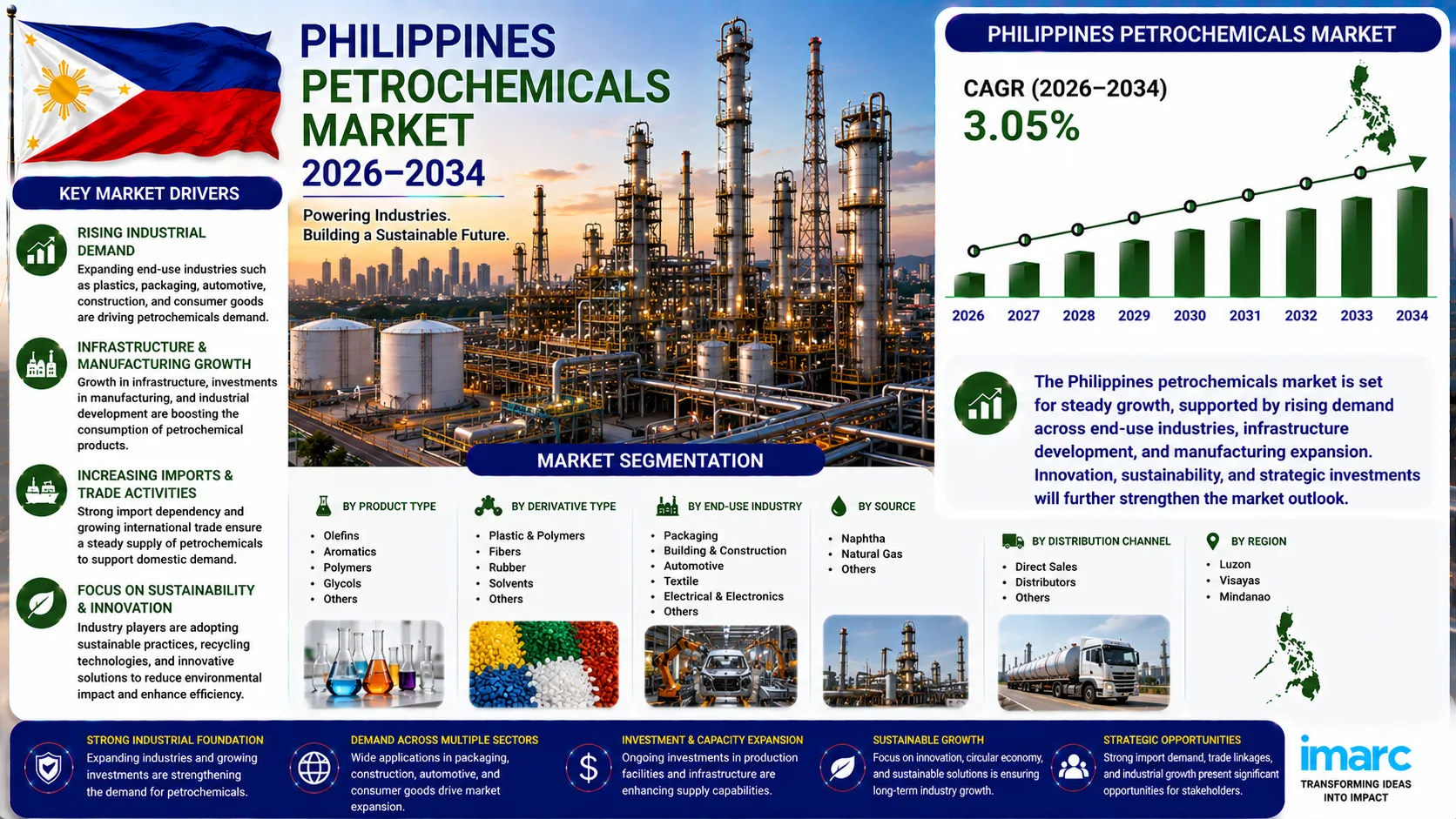
The Philippines petrochemicals market size reached USD 3.0 Billion in 2025 and is projected to reach USD 4.0 Billion by 2034, growing at a compound annual growth rate (CAGR) of 3.05% from 2026 to 2034. The market is driven by growing demand from construction, packaging, auto, and consumer goods sectors. Rising urbanization, infrastructure, and e-commerce growth are driving consumption of polymers, resins, and specialty chemicals in various applications. Sustainability efforts and adoption of renewable feedstocks are transforming the industry scenario as well. With robust domestic consumption and continued industrial developments, the industry is well-suited for long-term growth.
Request a Sample Report for In-Depth Market Insights: https://www.imarcgroup.com/philippines-petrochemicals-market/requestsample
Philippines Petrochemicals Market Summary
- The Philippines petrochemicals market encompasses a range of products, including ethylene, propylene, butadiene, benzene, toluene, xylene, methanol, and others, serving applications across polymers, paints and coatings, solvents, rubber, adhesives and sealants, surfactants and dyes, and others.
- These products are valued for their role in enabling infrastructure development, supporting packaging and consumer goods manufacturing, and providing essential inputs for automotive, construction, electrical and electronics, and healthcare industries.
- The ecosystem includes petrochemical manufacturers, feedstock suppliers, downstream processors, distributors, and end users across Luzon, Visayas, and Mindanao.
- Major segments identified in the market include type (ethylene, propylene, butadiene, benzene, toluene, xylene, methanol, others), application (polymers, paints and coatings, solvents, rubber, adhesives and sealants, surfactants and dyes, others), end use industry (packaging, automotive and transportation, construction, electrical and electronics, healthcare, others), and region (Luzon, Visayas, Mindanao).
- The market is benefiting from heightened demand from infrastructure development and construction, growing use of packaging and consumer products, and growing integration of renewable and sustainable solutions.
- In March 2024, JG Summit Olefins Corporation expanded petrochemical capacity in the Philippines to strengthen domestic supply and value chains.
Porter's Five Forces Analysis
- Competitive Rivalry: Moderate, with domestic manufacturers, international suppliers, and regional producers competing on price, product quality, and supply reliability. Business implication: Companies must differentiate through product innovation, cost efficiency, and supply chain integration.
- Supplier Power (Feedstock Suppliers): High. Suppliers of naphtha, natural gas, and other feedstock materials have significant leverage, given the Philippines' dependence on imports for petrochemical production. Business implication: Manufacturers should diversify sourcing and explore alternative feedstocks.
- Buyer Power (Downstream Manufacturers and Converters): High. Buyers have extensive choice across domestic and imported petrochemicals, with growing awareness of product quality, price, and sustainability credentials. Business implication: Providers must focus on quality consistency, cost competitiveness, and technical support to build loyalty.
- Threat of Substitutes: Moderate. Bio-based plastics, recycled materials, and alternative chemicals compete, but conventional petrochemicals remain essential for many applications. Business implication: The industry should emphasize performance, cost-effectiveness, and sustainability innovation.
- Threat of New Entrants: Moderate. Higher barriers for established players (capital requirements, feedstock access, regulatory compliance), but lower barriers for niche and specialty chemical entrants. Business implication: Established players should build defensible positions through scale, integration, and customer relationships.
Market Growth Drivers
Heightened Demand from Infrastructure Development and Construction
The Philippines continues to witness fast-paced development of infrastructure and real estate, creating high demand for petrochemical products like plastics, resins, and man-made materials in construction. State-led infrastructure projects and private real estate developments are driving the consumption of polymers, coatings, and specialty chemicals needed in the latest building applications. With the growth of urbanization, the dependency on light, strong, and inexpensive materials becomes more and more vital. This change in structure facilitates long-term Philippines petrochemicals market growth as industries turn to effective solutions for rising demands. Infrastructure modernization also amplifies downstream sectors such as automotive, packaging, and consumer goods, which further boost the base of applications. Petrochemicals are also increasingly finding applications in insulation, flooring, and piping systems, enhancing their contribution to sustainable and energy-saving construction methods. The synchronization of infrastructure growth with industrial demand underlines one of the most critical Philippines petrochemicals market trends for the upcoming decade.
Growing Use of Packaging and Consumer Products
The increasing middle-class population in the Philippines and changing consumer habits are contributing substantially to growing demand for consumer products and packaging materials. Flexible packaging, PET bottles, and lightweight containers are essential elements of the retail and food industries, which keep growing through advancing trade and e-commerce penetration. Petrochemicals are the backbone of such industries, providing flexibility, resistance, and affordability in packaging technologies. Mounting demand for convenience foods, drinks, and personal care products is fueling consistent Philippines petrochemicals market growth as packaging applications continue to diversify. Additionally, efforts on sustainable packaging are driving innovation in the creation of recyclable and bio-based solutions, opening avenues for innovation in petrochemical applications. Increased reliance on plastics and other associated materials in consumer-driven industries justifies one of the major Philippines petrochemicals market trends, where the need for high-quality, safe, and efficient packaging is a prevailing growth driver determining industrial strategies and product development in the nation.
Growing Integration of Renewable and Sustainable Solutions
The Philippines' petrochemicals sector is gradually adopting a transition to sustainability, following global movements focusing on circular economy principles. Increasing awareness about environmental effects is compelling businesses to embrace bio-based feedstocks, recyclable plastics, and energy-efficient technologies. Firms are spending on innovations to minimize carbon footprints, aligning with long-term environmental priorities while advancing industrial competitiveness. Such a shift is anticipated to make a substantial contribution towards Philippines petrochemicals market growth because demand is moving in the direction of cleaner and sustainable options. Pressure for renewable options also comes from consumer demand for environmentally friendly products and policy support for resource efficiency. The integration of sustainable technologies in manufacturing and end-use processes is one of the revolutionary Philippines petrochemicals market trends, with industries walking on a tightrope between economic prosperity and ecological responsibility. The convergence of sustainability with petrochemical production is set to define the sector's evolution, strengthening its role in the country's industrial ecosystem.
Expansion of Domestic Petrochemical Capacity
The expansion of domestic petrochemical capacity is a significant driver of the Philippines petrochemicals market. In March 2024, JG Summit Olefins Corporation expanded petrochemical capacity in the Philippines to strengthen domestic supply and value chains. The move addresses rising industrial demand for petrochemical products, supporting sectors such as construction, packaging, and manufacturing while reducing reliance on imports and fostering sustainable market growth. Domestic capacity expansion supports import substitution, strengthens supply chain resilience, and creates new opportunities for downstream manufacturers and converters across the country.
Philippines Petrochemicals Market Segmentation
Type Insights:
- Ethylene
- Propylene
- Butadiene
- Benzene
- Toluene
- Xylene
- Methanol
- Others
Application Insights:
- Polymers
- Paints and Coatings
- Solvents
- Rubber
- Adhesives and Sealants
- Surfactants and Dyes
- Others
End Use Industry Insights:
- Packaging
- Automotive and Transportation
- Construction
- Electrical and Electronics
- Healthcare
- Others
Regional Insights:
- Luzon
- Visayas
- Mindanao
Competitive Landscape
The Philippines petrochemicals market features a competitive landscape encompassing domestic manufacturers, international suppliers, and regional producers. Market participants differentiate through product quality, supply reliability, pricing, and technical support. The market is characterised by growing demand from downstream industries, increasing investment in domestic capacity, and rising focus on sustainability and circular economy principles. The competitive analysis includes market structure, key player positioning, top winning strategies, competitive dashboard, and company evaluation quadrant, with detailed profiles of all major companies provided in the report.
Key players mentioned in the report's context include:
- JG Summit Olefins Corporation expanded petrochemical capacity in the Philippines in March 2024 to strengthen domestic supply and value chains. The move addresses rising industrial demand for petrochemical products, supporting sectors such as construction, packaging, and manufacturing while reducing reliance on imports and fostering sustainable market growth.
- Leading domestic manufacturers, international suppliers, and regional producers are focusing on product quality, supply chain integration, and sustainability innovation to capture growing demand across diverse applications and end-use industries in the Philippines.
Regional Analysis
- Luzon: The dominant region driven by the concentration of petrochemical manufacturing facilities, downstream processing industries, and major end-use sectors including packaging, construction, and automotive. The region benefits from strong industrial infrastructure, proximity to major ports, and growing demand from consumer goods and electronics manufacturing.
- Visayas: A growing market driven by increasing industrial development, expanding construction activity, and growing demand for petrochemical products across Cebu, Iloilo, and other major urban centers. The region is emerging as a hub for downstream processing and specialty chemical applications.
- Mindanao: A significant market with growing petrochemical demand, supported by agricultural production, infrastructure development, and increasing investment in manufacturing. The region benefits from improving logistics infrastructure and growing demand for packaging and construction materials.
Recent Industry Developments
August 2026: Petron reported PHP3.8 billion net income in H1 2026, down 27% year-on-year, as Middle East tensions pushed crude, import premiums and freight costs higher. Dubai crude averaged US$91 per barrel during the first half, 27% above the same period in 2025, increasing pressure across petrochemical feedstock and downstream chemical costs.
April 2026: JG Summit Olefins Corporation’s petrochemical operations remained under an indefinite commercial shutdown, following the suspension that began in January 2025. The company continued facing weak polymer and olefins margins amid global oversupply and competition from lower-cost regional producers, creating greater reliance on imported petrochemical materials in the Philippines.
May 2026: Petron reported PHP1.8 billion net income in Q1 2026, down 56% year-on-year, while revenues increased 27% to PHP246 billion. Higher crude costs and reduced refinery production constrained margins, with Dubai crude averaging US$86 per barrel, 12% higher than Q1 2025.
April 2026: Industry discussions highlighted the Philippines’ increasing dependence on imported petrochemical feedstocks and intermediates after the shutdown of the country’s only naphtha cracker. Higher shipping costs and geopolitical disruptions exposed vulnerabilities in the domestic plastics and chemical supply chain, increasing pressure for renewed local industrial capacity and stronger supply resilience.
January 2026: The Philippine petrochemicals sector entered 2026 with continued pressure from global oversupply and weak margins, particularly in polymers and olefins. JG Summit’s shutdown reduced domestic production capacity, while local manufacturers increasingly relied on imported plastic resins and other petrochemical inputs to meet downstream demand from packaging, construction and consumer industries.
Key Aspects Required for the Philippines Petrochemicals Market
- Market Performance: USD 3.0 Billion in 2025, with a projected trajectory to USD 4.0 Billion by 2034.
- Market Outlook: A 3.05% CAGR through 2034 indicates steady growth across types, applications, end-use industries, and regions, driven by infrastructure development, packaging demand, and sustainability trends.
- Growth Drivers: Heightened demand from infrastructure development and construction; growing use of packaging and consumer products; growing integration of renewable and sustainable solutions; expansion of domestic petrochemical capacity; and rising urbanization and e-commerce growth.
- Competitive Landscape: A moderately competitive market with domestic manufacturers, international suppliers, and regional producers. Differentiation occurs through product quality, supply reliability, pricing, and technical support.
- Value Chain Analysis: From feedstock sourcing and petrochemical production through distribution and downstream processing to end-use in packaging, construction, automotive, and other industries, with sustainability and circular economy trends shaping market dynamics.
- Industry Trends: Growing demand from infrastructure and construction; expansion of packaging and consumer products; increasing adoption of bio-based feedstocks and recyclable plastics; domestic capacity expansion; and growing focus on energy-efficient technologies.
- Strategic Recommendations: Invest in domestic petrochemical capacity and feedstock diversification; develop sustainable and bio-based product offerings; expand downstream processing capabilities; strengthen supply chain integration and import substitution; and focus on circular economy and energy-efficient technologies.
Note: If you need any specific information that is not currently covered within the scope of the report, we will provide the same as a part of customization.
Speak to an analyst: https://www.imarcgroup.com/request?type=report&id=42280&flag=C
Report Format, Delivery, and Customization Details
- Report Format Mode: PDF and Excel (Editable version in PPT/Word format available on special request)
- Report Delivery Mode: Online Delivery, Physical Delivery
- Report Delivery Time: The report is delivered over email within 24 to 48 hours. If requested by the client, a physical copy will be delivered within three to ten days.
- Report Confirmation Mode: Yes, via email
- Report Customization Mode: Yes, via Email / Call
- Report Table of Content: Yes
- Report List of Figures: Yes
- Report Methodology Mode: Yes
- Request For Sample Report: Yes