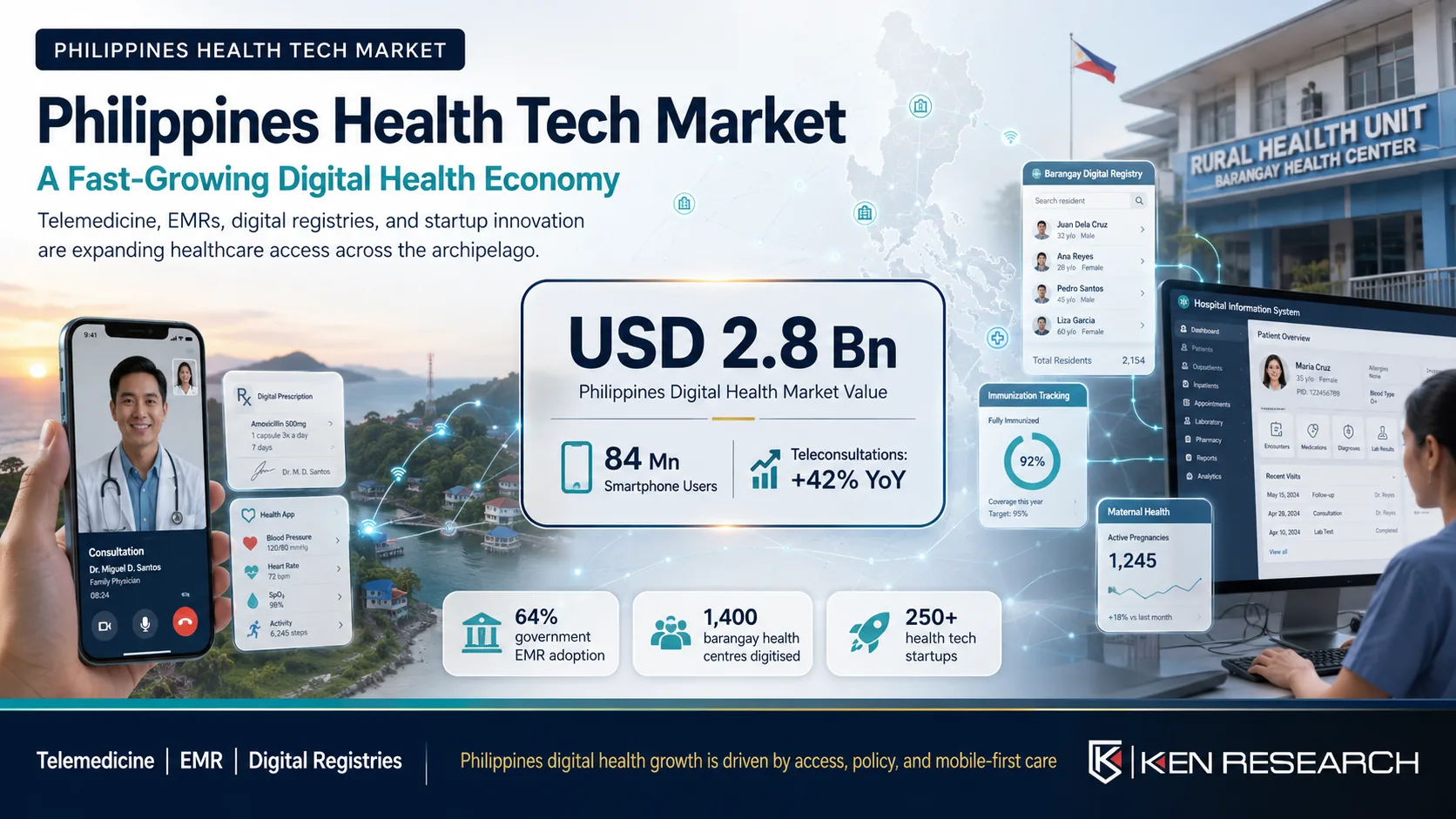
The Philippines Digital Health Market is valued at USD 2.8 billion, per Ken Research five-year historical analysis, driven by rising smartphone penetration, accelerating telemedicine adoption, and a government regulatory push to digitise the national health system under Universal Health Care. The country had approximately 84 million smartphone users, per Ken Research, and monthly teleconsultations grew 42% year-on-year in 2024, with the highest adoption in rural Mindanao, Eastern Visayas, and far-flung island communities, per the Department of Health. More than 64% of government health facilities adopted EMR systems by 2025, per DOH, while 1,400 barangay health centres now use digital registries for maternal health, immunisation, and disease surveillance tracking. The government's National eHealth Strategy Framework 2023 to 2028, led by the DOH, sets a unified roadmap covering EMR rollout, telemedicine network expansion, and digital infrastructure upgrades across public hospitals. The Philippines Health Tech Market report by Ken Research covers market sizing, segmentation by digital health category, competitive landscape, and demand outlook to 2025.
Key Insights: Philippines Health Tech Market
- Philippines Digital Health Market valued at USD 2.8 billion, per Ken Research five-year historical analysis
- 84 million smartphone users in the Philippines, per Ken Research, anchoring digital health addressable market
- Monthly teleconsultations grew 42% year-on-year in 2024, per DOH, with rural regions leading adoption
- Over 64% of government health facilities adopted EMR systems by 2025, per DOH
- 1,400 barangay health centres using digital registries, per DOH
- Philippines telemedicine market valued at USD 1.8 billion, projected to reach USD 7.5 billion by 2033 at 17% CAGR, per Ken Research
- Philippines Healthcare Analytics Market valued at USD 4 billion, per Ken Research
- PHP 325.4 billion (5.6% of the PHP 5.78 trillion national budget) allocated to the health sector in 2024, per DOH budget data
- Over 250 health tech startups operating in the Philippines, per Ken Research, with venture investments exceeding USD 120 million
- Key players: KonsultaMD, HealthNow, SeeYouDoc, Philips Healthcare, Siemens Healthineers, Medilink Network
What Is Driving the Philippines Health Tech Market?
The Philippines Health Tech Market is being driven by three converging forces: a government regulatory mandate that has created a digital health compliance floor across all public and private health facilities, a telemedicine surge that has proven durable beyond COVID-19, and a health tech startup ecosystem that is growing faster than most markets at comparable income levels.
The regulatory foundation is the Universal Health Care Act (Republic Act No. 11223), signed in 2019, which automatically enrolled all Filipinos under PhilHealth and mandated integrated health information systems across all health facilities. The DOH and PhilHealth subsequently issued Joint Administrative Order 2021-002 mandating national health data standards for interoperability, requiring all private and public healthcare providers to show compliance with national health data rules. This mandate created a procurement requirement across every licensed health facility in the Philippines, not just public hospitals.
Three structural dynamics defining the Philippines Health Tech Market trajectory:
- National eHealth Strategy Framework 2023 to 2028: The DOH's five-year digital health roadmap targets a unified EMR system, expanded telemedicine networks, and digital infrastructure upgrades in public hospitals. The Philippine General Hospital and regional medical centres are piloting AI-assisted radiology tools for tuberculosis and breast cancer diagnostics, per DOH 2025 data. Solar-powered connectivity hubs, funded through Asian Development Bank and USAID partnerships, are extending digital health reach into remote municipalities, with over 600 rural health units relying on satellite-enabled internet for telemedicine.
- Telemedicine as the market anchor: Telemedicine usage surged during the COVID-19 pandemic and has become a permanent pillar of the Philippines health system. The Philippines Telemedicine Devices and RPM Market is projected to grow from USD 1.8 billion to USD 7.5 billion by 2033 at a 17% CAGR, per Ken Research, driven by chronic disease management needs and geographic accessibility requirements across the archipelago. Platforms including KonsultaMD, HealthNow, and SeeYouDoc deliver online consultations, prescription access, and specialist referrals. PhilHealth is finalising telemedicine reimbursement schemes allowing patients to claim benefits for online consultations, a policy change that will structurally expand the addressable commercial market.
- Startup ecosystem acceleration: The Philippines has over 250 health tech startups, per Ken Research, with venture investments exceeding USD 120 million. More than 65% of health tech firms are expected to form partnerships with healthcare providers to scale delivery, per Ken Research projections. The DOH allocated approximately PHP 1.6 billion (USD 32 million) for digital health initiatives, per Ken Research, supporting the eHealth System and Services Act implementation. The Philippine Health Insurance Corporation's plan to extend coverage to an additional 12 million citizens creates a large new addressable market for digital health platforms integrating with PhilHealth's insurance infrastructure.
Competitive Landscape of the Philippines Health Tech Market
KonsultaMD, HealthNow, and SeeYouDoc are the leading telemedicine platforms by user volume in the Philippines. Philips Healthcare and Siemens Healthineers lead among international health IT and device players. Medilink Network is a major domestic player providing hospital information systems and health IT integration services. The Philippines Healthcare Analytics Market, valued at USD 4 billion per Ken Research, reflects the scale of data-driven health IT spend across hospitals, insurers, and government agencies. The market is fragmented below the top tier, with over 250 startups developing solutions across telemedicine, mHealth apps, hospital management, and insurance tech. The key constraint on market consolidation is the 35% to 40% of rural areas lacking reliable internet access, per multiple government sources, which limits total addressable market for digital platforms dependent on connectivity. For regional comparison, the Vietnam Health Tech Market shows how a comparable Southeast Asian market at similar income levels is navigating the same connectivity-versus-adoption tension across a distributed geographic base.
Conclusion
The Philippines Health Tech Market is growing on the back of regulatory mandates that are creating institutional demand across all healthcare facilities, a telemedicine channel that has proven commercially durable beyond the pandemic, and a startup ecosystem building rapidly on top of a mobile-first consumer base of 84 million smartphone users. The 17% CAGR projected for telemedicine through 2033 and the USD 4 billion healthcare analytics market collectively point to a market that is more structurally developed than its income-level peers. The connectivity gap between urban and rural Philippines remains the primary constraint on growth, but DOH's ADB and USAID-backed rural connectivity programme is systematically closing it. Operators who secure PhilHealth integration, DOH eHealth compliance, and rural distribution reach will capture the full trajectory the Philippines Health Tech Market Outlook projects to 2025 and beyond.
FAQs
1. How large is the Philippines Health Tech Market?
The Philippines Digital Health Market is valued at USD 2.8 billion, per Ken Research five-year historical analysis. The telemedicine segment alone is valued at USD 1.8 billion and is projected to reach USD 7.5 billion by 2033 at a 17% CAGR, per Ken Research. The Philippines Healthcare Analytics Market is separately valued at USD 4 billion. The government allocated PHP 325.4 billion (5.6% of the national budget) to the health sector in 2024, per DOH budget data. For full market sizing by digital health category, the Philippines Health Tech Industry Analysis by Ken Research covers all segments through 2025.
2. What government policies are driving the Philippines Health Tech Market?
The Universal Health Care Act (RA 11223, 2019) is the foundational policy mandate, automatically enrolling all Filipinos under PhilHealth and requiring integrated health information systems across all facilities. The DOH-PhilHealth Joint Administrative Order 2021-002 mandates national health data standards for interoperability across all providers. The DOH's National eHealth Strategy Framework 2023 to 2028 sets a five-year roadmap for unified EMR deployment, telemedicine expansion, and hospital digital upgrades. PhilHealth's finalization of telemedicine reimbursement schemes will add a commercial payment mechanism to the existing regulatory framework, structurally expanding the addressable market for telemedicine platforms.
3. How is telemedicine reshaping the Philippines Health Tech Market?
Telemedicine has become a permanent pillar of the Philippines health system following COVID-19 acceleration. Monthly teleconsultations grew 42% year-on-year in 2024, per DOH, with the highest adoption in rural Mindanao, Eastern Visayas, and island communities where specialist access is limited. The telemedicine market is projected to grow from USD 1.8 billion to USD 7.5 billion by 2033, per Ken Research. Key platforms including KonsultaMD, HealthNow, and SeeYouDoc are scaling nationally. PhilHealth's telemedicine reimbursement scheme, once implemented, will extend the commercial reach of digital consultations to all insured Filipinos.
4. What role does the health tech startup ecosystem play in the Philippines Health Tech Market?
The Philippines has over 250 health tech startups, per Ken Research, attracting over USD 120 million in venture investment. Startups are building solutions across telemedicine, mHealth apps, hospital management, insurance tech, and remote patient monitoring. More than 65% of health tech firms are expected to partner with healthcare providers for delivery at scale. The DOH allocated approximately PHP 1.6 billion (USD 32 million) for digital health initiatives supporting startup and institutional eHealth deployment. PhilHealth's planned extension of coverage to an additional 12 million citizens represents a significant new demand pool for digital health platforms seeking integration with the national insurance system.
5. What are the main challenges facing the Philippines Health Tech Market?
Two structural challenges constrain the Philippines Health Tech Market. First, rural connectivity: approximately 35% to 40% of rural areas lack reliable internet access, per National Telecommunications Commission data, limiting telemedicine and digital health reach outside urban centres. The DOH is addressing this through ADB and USAID-funded solar-powered connectivity hubs and satellite internet for over 600 rural health units. Second, regulatory compliance complexity: over 55% of health tech startups cited compliance with existing laws as a barrier to entry, per Ken Research, particularly around the Data Privacy Act of 2012 and PhilHealth data standards interoperability requirements under Joint Administrative Order 2021-002.