
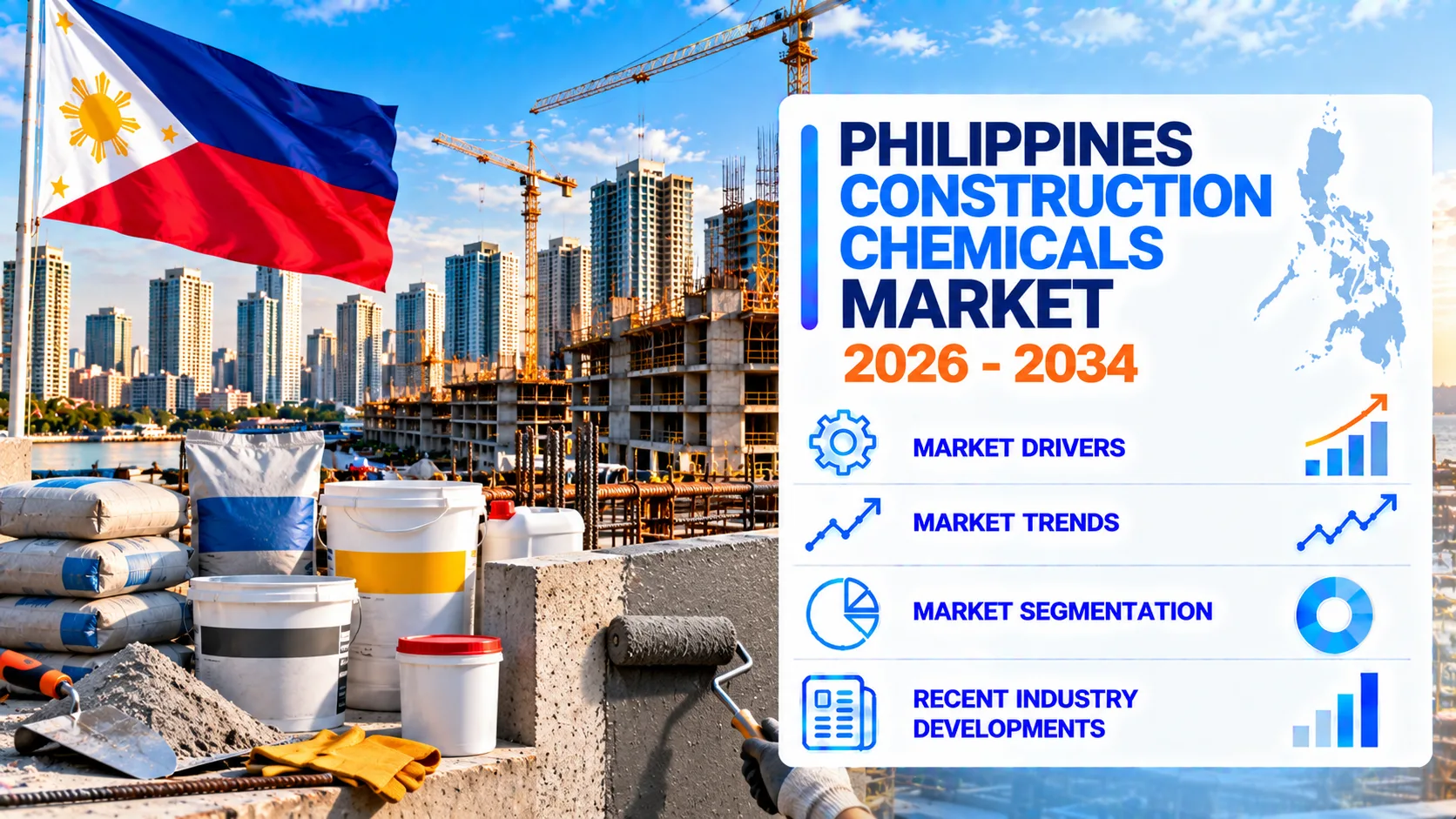
Market Overview
The Philippines construction chemicals market size reached USD 919.47 Million in 2025 and is projected to reach USD 1,392.91 Million by 2034, growing at a compound annual growth rate (CAGR) of 4.72% from 2026 to 2034. The market is driven by substantial government infrastructure investment through the Build Better More program, rapid urbanization, large-scale housing development initiatives aimed at reducing the national housing backlog, and the adoption of sustainable and green building practices aligned with the Philippine Green Building Code.
Request a Sample Report for In-Depth Market Insights: https://www.imarcgroup.com/philippines-construction-chemicals-market/requestsample
Philippines Construction Chemicals Market Summary
- The Philippines construction chemicals market encompasses a range of products, including concrete admixtures, waterproofing and roofing, repair, flooring, sealants and adhesives, and others, serving residential and non-residential applications across Luzon, Visayas, and Mindanao.
- These products are valued for their role in enhancing structural integrity, improving durability, extending service life, and enabling sustainable and cost-effective construction practices across diverse building and infrastructure projects.
- The ecosystem includes local manufacturers, international suppliers, distributors, construction contractors, project developers, and government agencies across the archipelago.
- Major segments identified in the market include type (concrete admixtures, waterproofing and roofing, repair, flooring, sealants and adhesives, others), application (residential, non-residential), and region (Luzon, Visayas, Mindanao).
- The market is benefiting from rising infrastructure investment, expansion of sustainable and green construction practices, technological advancements and product innovation, and the government's focus on renewable energy development.
- The enforcement of the Philippine Green Building Code, coupled with a growing emphasis on sustainable construction practices, is encouraging the adoption of eco-friendly chemical formulations, creating fresh opportunities for market growth.
Porter's Five Forces Analysis
- Competitive Rivalry: Moderate, with local producers and international suppliers competing on product quality, technical support, and the ability to provide tailored solutions for large-scale infrastructure and commercial projects. Business implication: Companies must differentiate through innovation, technical expertise, and localized manufacturing capabilities.
- Supplier Power (Raw Material Suppliers): High, as essential ingredients like polymers, resins, and specialty additives are often imported, making the sector vulnerable to shifts in global commodity prices and foreign exchange fluctuations. Business implication: Manufacturers should diversify sourcing and explore domestic raw material development.
- Buyer Power (Contractors and Developers): High, with extensive choice across domestic and international suppliers, and growing awareness of product performance, cost, and sustainability credentials. Business implication: Providers must focus on technical support, product quality, and cost competitiveness to build loyalty.
- Threat of Substitutes: Moderate, as traditional construction materials and methods compete, but the performance benefits, cost savings, and sustainability advantages of modern construction chemicals support their position. Business implication: The industry should emphasize long-term cost savings, structural benefits, and compliance with green building standards.
- Threat of New Entrants: Moderate, with higher barriers for established players (distribution networks, technical expertise, brand trust), but lower barriers for niche and specialty chemical entrants. Business implication: Established players should build defensible positions through technical service, product portfolios, and strategic partnerships.
Market Growth Drivers
Expansion of Sustainable and Green Construction Practices
The increasing focus on environmentally responsible building methods is influencing the demand for sustainable construction chemicals market in the Philippines. Developers are progressively utilizing low-VOC adhesives, water-based coatings, and bio-based admixtures to meet the standards set by the Philippine Green Building Code and various international sustainability certifications. These materials not only enhance environmental performance but also contribute to building durability and energy efficiency. The government's dedication to climate resilience and resource-efficient infrastructure is further fueling innovation in eco-friendly concrete additives, waterproofing solutions, and repair materials. As sustainability becomes a core element of construction planning, the demand for green chemical formulations is anticipated to grow substantially in both public and private sectors.
Rising Infrastructure Investment Driving Market Demand
The ongoing growth in infrastructure development continues to be a primary driver for the Philippines construction chemicals market growth. Current investments in transportation, utilities, and renewable energy projects are increasing the need for high-performance concrete admixtures, sealants, and protective coatings. Large-scale infrastructure projects under national development initiatives are creating significant market opportunities for suppliers of construction chemicals, particularly those focused on heavy civil engineering and industrial applications. Furthermore, the construction of new residential and commercial properties in both urban and rural regions continues to boost the utilization of these products. This momentum in investment, combined with the government's emphasis on modernizing transport and energy infrastructures, ensures sustained long-term growth for the construction chemicals industry.
Technological Advancements and Product Innovation
Rapid advancements in material science are reshaping the construction chemicals sector in the Philippines. Manufacturers are prioritizing the creation of advanced admixtures and self-healing concrete solutions to improve the longevity of structures and minimize maintenance expenses. The increasing use of nanotechnology-based coatings and innovative waterproofing systems is resulting in enhanced performance, particularly in extreme weather conditions. Additionally, digital tools such as Building Information Modeling (BIM) are being integrated into construction methodologies to ensure accuracy and efficiency in material application. These technological advancements not only enhance project results but also aid the industry's shift towards sustainable and cost-effective solutions. As innovation continues to accelerate, products that leverage advanced technology are projected to take precedence in the market landscape.
Government Infrastructure Investment Through Build Better More Program
The Philippines government has prioritized infrastructure development through the Build Better More program, driving strong demand for construction chemicals across physical connectivity, water resources, and energy projects nationwide. The government's focus on renewable energy development, aimed at significantly increasing the share of renewables in the power mix by 2030, is expected to stimulate demand for advanced construction chemicals used in energy-related projects. This sustained government investment in infrastructure modernization ensures a steady pipeline of projects requiring high-performance construction chemicals, supporting long-term market growth.
Philippines Construction Chemicals Market Segmentation
Type Insights:
- Concrete Admixtures
- Waterproofing and Roofing
- Repair
- Flooring
- Sealants and Adhesives
- Others
Application Insights:
- Residential
- Non-Residential
Regional Insights:
- Luzon
- Visayas
- Mindanao
Competitive Landscape
The competitive landscape of the Philippines construction chemicals market is characterized by the presence of both local producers and international suppliers offering a wide portfolio of admixtures, sealants, waterproofing agents, and repair materials. Market participants compete primarily on product quality, technical support, and the ability to provide tailored solutions for large-scale infrastructure and commercial projects. Companies are increasingly focusing on developing sustainable and low-VOC formulations in line with green building standards and regulatory expectations. Strategic collaborations with construction firms, distribution partnerships, and capacity expansion initiatives are common to enhance market penetration. Continuous innovation, cost efficiency, and localized manufacturing capabilities remain key differentiators shaping competition within the Philippines construction chemicals market.
Key players mentioned in the report context include:
- The competitive landscape includes both local producers and international suppliers offering a wide portfolio of admixtures, sealants, waterproofing agents, and repair materials. Market participants compete primarily on product quality, technical support, and the ability to provide tailored solutions for large-scale infrastructure and commercial projects.
- Companies are increasingly focusing on developing sustainable and low-VOC formulations in line with green building standards and regulatory expectations, with strategic collaborations with construction firms, distribution partnerships, and capacity expansion initiatives common to enhance market penetration.
Regional Analysis
- Luzon: The dominant region driven by Metro Manila's high concentration of construction activity, major infrastructure projects, and the presence of key manufacturers and distributors. The region benefits from the highest demand for concrete admixtures, waterproofing, and flooring chemicals across residential, commercial, and infrastructure applications. Government infrastructure projects including the Build Better More program are driving significant demand.
- Visayas: A growing market driven by increasing urbanization, infrastructure development, and rising demand for construction chemicals across Cebu, Iloilo, and other major urban centers. The region benefits from expanding commercial and residential construction, supported by improving retail infrastructure and growing awareness of high-performance construction materials.
- Mindanao: A significant market with growing construction chemicals demand, supported by infrastructure development, increasing urbanization, and growing investment in commercial and residential construction in Davao and other regional centers. The region presents significant potential for expanded distribution and retail presence as construction activity spreads beyond Luzon.
Recent Industry Developments
2026: The Philippines construction chemicals market continued its evolution toward sustainable and high-performance products, with increasing adoption of low-VOC adhesives, water-based coatings, and bio-based admixtures aligned with the Philippine Green Building Code and international sustainability certifications.
2026: Rising infrastructure investment under the Build Better More program continued to drive demand for construction chemicals across transportation, utilities, and renewable energy projects, creating significant market opportunities for suppliers focused on heavy civil engineering and industrial applications.
2026: Technological advancements in material science accelerated, with manufacturers prioritizing advanced admixtures, self-healing concrete solutions, nanotechnology-based coatings, and innovative waterproofing systems to improve structural longevity and performance in extreme weather conditions.
2026: The enforcement of the Philippine Green Building Code, coupled with growing emphasis on sustainable construction practices, encouraged the adoption of eco-friendly chemical formulations, creating fresh opportunities for market growth in both public and private sectors.
Key Aspects Required for the Philippines Construction Chemicals Market
- Market Performance: USD 919.47 Million in 2025, with a projected trajectory to USD 1,392.91 Million by 2034.
- Market Outlook: A 4.72% CAGR through 2034 indicates steady growth across types, applications, and regions, driven by infrastructure development, urbanization, sustainability trends, and technological advancements.
- Growth Drivers: Expansion of sustainable and green construction practices; rising infrastructure investment driving market demand; technological advancements and product innovation; government infrastructure investment through Build Better More program; rapid urbanization and housing development; and focus on renewable energy development.
- Competitive Landscape: A moderately competitive market with local producers and international suppliers. Differentiation occurs through product quality, technical support, sustainability credentials, and localized manufacturing capabilities.
- Value Chain Analysis: From raw material sourcing and chemical manufacturing through distribution and technical support to application in residential, commercial, and infrastructure projects, with sustainability and digitalization trends shaping market dynamics.
- Industry Trends: Rising adoption of high-performance products; increasing use of nanotechnology-based coatings and self-healing concrete; integration of Building Information Modeling (BIM) in construction; growing demand for water-based and low-VOC formulations; and expanding use across non-structural segments including renderings and coatings.
- Strategic Recommendations: Invest in sustainable and low-VOC product development; expand technical support and application expertise; develop localized manufacturing capabilities; leverage government infrastructure programs; and focus on waterproofing and protective solutions for climate resilience.
Note: If you need any specific information that is not currently covered within the scope of the report, we will provide the same as a part of customization.
Speak to an analyst: https://www.imarcgroup.com/request?type=report&id=44490&flag=C
Report Format, Delivery, and Customization Details
- Report Format Mode: PDF and Excel (Editable version in PPT/Word format available on special request)
- Report Delivery Mode: Online Delivery, Physical Delivery
- Report Delivery Time: The report is delivered over email within 24 to 48 hours. If requested by the client, a physical copy will be delivered within three to ten days.
- Report Confirmation Mode: Yes, via email
- Report Customization Mode: Yes, via Email / Call
- Report Table of Content: Yes
- Report List of Figures: Yes
- Report Methodology Mode: Yes
- Request For Sample Report: Yes