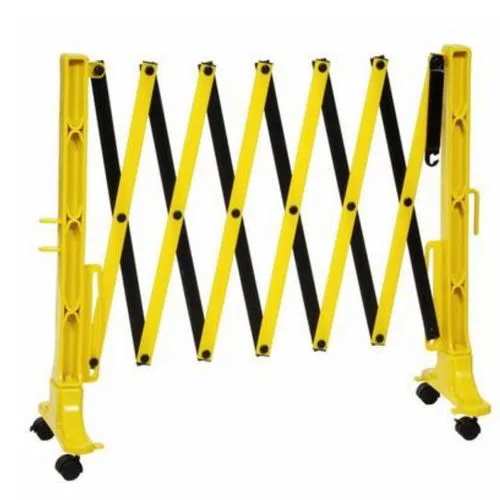
Most companies think about pedestrian barriers too late.
The usual sequence goes something like this:
A warehouse opens.
A factory expands.
A logistics yard gets busier.
People start moving through the space in whatever way feels convenient.
Then, after a near-miss, a safety audit, or a growing concern about traffic flow, someone says:
"We should probably install some pedestrian barriers."
The barriers arrive.
The walkways are marked.
The problem is supposedly solved.
Except sometimes it isn't.
Because barriers themselves don't create safer walkways.
Good layout planning does.
And that distinction matters.
A poorly planned barrier system can create confusion, congestion, bottlenecks, and even new hazards. A well-planned system, on the other hand, quietly transforms how people move through a space without them even noticing.
That's why the most effective pedestrian barrier systems—whether installed in warehouses, manufacturing facilities, shopping centres, parking structures, or logistics yards—begin with a question that has nothing to do with barriers:
How do people naturally move through this environment?
Only then should the barrier design begin.
The Biggest Mistake in Walkway Design
Here's an uncomfortable truth.
People rarely use the routes that designers think they should use.
They use the routes that feel easiest.
You can see this everywhere.
University campuses often have dirt paths cutting across grass because students ignored the official sidewalks.
Retail customers rarely follow ideal traffic patterns.
Warehouse staff develop shortcuts within weeks of a layout change.
Humans are efficiency-seeking creatures.
If the safest route is significantly less convenient than the fastest route, many people will choose the faster option.
Not because they're careless.
Because they're human.
This is why effective pedestrian barrier planning starts with behavioural observation rather than engineering drawings.
Before Installing Barriers, Watch the Movement
One of the smartest things a facility manager can do is simply observe.
Not for five minutes.
For several days.
Watch:
- where people naturally walk
- where vehicles frequently travel
- where congestion occurs
- where near-misses happen
- where shortcuts emerge
These observations often reveal something surprising.
The real movement patterns are rarely identical to the official movement patterns.
And designing barriers around reality rather than assumptions is often the difference between a successful project and an expensive frustration.
Think Like a Traffic Engineer, Not a Safety Officer
This may sound strange, but pedestrian barrier layout planning has a lot in common with city planning.
Good cities don't work because roads exist.
They work because movement is predictable.
Drivers know where vehicles are likely to be.
Pedestrians know where crossings are located.
Traffic flows because expectations are aligned.
Industrial and commercial spaces function the same way.
The objective isn't simply to separate people and vehicles.
It's to create movement systems that are intuitive.
When people have to stop and think about where they should walk, the design has already lost some effectiveness.
The Four Questions Every Barrier Layout Should Answer
Before placing a single barrier, ask:
1. Where Do Pedestrians Need to Go Most Often?
Not occasionally.
Not theoretically.
Most often.
Look at:
- entrances
- break rooms
- offices
- loading areas
- workstations
- parking facilities
These destinations create the primary movement routes.
The safest path should also be the most practical path.
Otherwise people will create their own.
2. Where Are Vehicles Most Active?
Vehicle traffic is rarely distributed evenly.
Some areas become natural hotspots:
- forklift intersections
- loading bays
- dispatch zones
- delivery entrances
- turning areas
These zones often deserve the strongest separation measures.
Not because they're dangerous by default.
Because they're busy.
And activity creates risk.
3. Where Is Visibility Limited?
Some locations create risk even when traffic volumes are relatively low.
Think about:
- blind corners
- shelving intersections
- machinery zones
- parked vehicle areas
- narrow corridors
A pedestrian walkway that passes through a visibility problem often requires additional protection, such as:
- pedestrian barriers
- convex mirrors
- controlled crossing points
The goal is to remove surprises from the environment.
4. Where Are People Likely to Ignore the Design?
This might be the most important question.
Every facility has temptation zones.
Places where employees are likely to think: "It's quicker if I just cut through here."
Good layout planning identifies these locations in advance.
And then removes the temptation.
The Concept of "Desire Lines"
Urban planners use a fascinating concept called a desire line.
A desire line is the route people naturally prefer to take, regardless of the route that was originally designed. You can often spot them as worn paths across grass.
Industrial facilities have desirable lines too.
They appear as:
- unofficial shortcuts
- frequently crossed vehicle lanes
- worn floor areas
- recurring near-miss locations
Rather than fighting desire lines, smart barrier planning works with them.
The safest route should align with natural movement whenever possible.
Otherwise the environment creates a constant battle between safety and convenience.
And convenience usually wins.
Case Study Logic: The Warehouse Walkway Nobody Used
A distribution facility installed new pedestrian walkways after a safety review.
The design looked excellent on paper.
Clearly marked routes.
Protective barriers.
Dedicated crossings.
Yet employees kept bypassing the system.
Management initially assumed it was a compliance issue.
It wasn't.
The problem was distance.
The designated route added several minutes to routine tasks.
Workers responded exactly as humans tend to respond.
They found shorter alternatives.
The facility eventually redesigned the layout by studying actual movement patterns.
The updated barrier system aligned safety routes with operational realities.
Almost immediately:
- shortcutting decreased
- compliance improved
- congestion reduced
Not because enforcement increased.
Because the design became practical.
Fixed vs Flexible Walkway Planning
Another factor often overlooked is how dynamic the environment is.
Some spaces are highly stable.
Others evolve constantly.
Stable Environments
Examples:
- manufacturing facilities
- production lines
- permanent storage areas
These environments benefit from:
- fixed pedestrian barriers
- long-term walkway layouts
- permanent movement zones
Consistency becomes a strength.
Dynamic Environments
Examples:
- logistics hubs
- seasonal warehousing
- temporary event facilities
These environments often benefit from:
- modular barriers
- adjustable layouts
- scalable pedestrian routes
Flexibility becomes more valuable than permanence.
The key is matching the barrier strategy to the operational reality.
Why Crossings Deserve Special Attention
Most incidents don't happen in walkways.
They happen where walkways interact with something else.
Crossings deserve disproportionate attention because they represent decision points.
At crossings:
- pedestrians assess vehicle movement
- operators assess pedestrian movement
- visibility becomes critical
- reaction times matter
Good crossing design often includes:
- narrowed crossing zones
- physical channelling
- visibility enhancements
- clear visual distinction
The fewer variables involved, the safer the interaction becomes.
The Hidden Productivity Benefit of Good Layout Design
Here's something many businesses don't expect.
Well-planned pedestrian barriers often improve efficiency.
Not because workers move faster.
Because they move with less hesitation.
When pathways are:
- obvious
- predictable
- protected
People spend less time:
- waiting
- second-guessing
- navigating around obstacles
- negotiating shared spaces
Movement becomes smoother.
And smooth movement supports productivity.
Designing for Five Years, Not Five Months
One of the biggest planning mistakes is designing solely for current conditions.
Industrial and commercial environments evolve.
Traffic volumes increase.
Storage requirements change.
Operations expand.
A walkway system that works perfectly today may become strained in two years.
Good barrier planning considers:
- future growth
- operational expansion
- increased vehicle traffic
- changing workforce numbers
In many cases, slightly over-planning today prevents major redesign costs later.
The Best Pedestrian Barrier Layouts Feel Invisible
This might sound contradictory.
But the best pedestrian barrier systems are often the ones people stop noticing.
Not because they disappear.
Because they become intuitive.
People know where to walk.
Vehicle operators know where pedestrians will be.
Movement feels natural.
When a layout achieves that level of predictability, the barriers have succeeded.
They are no longer directing behaviour.
They are supporting it.
Key Takeaways
- Effective pedestrian barrier systems begin with movement analysis, not product selection.
- People naturally follow the most convenient route, not always the intended route.
- Observing real-world movement patterns helps create more effective walkway designs.
- Desire lines often reveal how employees actually move through a facility.
- Vehicle hotspots and visibility challenges should heavily influence barrier placement.
- Crossings require special attention because they are key interaction points.
- Well-designed barrier systems improve both safety and operational efficiency.
- Future growth should be considered when planning walkway infrastructure.
FAQ
1. What is the purpose of pedestrian barrier layout planning?
The goal is to create safe, predictable pedestrian routes that minimise interaction with vehicles and other workplace hazards.
2. Why do some pedestrian barrier systems fail?
Many fail because they are designed around assumptions rather than actual movement patterns.
3. What are desired lines in walkway planning?
Desire lines are the routes people naturally choose to take, even if they differ from the intended pathway.
4. How do pedestrian barriers improve workplace safety?
They physically guide pedestrian movement, reduce shortcuts, and separate people from vehicle traffic.
5. Should pedestrian walkways always be permanent?
Not necessarily. Dynamic environments may benefit more from modular and adaptable barrier systems.
6. Can barrier layout planning improve productivity?
Yes. Predictable movement reduces congestion, hesitation, and unnecessary interactions between pedestrians and vehicles.
Conclusion
Pedestrian barriers are often viewed as safety products.
In reality, they are movement-management tools.
The difference is important.
A barrier installed without planning may create a boundary. A barrier system designed around real movement patterns creates something far more valuable: a safer, more predictable environment.
The most successful industrial and commercial spaces don't simply separate people from vehicles. They understand how people naturally move, then build infrastructure that supports those behaviours safely.
When that happens, barriers stop feeling restrictive.
They start feeling invisible.
And that's usually the sign of a design that works.
Design Smarter Walkways with SafetyXpress
SafetyXpress supplies traffic and industrial safety equipment in South Africa, including RoadQuip pedestrian barriers, Big Foot barriers, convex mirrors, road signage, and workplace safety solutions designed to improve pedestrian flow and reduce operational risk.
👉 Explore SafetyXpress solutions to create safer, more efficient walkways that support both workplace compliance and long-term operational performance.