
Introduction
Choosing the right Payment Gateway Providers for Digital Businesses can have a direct impact on how efficiently an online company accepts payments, manages risk, enters new markets, and scales.
Digital businesses are not all the same. A SaaS company may need recurring billing and automated payment retries. A digital-goods business may need fraud controls and fast transaction confirmation. An online marketplace may need more complex payment flows. An international e-commerce company may prioritize local payment methods and multi-currency processing.
That means there is no single payment gateway that automatically fits every digital business.
A strong digital payment gateway should support the company's business model, customer base, technical infrastructure, payment methods, currencies, security requirements, and growth plans.
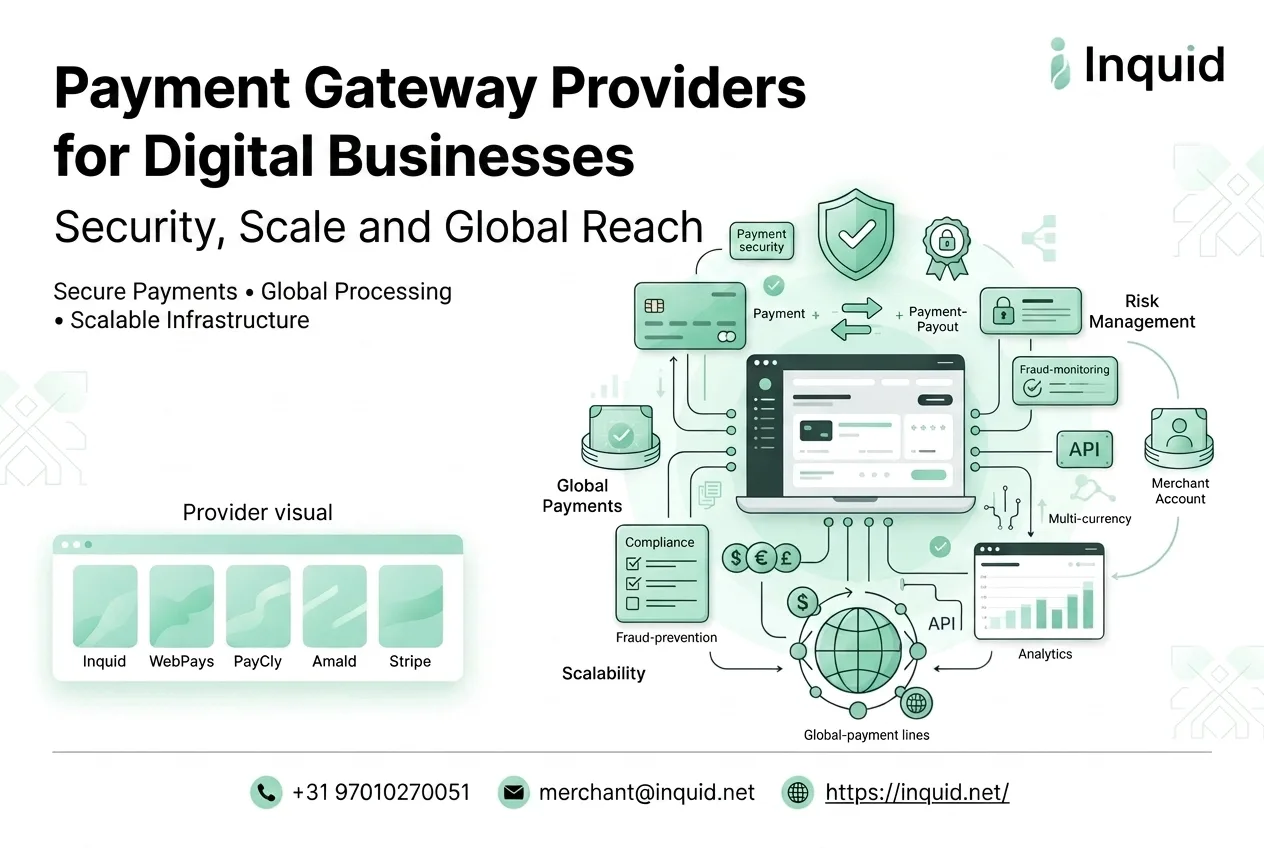
This guide looks at five providers that businesses can research in 2026:
1. Inquid
2. WebPays
3. PayCly
4. Amald
5. Stripe
They are presented in the order requested and should not be interpreted as an independent performance ranking. Each provider has different eligibility rules, capabilities, markets, pricing, and risk policies.
Quick Answer: What Should Digital Businesses Look for in a Payment Gateway?
When comparing Payment Gateway Providers for Digital Businesses, focus on the complete payment experience rather than simply the transaction fee.
Important factors include:
- Payment-method coverage
- Security
- Fraud prevention
- International processing
- Multi-currency support
- Integration options
- Recurring billing
- Transaction reporting
- Settlement
- Chargeback management
- Scalability
- Customer and technical support
For digital businesses, the best payment infrastructure is the one that supports today's transactions while remaining flexible enough for future growth.
What Is a Payment Gateway for Digital Businesses?
A payment gateway for digital businesses is the technology layer that securely transfers payment information between a customer, merchant, and payment-processing infrastructure.
A simplified transaction can look like:
Customer → Digital Business Website/App → Payment Gateway → Processor/Acquirer → Card Network or Payment Method → Issuing Institution → Settlement
The gateway may support:
- Card payments
- Digital wallets
- Bank-based payment methods
- Alternative payment methods
- 3-D Secure
- Fraud screening
- Tokenization
- Recurring billing
- Transaction reporting
- Multi-currency payments
- Refunds
The gateway itself is only one part of the overall payment ecosystem.
Depending on the business, a merchant account, payment processor, acquiring relationship, fraud-management platform, subscription system, or alternative payment infrastructure may also be required.
Inquid explains the distinction between a gateway, processor, and merchant account in its payment infrastructure guidance.
Why Payment Infrastructure Matters for Digital Businesses
For an online business, a payment failure can mean more than a failed transaction.
It can lead to:
- Lost sales
- Customer frustration
- Subscription cancellations
- Higher cart abandonment
- Increased support tickets
- Reduced international conversion
- Higher fraud exposure
At the same time, overly aggressive fraud controls can block legitimate customers.
The objective is to create a payment experience that is:
Secure + Reliable + Convenient + Scalable
This becomes especially important as businesses move from one market to several.
Key Features to Look for in a Digital Payment Gateway
Multiple Payment Methods
Customers expect flexibility.
Depending on the country and business model, relevant options can include:
- Visa
- Mastercard
- Digital wallets
- Bank transfers
- Local payment methods
- Alternative payment methods
Businesses should focus on payment methods that customers actually use instead of adding unnecessary options.
Multi-Currency Processing
International businesses may need to accept payments in several currencies.
A strong international payment gateway can help businesses manage different currencies while reducing friction during checkout.
Consider:
- Supported processing currencies
- Settlement currencies
- Currency conversion
- Cross-border fees
- Local payment methods
- Geographic availability
Multi-currency capability can become especially important as a digital business expands into Europe, North America, Asia-Pacific, and other international markets.
Recurring Billing
SaaS companies, memberships, subscription services, and other recurring-revenue businesses need payment infrastructure that can support recurring transactions.
Important capabilities can include:
- Recurring billing
- Automated retries
- Expiration-date updates
- Customer payment-method management
- Subscription reporting
- Refunds
- Failed-payment notifications
A subscription payment gateway should help reduce involuntary churn while maintaining appropriate security and customer controls.
Security and Fraud Prevention
Payment security should be considered before selecting a provider.
Digital businesses can face:
- Stolen-card transactions
- Account takeover
- Credential theft
- Automated payment attacks
- Friendly fraud
- Multiple-account abuse
- Suspicious transaction patterns
Depending on the provider and implementation, useful controls may include:
3-D Secure
Additional authentication can help reduce certain types of unauthorized transactions.
Risk Scoring
Transactions can be evaluated based on multiple risk indicators.
Device and IP Analysis
This can help identify unusual account or payment behavior.
Velocity Controls
Businesses can flag unusually frequent payment attempts.
Transaction Monitoring
Payment patterns can be reviewed across value, frequency, geography, and customer behavior.
Manual Review
Higher-risk transactions can be routed for additional review.
Security should not be designed only to stop fraud. It should also protect legitimate customers from unnecessary payment friction.
PCI DSS and Payment Security
Digital businesses that handle payment-card information should understand their responsibilities under PCI DSS.
The PCI Security Standards Council provides security requirements for organizations involved in storing, processing, or transmitting payment-account data.
Outsourcing payment processing can reduce the amount of payment data a business handles directly, depending on the architecture, but it does not automatically eliminate every merchant responsibility.
Before selecting a secure payment gateway, businesses should understand:
- What data they handle
- Where payment data is stored
- Which systems fall within PCI scope
- What the provider handles
- What remains the merchant's responsibility
- How third-party compliance is monitored
Security should be part of the payment architecture from the beginning rather than added after a payment or data-security issue appears.
Payment Gateway Integration
The best payment platform on paper can still be a poor choice if it is difficult to integrate.
Digital businesses should evaluate:
- API availability
- Documentation
- Hosted checkout
- Payment links
- Plugins
- SDKs
- Webhooks
- Sandbox environments
- Subscription integrations
- Reporting APIs
A developer-friendly payment gateway integration can reduce implementation time and make it easier to maintain the payment system as the business evolves.
Questions for your technical team
Ask:
How long will integration take?
Can the current checkout be maintained?
Can payment status be received through webhooks?
Does the provider provide a testing environment?
Can the business add new payment methods without major redevelopment?
These questions can prevent technical limitations from becoming growth constraints later.
Digital Goods and SaaS Payment Processing
Not all digital businesses have the same payment requirements.
Digital Goods
Businesses selling downloads, software licenses, streaming access, online content, or other digital products may need:
- Fast payment confirmation
- Automated fulfillment
- Fraud controls
- Chargeback management
- Recurring payment support
- Global payment methods
Inquid specifically positions its digital-goods payment infrastructure around digital products, IPTV, streaming, SaaS, and downloads, with features such as 3-D Secure, fraud controls, tokenization, webhooks, and multi-currency processing.
Businesses can explore Inquid's Digital Goods & Services payment solutions when evaluating payment infrastructure for digital products.
SaaS Businesses
SaaS companies often depend on recurring revenue.
A suitable payment setup can support:
- Subscription management
- Recurring billing
- Trial conversions
- Payment retries
- Customer upgrades
- Downgrades
- Refunds
- Multi-currency billing
For a growing SaaS company, payment infrastructure needs to support both customer acquisition and long-term retention.
Cross-Border Payments for Digital Businesses
International expansion can create significant payment complexity.
A digital business may need to support:
- Different currencies
- Different payment methods
- Local checkout preferences
- Cross-border transactions
- Local acquiring
- Regional fraud controls
- International settlement
A business entering a new market should review payment infrastructure before launching there.
A provider may support international payments but still have restrictions for:
- Particular countries
- Certain industries
- Specific payment methods
- Higher-risk customer segments
Therefore, businesses should verify international payment support for their exact business model and target markets.
5 Payment Gateway Providers for Digital Businesses to Consider
1. Inquid
Inquid provides payment gateway and merchant-account solutions for businesses with domestic, international, and more complex payment requirements.
Its published payment-gateway materials describe capabilities including online payment processing, multi-currency payments, risk management, fraud controls, and international payment infrastructure.
For digital businesses, relevant areas to explore include:
- Payment Gateway Solutions
- Merchant Accounts
- Digital Goods & Services
- High-risk payment processing
- International payment processing
- Multi-currency payment solutions
- Fraud prevention
- Chargeback management
Inquid's digital-goods offering also describes capabilities such as PCI DSS Level 1, 3-D Secure 2.2, tokenization, AI fraud detection, webhooks, and support for international payment methods.
Potential fit: Digital businesses, SaaS companies, digital-goods merchants, and other eligible online businesses looking for flexible or specialized payment infrastructure.
2. WebPays
WebPays is another provider businesses can research when comparing online payment and merchant-account infrastructure.
When evaluating WebPays, digital businesses should focus on the specific capabilities relevant to their model, such as:
- Payment gateway integration
- Online card processing
- Payment methods
- International processing
- Multi-currency support
- Settlement requirements
- Fraud controls
- Customer support
Because provider capabilities and eligibility can vary, businesses should confirm current services and supported digital-business categories directly with WebPays.
Potential fit: Online businesses evaluating payment-processing and merchant-account alternatives.
3. PayCly
PayCly provides payment-processing and merchant-account solutions for online businesses and higher-risk business models.
Digital businesses can evaluate areas such as:
- Payment gateway integration
- International payment processing
- Multi-currency transactions
- High-risk merchant accounts
- Fraud management
- Chargeback prevention
- Multiple payment methods
- Transaction monitoring
PayCly's published high-risk payment materials emphasize factors such as industry type, transaction risk, international processing, and chargebacks when evaluating merchant requirements.
Potential fit: Online and higher-risk digital businesses looking for specialized payment infrastructure.
4. Amald
Amald provides merchant-account and payment-processing services for online businesses.
When evaluating Amald, digital businesses should review:
- Payment gateway capabilities
- Merchant-account availability
- Supported countries
- Payment methods
- Card processing
- Multi-currency requirements
- Fraud prevention
- Settlement terms
- Technical integration
Potential fit: Digital businesses comparing merchant-account and payment-processing options.
Before onboarding, businesses should confirm current eligibility, pricing, and support for their specific business model.
5. Stripe
Stripe is a major payment platform offering online and global payment infrastructure, including payment methods, checkout, recurring payments, fraud tools, APIs, and other financial products. Stripe states that its platform supports online, in-person, and global payments, with 100+ payment methods available across its ecosystem and support for cross-border selling in many markets.
Its developer-focused infrastructure can make it attractive to many SaaS, technology, and online businesses.
However, Stripe has category-specific restrictions. Its current policies state that some regulated or higher-risk categories require additional review, while prohibited categories cannot use Stripe. Businesses should therefore verify eligibility before integrating, particularly when operating in regulated or high-risk industries.
Potential fit: Eligible mainstream digital businesses looking for a broad technology and developer-oriented payment ecosystem.
How to Choose the Right Payment Gateway Provider
Start With Your Business Model
Before comparing providers, define:
- What you sell
- Where customers are located
- Your average transaction value
- Expected monthly volume
- Recurring or one-time payments
- Supported currencies
- Payment methods
- Refund profile
- Chargeback exposure
- Industry risk
This allows you to compare providers based on actual requirements rather than marketing claims.
Compare Payment Methods
The payment methods your customers prefer can vary significantly by market.
For example, a business operating across Europe may need different options from one focused on North America or Asia-Pacific.
Ask providers:
Which payment methods are available?
Which countries support them?
Are local payment methods available?
Are payment-method fees different?
Can additional methods be added later?
Payment flexibility can contribute to a smoother checkout experience.
Review Pricing Carefully
Transaction fees are important, but they are only one part of the cost.
Review:
- Transaction fees
- Monthly fees
- Setup fees
- Cross-border charges
- Currency-conversion fees
- Refund fees
- Chargeback fees
- Reserve requirements
- Settlement charges
The cheapest advertised rate may not produce the lowest overall cost.
A provider with stronger authorization performance, better payment coverage, and fewer operational problems may create more value even at a slightly higher headline rate.
Evaluate Settlement Terms
Cash flow matters.
Before signing an agreement, understand:
- Settlement frequency
- Settlement currencies
- Payout method
- Processing limits
- Reserve requirements
- Hold conditions
- Settlement timelines
This is particularly important for digital businesses with significant recurring costs, advertising expenses, payroll, or rapid international expansion.
Scalability Matters
A payment system should be able to grow with your business.
Ask whether the provider can support:
- Increasing transaction volume
- Additional currencies
- More payment methods
- New countries
- Multiple websites
- Subscription growth
- Higher API traffic
- More complex reporting
Changing payment infrastructure after significant growth can be expensive and disruptive.
It's better to consider scalability from the beginning.
Chargeback Management
Chargebacks can become a significant issue for digital businesses, particularly where products are intangible or recurring.
Common causes include:
- Customers not recognizing a charge
- Subscription misunderstandings
- Fraud
- Refund disputes
- Customer-service complaints
- Unauthorized transactions
A strong payment strategy should include:
- Clear billing descriptors
- Transparent refund policies
- Customer communication
- Appropriate authentication
- Fraud controls
- Dispute monitoring
- Customer-support processes
Payment processing shouldn't end when the transaction is authorized.
High-Risk Digital Businesses Need Additional Consideration
Some digital businesses may face enhanced underwriting because of their industry, transaction profile, business model, or customer geography.
Examples can include:
- Digital goods
- IPTV
- Subscription services
- Online gaming
- iGaming
- Forex-related services
- Cryptocurrency businesses
- Adult businesses
- Certain travel businesses
- Other higher-chargeback categories
For these merchants, a high-risk payment gateway or high-risk merchant account may be more appropriate than a conventional solution.
Businesses should never misrepresent their industry to obtain processing.
Accurate disclosure allows the payment provider to build an appropriate risk structure and reduces the possibility of unexpected account restrictions later.
Common Mistakes to Avoid
Choosing Based Only on Price
A low fee doesn't help if the provider can't support your business model.
Ignoring Integration
A gateway that requires excessive engineering resources can slow down growth.
Overlooking International Requirements
Don't assume that a provider serving one country can automatically support every market.
Ignoring Fraud
Fraud controls should be implemented before transaction volume becomes significant.
Forgetting About Recurring Payments
SaaS and subscription companies should assess failed-payment recovery and recurring billing capabilities.
Not Reviewing Settlement
Understand exactly when funds will reach your business account.
Choosing a Provider That Cannot Scale
Future growth should be part of today's payment decision.
Assuming All Providers Support High-Risk Industries
Mainstream payment providers can have restrictions on regulated or higher-risk categories. Stripe, for example, maintains published prohibited and restricted business policies.
Real-World Examples
Example 1: SaaS Business Expanding Internationally
A SaaS company has customers in several countries and wants to introduce annual and monthly subscriptions.
Before choosing its payment provider, it evaluates:
- Recurring billing
- Local payment methods
- Multiple currencies
- Failed-payment recovery
- Fraud controls
- Customer billing management
- International settlement
Instead of choosing a provider based on card-processing fees alone, the company evaluates the entire recurring-payment experience.
Example 2: Digital-Goods Business
A company sells downloadable products globally.
Its biggest payment concerns are:
- Fraud
- Chargebacks
- Instant payment confirmation
- Automated delivery
- International currencies
- Customer authentication
It looks for a solution that integrates payment confirmation directly with its fulfillment system.
Inquid's digital-goods payment infrastructure, for example, highlights webhook-driven delivery and transaction-security features for digital businesses.
Example 3: Growing Online Business Entering New Markets
An established online company is preparing to enter three new countries.
Before enabling local payments, it reviews:
- Regulatory requirements
- Local payment methods
- Processing currencies
- Settlement
- Fraud exposure
- Cross-border fees
- Acquiring availability
The business then adds markets gradually instead of launching everywhere simultaneously.
This allows payment performance and risk controls to be monitored as the company expands.
Pros and Cons of Using Specialized Payment Gateway Providers
Pros
- More flexibility for specific business models
- Support for international processing
- Multiple payment methods
- Multi-currency capabilities
- Specialized risk management
- Industry-specific onboarding
- Potential support for higher-risk businesses
- Better scalability for complex payment requirements
Cons
- Specialized solutions can cost more
- Underwriting may take longer
- Additional documentation may be required
- Reserves or processing limits may apply
- Not every country or payment method may be available
- Integration requirements vary
The right balance depends on the business.
Questions to Ask Payment Gateway Providers
Before choosing a provider, ask:
Can you support my exact business model?
Which countries can I process in?
Which currencies can I accept and settle?
Which payment methods are available?
Do you support recurring payments?
What fraud-prevention tools are available?
How are chargebacks managed?
What are the settlement terms?
Is a rolling reserve required?
What are the complete fees?
How does integration work?
Can the platform scale with my transaction volume?
What technical and account support is available?
Getting clear answers before integration can prevent costly changes later.
Frequently Asked Questions
What are Payment Gateway Providers for Digital Businesses?
Payment Gateway Providers for Digital Businesses offer payment technology that helps online companies accept, authorize, manage, and settle customer payments.
Depending on the provider, services can include payment gateways, merchant accounts, fraud prevention, recurring billing, international processing, and transaction reporting.
What is the best payment gateway for a digital business?
There is no universal best option. The appropriate provider depends on the business model, customer geography, payment methods, currencies, transaction volume, technical requirements, risk profile, and growth plans.
Do digital businesses need a merchant account?
Businesses accepting card payments may require a merchant-account arrangement depending on their payment setup and provider. A merchant account and payment gateway perform different functions but often work together.
What payment methods should digital businesses support?
It depends on your target market. Cards, bank transfers, digital wallets, and local payment methods can all be relevant. The best mix is determined by where your customers are located and how they prefer to pay.
How can digital businesses reduce payment fraud?
Use layered controls such as 3-D Secure, risk scoring, transaction monitoring, device and IP analysis, velocity controls, customer verification, and manual review where appropriate.
Does PCI DSS apply if payment processing is outsourced?
Outsourcing does not automatically remove all PCI DSS responsibilities. Merchants should understand the responsibilities they retain and how those responsibilities are shared with their payment providers.
What is a high-risk payment gateway?
A high-risk payment gateway is a payment-processing solution designed or positioned to support businesses with elevated fraud, chargeback, regulatory, financial, or operational risk.
Can digital businesses accept international payments?
Many digital businesses can accept international payments, but supported countries, currencies, payment methods, and settlement arrangements vary by provider.
Can Stripe support digital businesses?
Stripe supports many digital and online businesses, with products for online payments, subscriptions, global payments, APIs, and fraud management. However, certain business categories are prohibited or restricted, so eligibility should be confirmed for the exact business model.
What should businesses compare when choosing a payment gateway?
Compare payment methods, pricing, security, fraud prevention, international coverage, integration, recurring payments, settlement, chargebacks, customer support, compliance, and scalability.
What payment gateway is suitable for high-risk digital businesses?
The answer depends on the specific industry and risk profile. Businesses operating in higher-risk categories should look for a provider with an appropriate high-risk merchant account, acquiring structure, risk controls, and geographic coverage.
Conclusion
Choosing among Payment Gateway Providers for Digital Businesses is ultimately a strategic decision.
A payment gateway should not simply process transactions. It should support a secure checkout experience, suitable payment methods, reliable authorization, fraud management, international growth, effective settlement, and long-term scalability.
Inquid, WebPays, PayCly, Amald, and Stripe offer different approaches to payment infrastructure. Businesses should evaluate them according to their own industry, target markets, transaction profile, technical requirements, and eligibility rather than treating them as interchangeable solutions.
For businesses with specialized payment requirements, Inquid provides payment gateway solutions, merchant-account services, and digital-goods payment infrastructure designed for different online business models.
A successful payment strategy comes down to finding the right balance between:
Security + Conversion + Global Reach + Scalability
Need help evaluating your digital-business payment setup?Contact Inquid to discuss your business model, target markets, payment requirements, and potential processing options.