Decentralized finance (DeFi) is creating new opportunities for businesses interested in blockchain-based financial applications. Decentralized exchanges allow users to swap supported tokens through smart contracts and liquidity pools, providing an alternative to conventional exchange models.
For entrepreneurs planning to enter this space, a PancakeSwap Clone Script can serve as a starting point for developing a customized decentralized exchange. By evaluating existing software and adapting it to specific business requirements, businesses can plan a platform with token swapping, liquidity management, staking, yield farming, and other DeFi features.
What Is a PancakeSwap Clone Script?
A PancakeSwap Clone Script is software designed to help businesses develop a decentralized exchange inspired by common features of PancakeSwap. Depending on the solution and its implementation, it may include token swaps, liquidity pools, wallet integration, staking, yield farming, and token launch features.
A clone script should be understood as an independently developed or customizable software foundation, not as access to PancakeSwap's proprietary code or an official partnership with the platform.
Key Features of a PancakeSwap Clone Script
1. Token swapping
Token swapping enables users to exchange supported digital assets through the exchange's smart contracts and liquidity infrastructure. The interface should display relevant transaction details, estimated output, network fees, and price impact before a user confirms a transaction.
2. Automated market maker (AMM)
An automated market maker uses liquidity pools and a pricing mechanism to facilitate token swaps. Instead of relying exclusively on a traditional order book, users trade against available pool liquidity according to the protocol's rules.
AMM design, pricing formulas, and supported trading pairs should be selected according to the platform's requirements.
3. Liquidity pools
Liquidity pools allow eligible users to deposit token pairs under the protocol's rules. Liquidity providers may receive a share of eligible trading fees or other incentives, depending on the pool design.
Businesses should clearly communicate liquidity risks, including impermanent loss, smart-contract vulnerabilities, and changes in token prices.
4. Staking and yield farming
Staking and yield farming can provide additional ways to engage users. Depending on the implementation, participants may deposit eligible tokens or liquidity-provider tokens into contracts that distribute rewards.
Rewards are not guaranteed profits. Their availability and value depend on the protocol, token economics, market conditions, and other risks.
5. Digital wallet integration
Wallet integration allows users to connect compatible wallets, select supported networks, review transactions, and authorize on-chain actions. A good user experience should explain network requirements and transaction approvals clearly.
6. Customizable DeFi modules
Businesses may consider optional modules such as token launch features, governance voting, NFT marketplace functionality, or other decentralized finance tools. Every additional module introduces its own development, testing, and maintenance requirements.
How Does a PancakeSwap-Style DEX Work?
A typical decentralized exchange workflow includes these steps:
- A user connects a compatible wallet.
- The user selects the tokens and amount to exchange.
- The application retrieves a quote based on available liquidity and protocol rules.
- The user reviews the expected output, slippage, and transaction fees.
- The user approves the required transaction through the wallet.
- The smart contract executes the swap, subject to network conditions and contract logic.
The exact process varies depending on the blockchain, token permissions, smart-contract architecture, and exchange configuration.
Benefits of Using a DEX Clone Script
A suitable clone script may provide a development foundation that businesses can customize rather than creating every component from the beginning. It can also help teams evaluate existing workflows, define required integrations, and identify which features need additional engineering.
Before selecting a provider, review the source-code and licensing terms, supported networks, documentation, customization options, testing process, maintenance arrangements, and total cost of ownership.
Security Considerations for DeFi Exchange Development
Security is essential because smart-contract vulnerabilities and configuration errors can put digital assets at risk. Development teams should consider independent smart-contract audits, automated testing, access controls, secure wallet interactions, monitoring, incident response, and careful management of administrative privileges.
No software can be assumed to be completely secure. Businesses should also assess applicable legal and regulatory requirements in the jurisdictions where the platform will operate.
Why Consider Clarisco for PancakeSwap Clone Development?
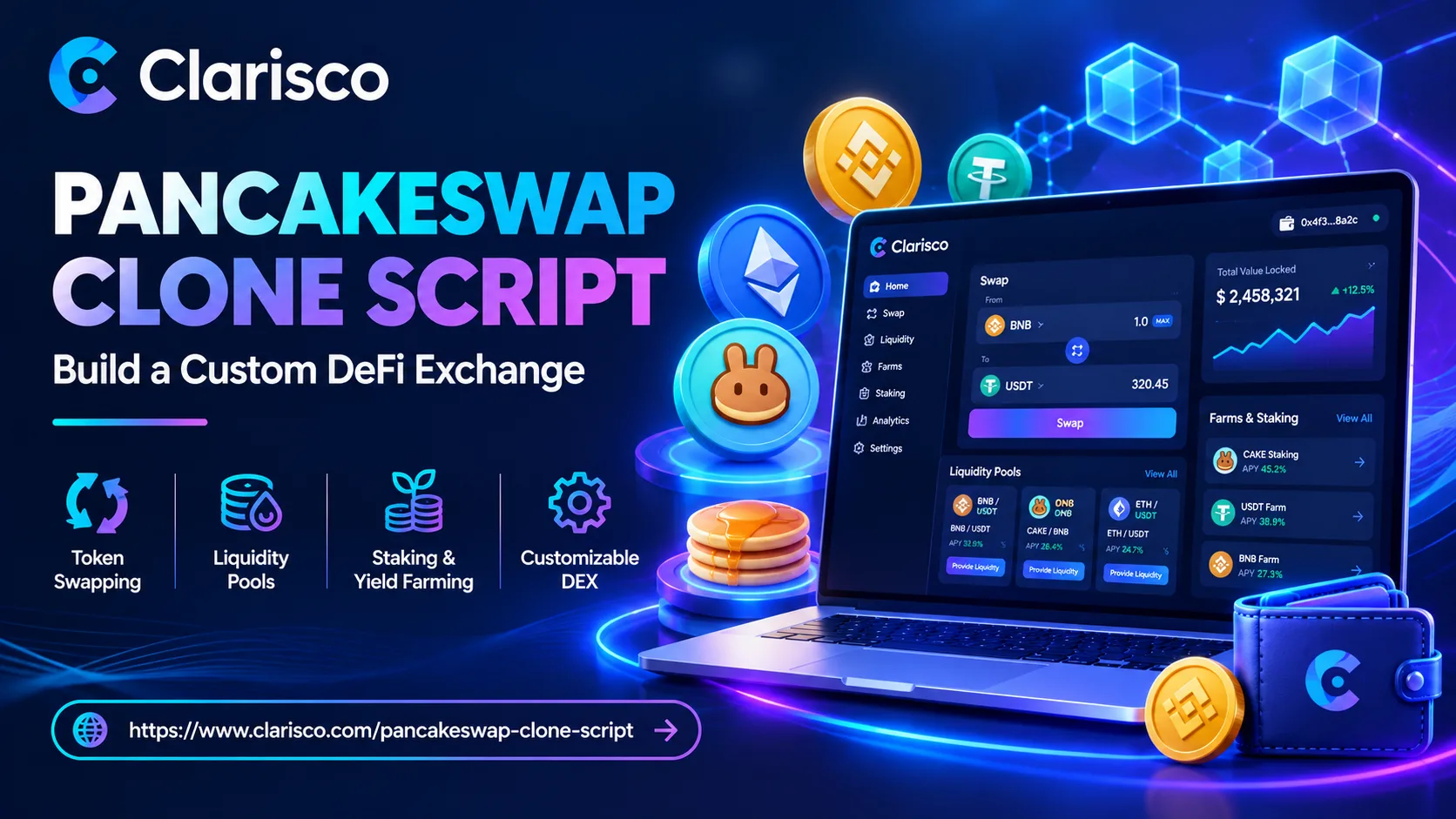
Clarisco provides a PancakeSwap Clone Script solution for businesses exploring customizable decentralized exchange software. Its page discusses features such as token swapping, AMM functionality, liquidity pools, staking, yield farming, and additional DeFi modules.
Businesses should confirm which features, networks, integrations, testing services, and customization options are included in their proposed project scope.
Explore the solution here: https://www.clarisco.com/pancakeswap-clone-script
Conclusion
Launching a decentralized exchange requires a clear product strategy, suitable blockchain infrastructure, well-designed smart contracts, and an understanding of DeFi risks. A PancakeSwap Clone Script can be one option for establishing a development foundation, provided the software matches the business's technical and operational needs.
Compare available solutions carefully, prioritize security and transparency, and select features based on your target audience rather than adding unnecessary complexity.
Frequently Asked Questions
1. What is a PancakeSwap Clone Script?
It is a software foundation for developing a decentralized exchange with features inspired by common DEX functionality, subject to the selected implementation.
2. What features can a PancakeSwap-style DEX include?
Possible features include token swapping, AMM functionality, liquidity pools, wallet integration, staking, yield farming, and governance tools.
3. What is an automated market maker?
An AMM uses liquidity pools and a pricing mechanism to enable token swaps without relying solely on a traditional order book.
4. Can a PancakeSwap clone support different blockchains?
That depends on the software architecture and integrations. Each supported network may require separate deployment, configuration, and testing.
5. How does a decentralized exchange generate revenue?
Potential models include trading fees and optional paid services. The actual model depends on protocol design, operating costs, user demand, and applicable regulations.
6. How much does PancakeSwap Clone Development cost?
Costs vary with feature complexity, blockchain integrations, smart-contract development, security reviews, interface design, and ongoing maintenance.
7. Is a clone script automatically secure?
No. Security depends on the implementation, code quality, testing, deployment configuration, and ongoing monitoring. Independent audits can help identify vulnerabilities but cannot guarantee their absence.