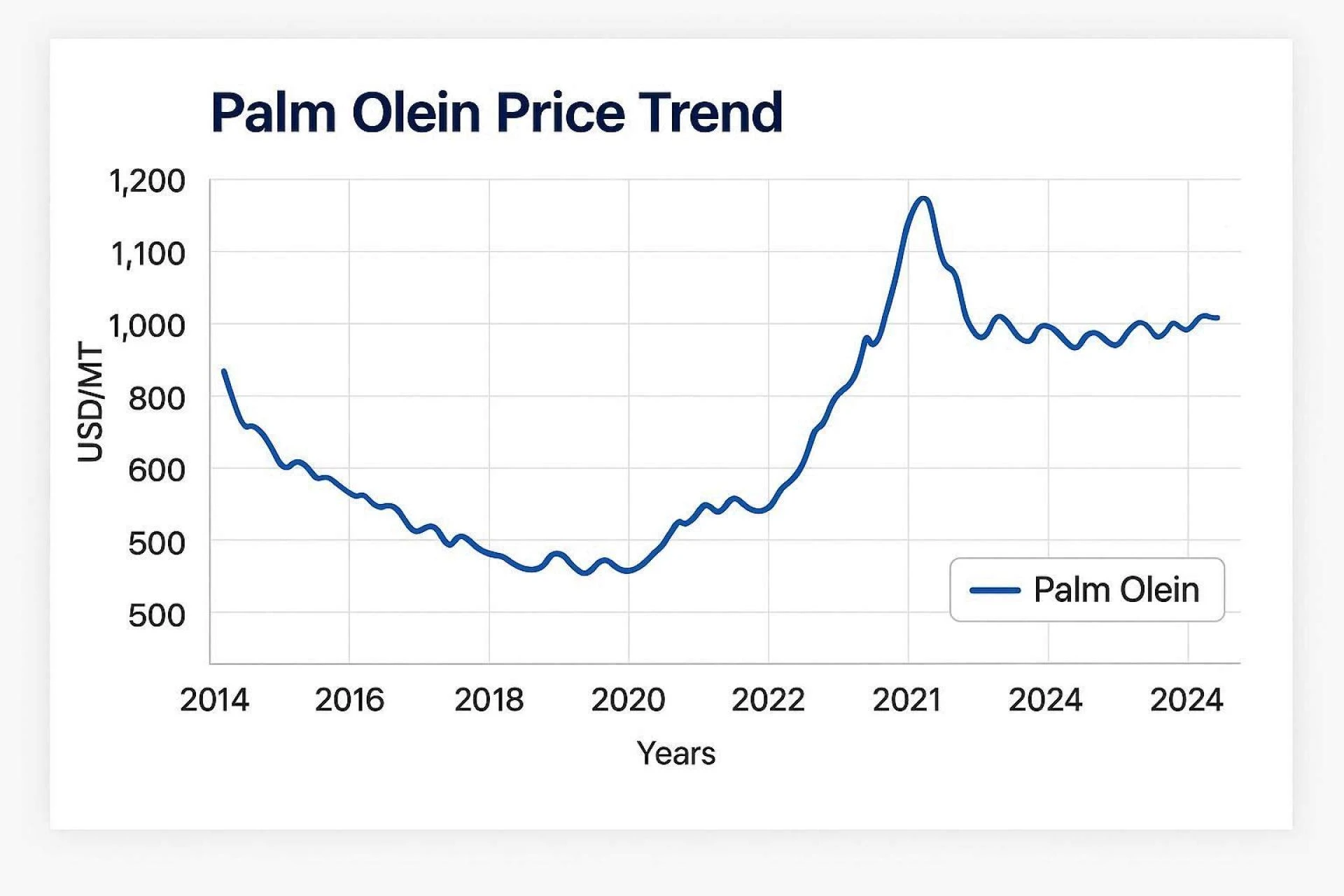
Palm Olein price trend has been shaped by fluctuations in crude palm oil supply, shifting export policies, and evolving food industry demand. Short-term price direction reflects tight supply dynamics and logistics costs, while demand from edible oil markets continues to influence stability. Over the next two years, prices are expected to remain sensitive to agricultural output cycles and global trade developments.
Quick Summary
Palm Olein Price Trend – Key Highlights
- Prices respond strongly to crude palm oil production levels
- Export regulations from producing countries influence global supply
- Food processing and edible oil demand remain the largest consumption drivers
- Freight costs and currency movements affect import pricing
- Market outlook suggests moderate volatility in the near term
Market Snapshot
Palm Olein Market Data Overview
- Commodity: Palm Olein
- Primary Use: Edible oil, food processing, frying applications
- Major Producing Regions: Southeast Asia dominates global supply
- Demand Centers: Asia-Pacific, Middle East, and Africa
- Market Structure: Agricultural commodity with seasonal output cycles
- Price Volatility Level: Moderate
- Forecast Horizon Covered: 2-Year Outlook
This structured market data allows procurement teams and analysts to track the Palm Olein price trend with better visibility across supply chain movements.
What is the Palm Olein Price Trend?
The Palm Olein price trend refers to the historical and ongoing movement of Palm Olein prices across international commodity markets.
Palm Olein is the liquid fraction obtained after fractionation of crude palm oil. It is widely used as a cooking oil due to its stability at high temperatures and favorable fatty acid composition.
Production Process Overview
Palm Olein is produced through a multi-stage process:
- Harvesting fresh palm fruit bunches
- Extraction of crude palm oil
- Refining to remove impurities
- Fractionation separating Palm Olein from palm stearin
The resulting product has characteristics that make it suitable for both household consumption and commercial food processing.
Industrial Properties
Key characteristics include:
- High oxidative stability
- Neutral flavor profile
- Long frying life
- Balanced fatty acid composition
These properties support consistent global demand across the food and hospitality industries.
Supply Chain Structure
The Palm Olein supply chain typically involves:
- Plantation cultivation
- Oil milling and refining
- Bulk export through trading hubs
- Distribution to food manufacturers and retailers
Changes at any stage of this chain can influence the overall Palm Olein price trend.
Current Price Trend Analysis (2024–2026)
Recent market developments indicate that Palm Olein prices have been influenced by agricultural output conditions and international edible oil competition.
- Seasonal Production Cycles: Palm oil production follows seasonal harvesting patterns. Periods of lower output can tighten supply, influencing Palm Olein pricing in global markets.
- Export Policy Influence: Export policies from major producing countries can alter global supply availability. Restrictions or policy changes often create short-term price volatility.
- Demand Behavior: Demand from the food processing sector remains steady, particularly from emerging economies where Palm Olein is widely used for frying and packaged food manufacturing.
- Year-on-Year Market Comparison: Compared to previous market cycles, the Palm Olein market has experienced shifting demand patterns as buyers adjust procurement strategies in response to supply uncertainties.
Key Price Drivers
Raw Material Supply
Palm Olein pricing is closely tied to crude palm oil availability.
Supply fluctuation → Reduced production → Upward pressure on Palm Olein prices
Weather conditions, plantation yields, and harvesting productivity all affect supply levels.
Energy and Processing Costs
Palm oil refining and fractionation require energy-intensive processing.
Higher energy costs → Increased refining costs → Higher commodity pricing
Energy price volatility therefore indirectly impacts Palm Olein market pricing.
Industrial Demand
Palm Olein is widely used in:
- Food manufacturing
- Quick-service restaurants
- Packaged snack production
Rising consumption → Increased procurement → Price strengthening
Environmental Regulations
Sustainability policies and environmental standards are becoming increasingly influential.
Stricter environmental compliance → Higher production costs → Supply adjustments
These regulatory factors can influence long-term pricing dynamics.
Logistics and Freight
Global shipping conditions affect commodity trade.
Higher freight costs → Increased landed cost for importers → Price adjustments in destination markets
Geopolitical Factors
Trade relations and regional policy changes can impact edible oil trade flows.
Trade disruptions → Supply chain uncertainty → Increased price volatility
Regional Analysis
Asia-Pacific
Asia-Pacific dominates both production and consumption of Palm Olein.
Large populations and strong demand from food processing industries make the region a major price-setting market.
North America
Demand in North America is largely driven by food manufacturing and specialty cooking oil applications. Import pricing is influenced by freight costs and currency exchange movements.
Europe
European markets place strong emphasis on sustainability certifications and traceability standards, which can affect sourcing strategies and pricing structures.
Middle East
The Middle East represents a significant import market for edible oils due to limited domestic agricultural production. Palm Olein demand remains stable due to its affordability and functional properties.
Forecast & Outlook (2026–2027)
Short-Term Outlook
Over the next year, Palm Olein prices are expected to remain influenced by production cycles and export policies from key producing regions.
Market sentiment indicates moderate volatility as buyers balance procurement against supply uncertainties.
Medium-Term Outlook
Over the two-year forecast horizon:
- Demand from food processing industries is expected to remain stable
- Supply conditions will depend on plantation productivity
- Freight and logistics costs may continue to influence import markets
Overall directional bias: Stable with periodic volatility
Upside Risks
- Weather-related supply disruptions
- Export policy changes
- Rising global edible oil demand
Downside Risks
- Higher global vegetable oil supply
- Demand slowdown from food manufacturers
- Trade policy shifts affecting export flows
Strategic Procurement Insights
Procurement teams monitoring the Palm Olein price trend should consider the following strategies:
- Supplier Diversification: Working with suppliers across multiple producing regions reduces dependency on a single source.
- Contract Structuring: Balanced procurement contracts can help manage exposure to sudden price fluctuations.
- Inventory Timing: Strategic inventory planning during favorable market conditions can reduce procurement costs.
- Hedging Approach: Commodity hedging mechanisms may help protect against short-term price volatility.
- Risk Mitigation Framework
Procurement leaders should monitor:
- crop production reports
- export policies
- freight market changes
- global edible oil demand trends
These indicators often signal future price movements.
Request Latest Price Data
Procurement teams seeking detailed datasets, historical pricing analysis, or market intelligence insights can request the latest Palm Olein price information and downloadable reports.
FAQs
What is driving the Palm Olein price trend?
The Palm Olein price trend is primarily influenced by crude palm oil production, export policies from producing countries, global edible oil demand, and freight costs. Seasonal harvesting cycles and environmental regulations can also affect supply availability and market pricing.
Is Palm Olein price expected to rise in 2026?
Palm Olein prices may experience moderate volatility in 2026 due to supply-side agricultural factors and demand from food processing industries. Weather conditions, export regulations, and logistics costs will remain key determinants of price direction.
Which region offers the lowest Palm Olein pricing?
Regions closer to major producing countries generally experience lower procurement costs due to reduced logistics expenses. Import-dependent regions often see higher landed prices because of freight costs and supply chain margins.
Is Palm Olein a volatile commodity?
Palm Olein typically shows moderate price volatility. While agricultural output cycles influence supply, steady demand from food industries provides a degree of market stability.
Which industries monitor Palm Olein prices?
Industries closely tracking Palm Olein prices include food processing, snack manufacturing, restaurant chains, edible oil distributors, and packaged food producers. These sectors rely heavily on Palm Olein for frying and cooking applications.
How can buyers track Palm Olein price movements?
Commodity intelligence platforms, historical price databases, and market analytics tools are commonly used to track Palm Olein price movements. These tools allow procurement teams to analyze long-term trends and compare price behavior across regions.
Analyst Note
Author: Senior Commodity Market Analyst
Experience: 12+ years in global commodity market intelligence
Data Methodology:
Analysis is based on historical commodity market monitoring, supply chain evaluation, agricultural production trends, and global trade dynamics affecting Palm Olein markets.