
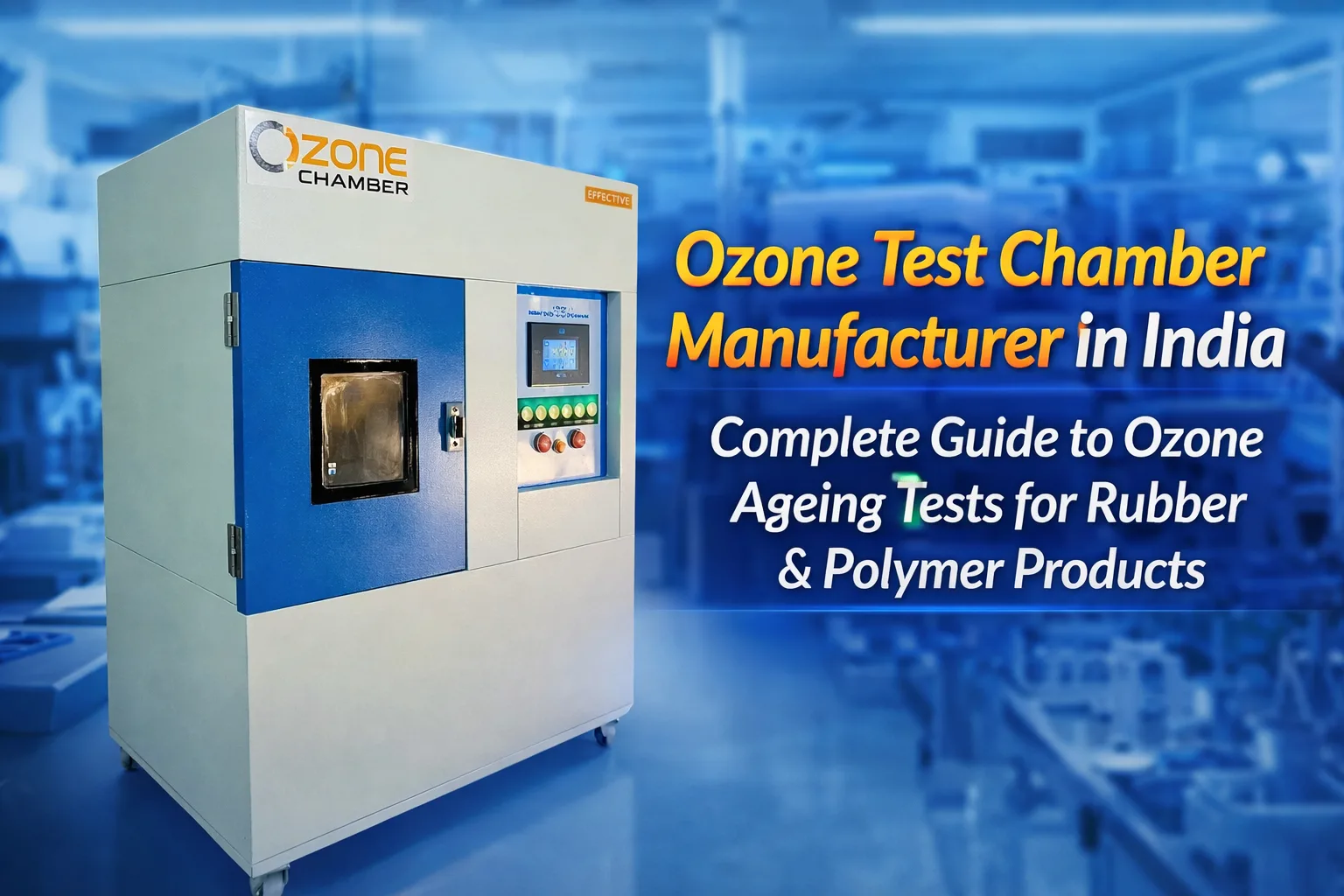
If your products contain rubber, elastomers, or polymer-based materials, ozone degradation is one of the most serious quality risks you face — and one of the most preventable. At Effective Lab India, we manufacture ozone test chambers that help quality control laboratories, rubber product manufacturers, and R&D teams across India simulate and measure the effects of ozone exposure quickly, accurately, and in full compliance with IS, ISO, and ASTM standards.
In this guide, we explain what an ozone test chamber is, how it works, which Indian industries need it most, which standards it supports, and what to look for when buying one. Whether you are setting up a new QC lab in Pune, upgrading ageing equipment in Chennai, or seeking NABL accreditation in Delhi NCR, this guide gives you the technical and commercial information you need to make the right decision.
What Is an Ozone Test Chamber and Why Does It Matter for Indian Manufacturers?
An ozone test chamber is a laboratory instrument that generates a controlled concentration of ozone gas inside an insulated, sealed enclosure and exposes rubber or polymer specimens to that atmosphere for a defined duration. The purpose is to accelerate the ozone ageing process — a degradation mechanism that causes surface cracking, loss of tensile strength, and eventual mechanical failure in rubber components — so that manufacturers can evaluate product durability in days rather than waiting months for real-world results.
India's rubber manufacturing sector is one of the largest in the world, with major hubs in Kerala, Tamil Nadu, Maharashtra, Gujarat, and Uttar Pradesh. Indian manufacturers export rubber components to automotive OEMs, cable producers, and industrial equipment suppliers globally. Buyers in Europe, Japan, and the United States routinely require test reports from ISO 1431 or ASTM D1171 ozone ageing tests before approving new suppliers or part numbers. Without an in-house ozone test chamber, Indian manufacturers either face delays in export approvals or incur the ongoing cost of outsourcing tests to third-party laboratories.
Owning an in-house ozone test chamber from Effective Lab India eliminates both problems. You get faster turnaround on development tests, full control over test conditions, and audit-ready test records for your QC documentation system.
How Effective Lab India's Ozone Test Chamber Works
Our ozone test chambers are designed for ease of operation and long-term reliability in an Indian laboratory environment. Here is how the key components work together:
Ozone generation
Ozone is generated inside the chamber using an ultraviolet (UV) lamp or corona discharge tube. The concentration is continuously monitored by a built-in electrochemical or UV-photometric ozone sensor and maintained at the operator-set level — typically between 25 pphm and 200 pphm — by the PID controller. This ensures that the ozone concentration remains stable throughout the test, which is a critical requirement under ISO 1431-1.
Temperature and humidity control
The chamber maintains a test temperature of 40 °C (± 1 °C) using an electric heater and a thermostat-controlled fan circulation system. Relative humidity can be set as required by the applicable test method. The stainless-steel interior is easy to clean and resistant to ozone attack, ensuring a long service life even with daily use.
Specimen mounting
Specimens are mounted on a rotating specimen holder that ensures every sample receives uniform ozone exposure. Static and dynamic strain fixtures are available to hold specimens under defined elongation — a requirement for detecting strain-induced cracking per IS 3400 Part 20 and ISO 1431-1.
Safety features
Ozone is a hazardous gas above permissible exposure limits. Our chambers include an automatic ozone destruct system (activated charcoal catalytic converter) that breaks down residual ozone inside the chamber before the door release is enabled. An audible alarm and indicator light alert operators if the ambient ozone level exceeds safe limits. These safety systems comply with occupational health requirements under the Factories Act and are essential for any laboratory operating under ISO/IEC 17025.
Industries Across India That Rely on Ozone Test Chambers
Ozone ageing testing is not limited to tyre manufacturers. The following industries across India routinely require ozone test chamber results as part of their product approval, export compliance, or customer audit processes:
Automotive rubber components
Door seals, engine mounts, radiator hoses, fuel hoses, wiper blades, and suspension bushes are all subject to ozone attack. Automotive suppliers to Maruti Suzuki, Tata Motors, Mahindra, and international OEMs must demonstrate ozone resistance as part of PPAP (Production Part Approval Process) documentation.
Cable and wire manufacturers
PVC, XLPE, EPDM, and neoprene cable jackets are tested for ozone resistance to meet BIS standards and international cable specifications including IEC and BS norms. Cable manufacturers in and around Faridabad, Baddi, and Coimbatore use ozone chambers as part of routine incoming and outgoing quality inspection.
Footwear industry
India is the second-largest footwear producer in the world. Rubber outsoles and straps must resist ozone cracking during storage and use. Footwear exporters to Europe must comply with REACH and EN standard requirements that include ozone resistance data.
Medical devices and pharma packaging
Silicone seals, rubber stoppers, latex gloves, and elastomeric tubing used in medical devices and pharmaceutical packaging are validated against ozone ageing to demonstrate shelf-life compliance under ISO 11607 and USP standards.
Industrial sealing and engineering
Hydraulic seals, O-rings, conveyor belt covers, and expansion joints used in chemical plants, refineries, and infrastructure projects must demonstrate ozone resistance for long-term reliability. Engineers in Gujarat and Maharashtra's petrochemical corridors rely on ozone test data for material selection and vendor qualification.
Applicable Indian and International Standards
Effective Lab India's ozone test chambers are designed to support the following standards commonly referenced by Indian manufacturers and their export customers:
- ISO 1431-1 — Rubber, vulcanised or thermoplastic — resistance to ozone cracking under static conditions
- ISO 1431-2 — Ozone resistance — dynamic strain testing
- ASTM D1171 — Standard test method for rubber deterioration in an ozone chamber
- IS 3400 Part 20 — Methods of test for vulcanised rubber: ozone cracking (Bureau of Indian Standards)
- DIN 53509 — Testing of rubber — determination of resistance to ozone cracking
- IEC 60811-403 — Cables and optical fibres — test for resistance to ozone
Our technical team can advise on which standard applies to your product category and help you configure the correct test parameters — ozone concentration, temperature, strain level, and test duration — before your first run.
What to Look for When Buying an Ozone Test Chamber in India
The Indian market has many options for ozone test chambers, ranging from imported European instruments to locally assembled units. Here is what to evaluate before you buy:
- Ozone concentration range and stability: Ensure the chamber can maintain concentration within ± 5 pphm of the set point throughout the test duration. Ask for validation data.
- Sensor type: UV-photometric sensors are more accurate and longer-lasting than electrochemical sensors, especially for continuous use. Ask which type is fitted.
- Safety systems: An ozone destruct unit is non-negotiable. Confirm it is fitted as standard, not as a paid option.
- Calibration certificate: The chamber should ship with a NABL-traceable calibration certificate. If the supplier cannot provide this, your test data will not be accepted by NABL assessors.
- After-sales support: Ask about the supplier's service network. Effective Lab India is headquartered in Faridabad with service reach across North India and field engineers available in major metro areas.
- Spare parts availability: Ozone lamps and sensors require periodic replacement. Confirm spares are stocked locally in India and not subject to long import lead times.
Effective Lab India manufactures ozone test chambers in 100-litre and 250-litre configurations. Custom sizes are available for oversized specimens or high-throughput production testing environments.
Frequently Asked Questions
Q1. Is an ozone test chamber mandatory for BIS certification in India?
Ozone resistance testing is a mandatory requirement under several BIS (Bureau of Indian Standards) product certification schemes, particularly for rubber hoses (IS 6855), rubber seals, and cable sheaths. If your product falls under a BIS certification scheme that references IS 3400 Part 20 or an equivalent ozone test method, you will need access to a compliant ozone test chamber — either in-house or via an accredited third-party laboratory. Having your own chamber significantly reduces turnaround time for surveillance testing and annual renewal audits.
Q2. How often does the ozone sensor need to be recalibrated?
We recommend annual recalibration of the ozone sensor to maintain test accuracy and meet the equipment qualification requirements of ISO/IEC 17025-accredited laboratories. Effective Lab India offers Annual Maintenance Contracts (AMC) that include on-site sensor recalibration, lamp replacement check, safety system verification, and issuance of an updated calibration certificate. This is particularly important for laboratories undergoing NABL accreditation or surveillance assessments, where calibration records for all critical instruments are reviewed by the assessor.
Q3. Can the ozone test chamber be used for testing cable insulation as well as rubber specimens?
Yes. Our ozone test chambers are suitable for testing both solid rubber specimens (sheets, moulded parts, O-rings) and cable samples (cut lengths of insulated or jacketed cable). The rotating specimen holder accommodates a range of fixture types, and we supply mandrel-winding fixtures for cable ozone testing per IEC 60811-403 as an optional accessory. If you need to test both rubber components and cables in the same chamber, our technical team can advise on fixture configuration and test sequence scheduling to avoid cross-contamination between test methods.
Contact Effective Lab India for a Free Quote
Effective Lab India is your trusted ozone test chamber manufacturer in India. Our engineering team is available Monday to Saturday to answer technical questions, provide product demonstrations, and prepare a detailed quotation with delivery timelines.
- Phone / WhatsApp: (+91) 9555515525
- Email: [email protected]
- Address: Plot No. 65, Jeevan Nagar Part-2, Faridabad, Haryana 121005
- Website: effectivelabindia.com