A procurement officer at a 400-bed government hospital in Bhopal once told us she'd spent four months comparing quotations before realizing half the suppliers she'd contacted were reselling the same base unit under different brand names. That's the reality of shopping for an Oxygen Gas Plant in India right now — the market is crowded, the terminology gets used loosely, and distinguishing an actual manufacturer from a repackaged import takes more digging than most procurement timelines allow for. Which means the buyers who do their homework end up with systems that run for a decade, and the ones who don't end up renegotiating within eighteen months.
Nobody explains upfront that "oxygen gas plant" and "oxygen generator" get used interchangeably in casual conversation but sometimes mean genuinely different scales of equipment. That confusion alone derails a fair number of procurement conversations before they even get to technical specifications.
Specification — What an Oxygen Gas Plant Actually Includes
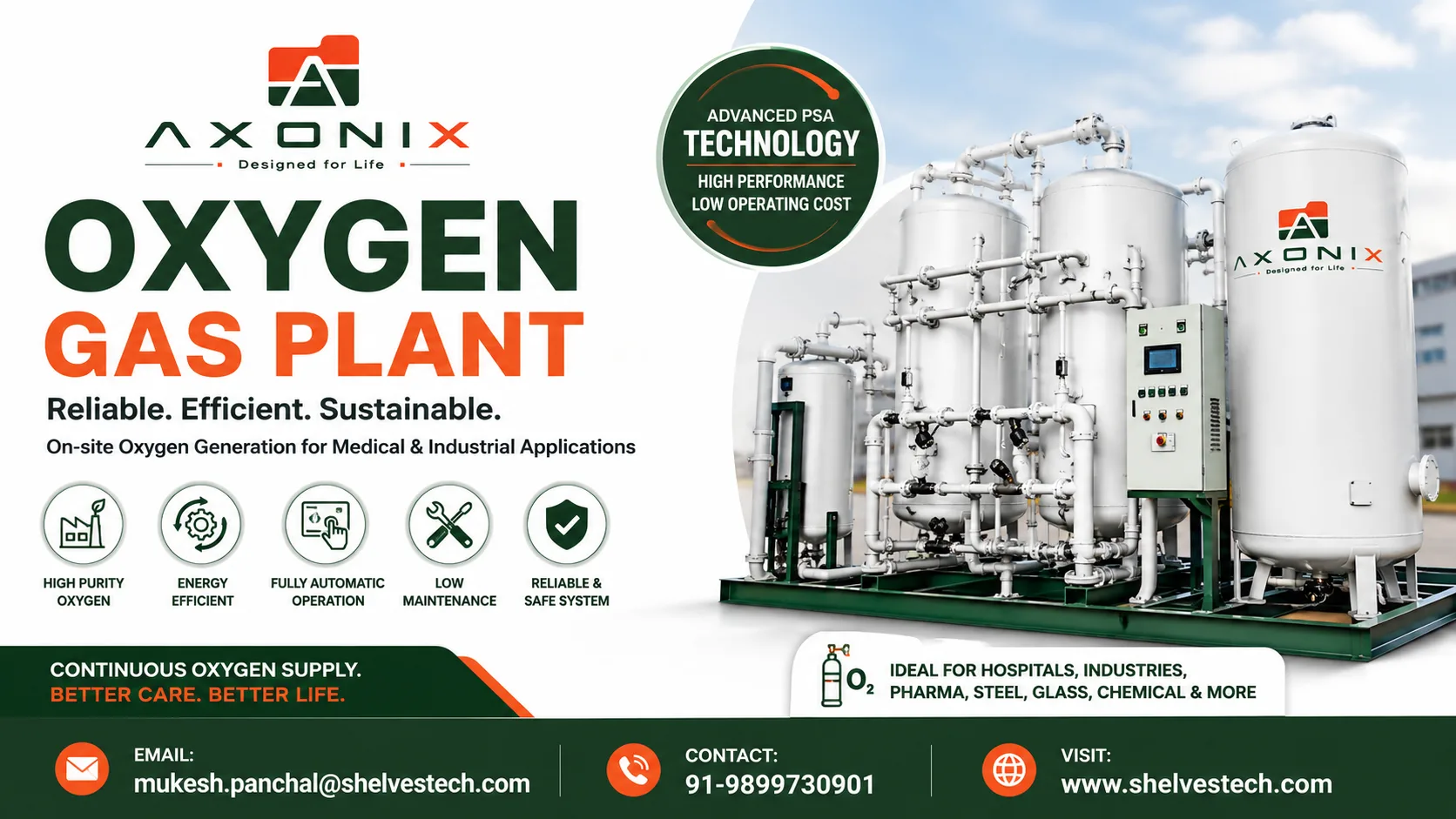
At its core, an Oxygen Gas Plant separates oxygen from compressed atmospheric air using Pressure Swing Adsorption — pushing air through zeolite molecular sieve beds that selectively trap nitrogen while oxygen passes through concentrated. The principle is decades old. The engineering quality behind the execution is where plants genuinely differ.
Core System Components
- Oil-free reciprocating or screw compressor with air receiver
- Refrigerated compressed air dryer
- Twin-tower PSA vessel with zeolite molecular sieve
- Oxygen storage/buffer tank
- PLC automation panel with purity sensors and cycle control
- Optional oxygen booster compressor for cylinder-filling operations
Capacity and Purity Ranges
Output capacity for an Oxygen Gas Plant typically spans 3 Nm³/hr for small clinics up to 1,000+ Nm³/hr for large industrial or hospital installations. Purity generally sits at 90–95% for general industrial use and 93% ± 3% where medical-grade compliance applies.
Here's the detail buyers consistently overlook: ambient temperature and humidity at the installation site directly affect PSA efficiency. A plant rated for a certain output under standard test conditions can underperform by a noticeable margin in a poorly ventilated compressor room during peak summer heat — and that gap rarely gets disclosed unless you specifically ask for derated performance figures under local climate conditions.
Objective — 5 Criteria for Evaluating Any Oxygen Gas Plant Manufacturer
Most procurement checklists focus on price per Nm³ and delivery timeline, which misses the factors that actually determine whether the plant performs consistently for years.
- Do they provide performance data under actual site conditions, not just factory test conditions? Bad answer: "Our rated capacity is standard across installations." Ambient conditions vary — a manufacturer who can't adjust for your specific site isn't giving you an honest number.
- Is their manufacturing process actually in-house, or assembled from bought-in modules? Bad answer: "We work with a trusted network of component suppliers." That phrasing often means limited direct quality control over the parts most likely to fail first.
- Can they document sieve bed lifecycle expectations specific to your operating environment? Bad answer: "Sieve beds generally last a long time." Vague reassurance isn't a maintenance plan — ask for a specific expected interval and what factors shorten it.
- What's their actual after-sales service radius and response commitment? Bad answer: "We provide support across India." Support existing on paper isn't the same as a technician who can physically reach your site within a stated window.
- Do they disclose known limitations of their system upfront? Bad answer: a quotation with no mention of any operational caveats whatsoever. Every system has limitations — a supplier who won't name theirs either doesn't know them or isn't telling you.
Benefits — Why an Oxygen Gas Plant Reduces Operational Risk
An Oxygen Gas Plant converts an unpredictable, delivery-dependent expense into a fixed, controllable operating cost — and that shift matters more the longer your facility depends on continuous oxygen supply.
- Elimination of delivery-dependent risk — no exposure to cylinder logistics, transport delays, or regional shortages
- Lower long-term cost per unit volume compared to ongoing cylinder procurement, once rental and transport costs are factored in
- Consistent, automated purity control — reduces the human error risk inherent in manual cylinder handling and swapping
- Reduced cylinder storage footprint — fewer pressurized vessels on-site lowers handling risk for staff
- Documented, auditable output — supports both regulatory compliance reviews and internal quality assurance
- Scalable modular capacity — supports facility growth without requiring a full system replacement
Availability — Oxygen Gas Plant Manufacturers, Suppliers, and Exporters in India
Where you manufacture is about much more than shipping time it’s also about spare parts availability, response time of the technicians, and if your warranty claims get fixed in weeks or months.
Shelves Tech is one of the proven Oxygen Gas Plant Manufacturers in India that provision hospitals, medical colleges and industries throughout the country with domestically assembled units. One of the existing Oxygen Gas Plant Suppliers in India producing on the premises, turn around time and service response is much less than most importers’ quote for the same size. For distributors and institutions seeking cross-border delivery, Shelves Tech is also in the pool of Oxygen Gas Plant Exporters in India, handling all export paperwork and packaging for overseas delivery.
One of the supply chain points to keep in mind: eastern and northeastern Indian facilities, whether manufacturing or distribution, tend to have the longest service response windows because most of the manufacturing and distribution infrastructure is centered in industrial corridors of the western and northern parts of the country. If a manufacturer can truly service India-wide not claim it on a Website it actually makes a significant difference to their service time.
About Us
We manufacture Oxygen Gas Plant systems in-house because we've seen too many buyers discover, months after installation, that their "manufacturer" was actually reselling a third-party unit with a different nameplate. Controlling our own compression and sieve bed calibration means we can actually answer technical questions about our own systems, instead of relaying them to an upstream supplier and waiting days for a response.
One specific change we made: after two clients in high-humidity coastal regions reported purity drops during monsoon months, we started including derated performance figures for high-humidity conditions as standard in our technical documentation, not as an optional disclosure. It made our spec sheets less flattering on paper. We kept the practice anyway, because a buyer choosing based on inflated numbers ends up disappointed at exactly the moment they need the plant to perform.
Our engineers handle site assessments before finalizing capacity recommendations — not a generic sizing formula applied regardless of location.
Call to Action
Send us your required capacity, application type (medical or industrial), and site location, including regional climate conditions if relevant. We respond to technical enquiries within 24 hours on working days. Minimum order quantity is one unit — we size systems individually rather than pushing bulk order minimums. Reach out to Shelves Tech through our website, and we'll provide performance figures adjusted for your actual site conditions, not generic factory-test numbers.
Conclusion
An Oxygen Gas Plant is only as reliable as the manufacturer's willingness to disclose what actually affects its performance at your specific site. The suppliers worth trusting are the ones who tell you about humidity derating, sieve bed lifecycle, and service response times before you ask, not after you've signed. Choose that kind of transparency now, and the plant simply works when you need it to.
FAQs
What's the difference between an Oxygen Gas Plant and an oxygen concentrator?
An Oxygen Gas Plant is a larger, facility-scale system generating continuous bulk oxygen supply for a hospital or industrial site. A concentrator is a smaller, often portable unit designed for individual patient use — the scale and application differ substantially.
How does site climate affect Oxygen Gas Plant performance?
Meaningfully, particularly in high-humidity or high-temperature environments. A plant's rated output under standard test conditions can underperform on-site if the compressor room isn't adequately ventilated — ask any manufacturer for site-adjusted figures, not just catalog numbers.
Are Oxygen Gas Plant manufacturers in India equipped to handle both medical and industrial orders?
Many are, though the engineering emphasis differs — medical-grade builds require tighter purity monitoring and compliance documentation that industrial applications typically don't need.
What should buyers verify before choosing between Oxygen Gas Plant suppliers and manufacturers?
Ask directly whether the company manufactures in-house or resells a third-party design. Suppliers reselling standardized units often can't provide the same depth of technical support when something site-specific goes wrong.
How often does an Oxygen Gas Plant require maintenance?
Routine filter and compressor servicing is typically needed on a scheduled basis, while sieve beds generally last 6 to 8 years depending on operating conditions — humid environments tend to shorten that interval, which is worth planning for rather than discovering later.