
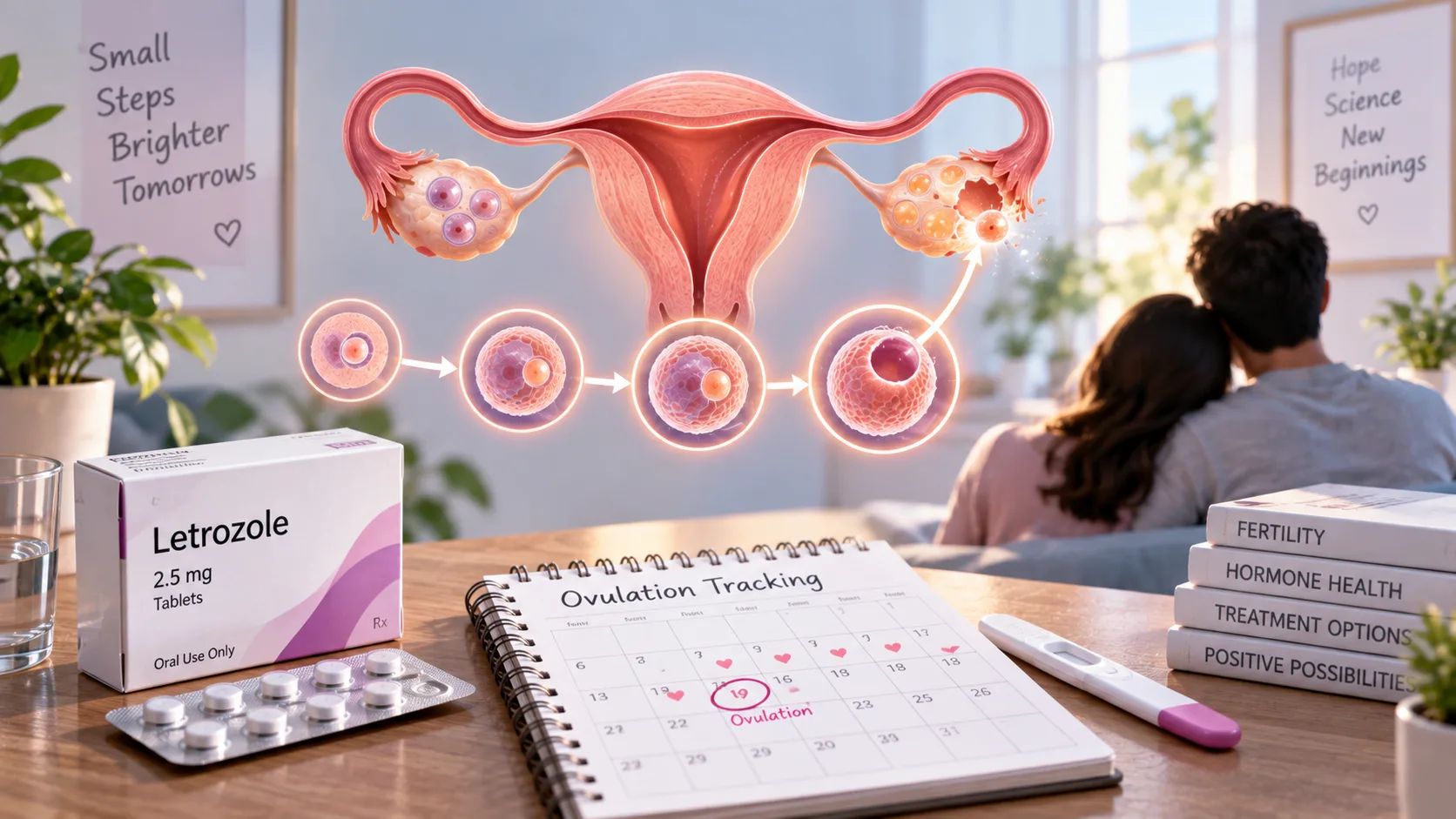
For people who do not ovulate regularly, getting pregnant can be difficult because there may not be an egg available for fertilization during every menstrual cycle. Ovulation induction with letrozole is one treatment option used to encourage ovulation.
Letrozole is an oral medication that can help stimulate the development and release of an egg. It is commonly used when ovulation is irregular or absent, including in some people with polycystic ovary syndrome (PCOS).
The treatment is relatively simple, but the dose, timing, monitoring, and number of cycles should be determined by a fertility specialist based on individual circumstances.
What Is Letrozole?
Letrozole is a medication that reduces the production of estrogen for a short period. The temporary reduction in estrogen can encourage the brain to increase signals that stimulate the ovaries.
This may help a follicle develop and release an egg.
Although letrozole is widely known as a medication used in breast cancer treatment, fertility specialists also use it for letrozole fertility treatment and ovulation induction.
Who May Benefit From Letrozole for Ovulation?
Letrozole for ovulation may be considered for people who have difficulty ovulating regularly.
It may be particularly useful in cases involving:
- Irregular or absent ovulation
- PCOS-related ovulation problems
- Certain cases of unexplained infertility
- Irregular menstrual cycles associated with ovulatory dysfunction
It is not suitable for everyone trying to conceive. A fertility specialist may first evaluate menstrual history, ovarian function, sperm health, fallopian tubes, and other factors.
How Does Ovulation Induction With Letrozole Work?
The treatment generally begins early in the menstrual cycle.
A simplified process may look like this:
- Period begins: The first day of menstrual bleeding is considered Day 1.
- Letrozole is taken: The medication is prescribed for a specific number of days, commonly early in the cycle.
- Follicles develop: The ovaries respond to the medication and one or more follicles may grow.
- Monitoring: Ultrasound may be used to assess follicle development.
- Ovulation: The mature follicle releases an egg naturally or after additional medication when clinically appropriate.
- Timed intercourse or IUI: Depending on the treatment plan, intercourse may be timed around ovulation or an IUI may be performed.
- Pregnancy testing: If menstruation does not occur, a pregnancy test is performed at the appropriate time.
The exact protocol can differ between patients.
Letrozole Timing for Ovulation
The timing of letrozole depends on the fertility specialist's protocol.
It is commonly prescribed for several days near the beginning of the menstrual cycle. The doctor then determines when ovulation is likely to occur based on the person's response.
Some cycles may involve ultrasound monitoring to identify follicle development and help determine the appropriate timing for intercourse or IUI.
It is important not to change the dose or timing yourself. Taking additional tablets does not necessarily increase the chance of pregnancy and may create unnecessary risks.
What Happens After Taking Letrozole?
After the medication course is completed, the ovaries may continue developing a mature follicle.
Some patients ovulate naturally. In other situations, the fertility team may use additional monitoring or medication to help determine or trigger ovulation.
Once ovulation is expected, the couple may be advised to have intercourse during the fertile window. If letrozole is being combined with IUI, the insemination is timed around ovulation.
How Successful Is Letrozole?
The ovulation induction success rate depends heavily on why ovulation is irregular and on other fertility factors.
Success can be influenced by:
- Age
- Cause of ovulatory dysfunction
- Ovarian reserve
- Sperm quality
- Fallopian tube health
- Body weight and metabolic factors
- Duration of infertility
- Previous fertility treatment
For someone who does not ovulate regularly, inducing ovulation can improve the opportunity for pregnancy. However, ovulation itself is not the same as achieving pregnancy.
A person may successfully ovulate after taking letrozole but not become pregnant during that cycle.
Letrozole and PCOS
PCOS is one of the common conditions associated with irregular or absent ovulation.
For people with PCOS who are trying to conceive and have anovulatory infertility, letrozole may be recommended as an ovulation-induction medication.
However, PCOS is a broad condition, and not everyone with PCOS needs the same fertility treatment.
A doctor may consider menstrual patterns, metabolic health, ovarian findings, sperm parameters, and other factors before choosing a treatment.
Letrozole vs Clomiphene
Letrozole and clomiphene citrate are both medications that can be used to induce ovulation, but they work differently.
FactorLetrozoleClomipheneTypeAromatase inhibitorSelective estrogen receptor modulatorMain fertility useOvulation inductionOvulation inductionCommon applicationOvulatory dysfunction, including PCOSOvulatory dysfunctionAdministrationOralOralMonitoringMay be recommendedMay be recommendedChoiceDepends on individual factorsDepends on individual factorsFor people with PCOS and anovulatory infertility, clinical guidelines have supported letrozole as an important first-line pharmacological option in appropriate circumstances.
Your doctor can explain which medication is more suitable for your situation.
Common Side Effects of Letrozole
Most people tolerate letrozole reasonably well, but side effects can occur.
Possible side effects include:
- Headache
- Dizziness
- Fatigue
- Hot flashes
- Nausea
- Breast tenderness
- Mood changes
- Abdominal discomfort
Side effects are not necessarily a sign that the medication is working.
If symptoms are severe, persistent, or concerning, contact your healthcare provider.
Risks of Ovulation Induction With Letrozole
Like any fertility treatment, ovulation induction with letrozole has potential risks.
Multiple Pregnancy
Letrozole can sometimes result in the development of more than one mature follicle. This can increase the possibility of twins or, less commonly, a higher-order multiple pregnancy.
Ovarian Cysts
Ovarian changes can occur during fertility treatment. Your doctor may recommend an ultrasound if there is a clinical concern.
Ovarian Hyperstimulation
Letrozole generally has a lower risk of ovarian hyperstimulation than some injectable stimulation protocols, but fertility treatment still requires appropriate medical supervision.
Treatment Failure
Ovulation may not occur despite treatment, or ovulation may occur without resulting in pregnancy.
If several cycles are unsuccessful, your specialist may reassess the diagnosis and discuss other options.
When Should You Take a Pregnancy Test?
A pregnancy test should generally be taken at the time recommended by your fertility specialist.
Testing too early may produce a negative result even if pregnancy has occurred because pregnancy hormone levels may not yet be detectable.
If an ovulation-triggering medication containing hCG has been used, testing too early can also sometimes produce a misleading positive result.
How Many Letrozole Cycles Are Usually Tried?
There is no single number of cycles that applies to everyone.
The appropriate duration depends on age, diagnosis, treatment response, other fertility factors, and whether timed intercourse or IUI is being used.
If ovulation occurs but pregnancy does not happen after several treatment cycles, the doctor may review whether continuing the same approach makes sense or whether additional fertility testing or treatment should be considered.
Questions to Ask Your Fertility Specialist
Before starting treatment, consider asking:
- Why am I having difficulty ovulating?
- Is letrozole appropriate for my situation?
- What dose and schedule will I follow?
- Will I need ultrasound monitoring?
- When should we have intercourse or schedule IUI?
- What side effects should I watch for?
- How many cycles do you recommend trying?
- When should we consider another fertility treatment?
These questions can help you understand what to expect from the treatment.
Frequently Asked Questions
How does letrozole help with ovulation?
Letrozole temporarily lowers estrogen production, which can increase hormonal signals that stimulate the ovaries and encourage follicle development and ovulation.
How many days do you take letrozole for ovulation?
The medication is commonly prescribed for several days early in the menstrual cycle, but the exact dose and schedule should be determined by your fertility specialist.
Does letrozole guarantee ovulation?
No. Some people respond to letrozole and ovulate, while others may need a different dose, additional treatment, or another fertility approach.
Is letrozole safe for fertility treatment?
Letrozole is widely used for ovulation induction, but it is a prescription medication and should be used under medical supervision. Your doctor can discuss its benefits, risks, and suitability for you.
Can letrozole increase the chance of twins?
Yes. Because letrozole can sometimes stimulate more than one follicle, the possibility of multiple pregnancy can increase compared with an unstimulated cycle. The exact risk varies by individual and treatment protocol.
Final Takeaway
Ovulation induction with letrozole can help people who have difficulty ovulating regularly by encouraging follicle development and ovulation.
The treatment is often considered for ovulatory dysfunction, including PCOS-related infertility. Its effectiveness depends on the underlying cause of infertility and other factors such as age, sperm health, fallopian tube function, and ovarian reserve.
Letrozole should be taken exactly as prescribed, with monitoring when recommended. If pregnancy does not occur after treatment, your fertility specialist can reassess the situation and discuss the next appropriate step.