A disproportionate number of industrial incidents occur not during peak production, but during shift changeovers. It’s a narrow window—often less than an hour—yet it consistently appears in HSE investigations as a high-risk period. The reason is simple: attention drops, assumptions increase, and communication gaps emerge.
In crane operations, that combination is dangerous. Loads continue moving while responsibility transitions between operators. During this vulnerable phase, overhead crane warning lights act as a constant, non-verbal safeguard. They do not rely on memory, briefings, or human consistency. When configured correctly, they provide uninterrupted hazard communication exactly when your workforce is most exposed.

Why Shift Changeovers Increase Risk
Shift handovers introduce a temporary breakdown in situational awareness. Outgoing operators may already be mentally disengaging, while incoming staff are still orienting themselves to the environment.
Research in human factors consistently shows that transitional periods carry elevated risk due to:
- Reduced concentration at the end of a shift
- Incomplete or rushed communication between teams
- Assumptions about equipment status or load position
In crane operations, these factors translate into real hazards. A suspended load may be in motion, partially secured, or positioned in a high-risk zone.
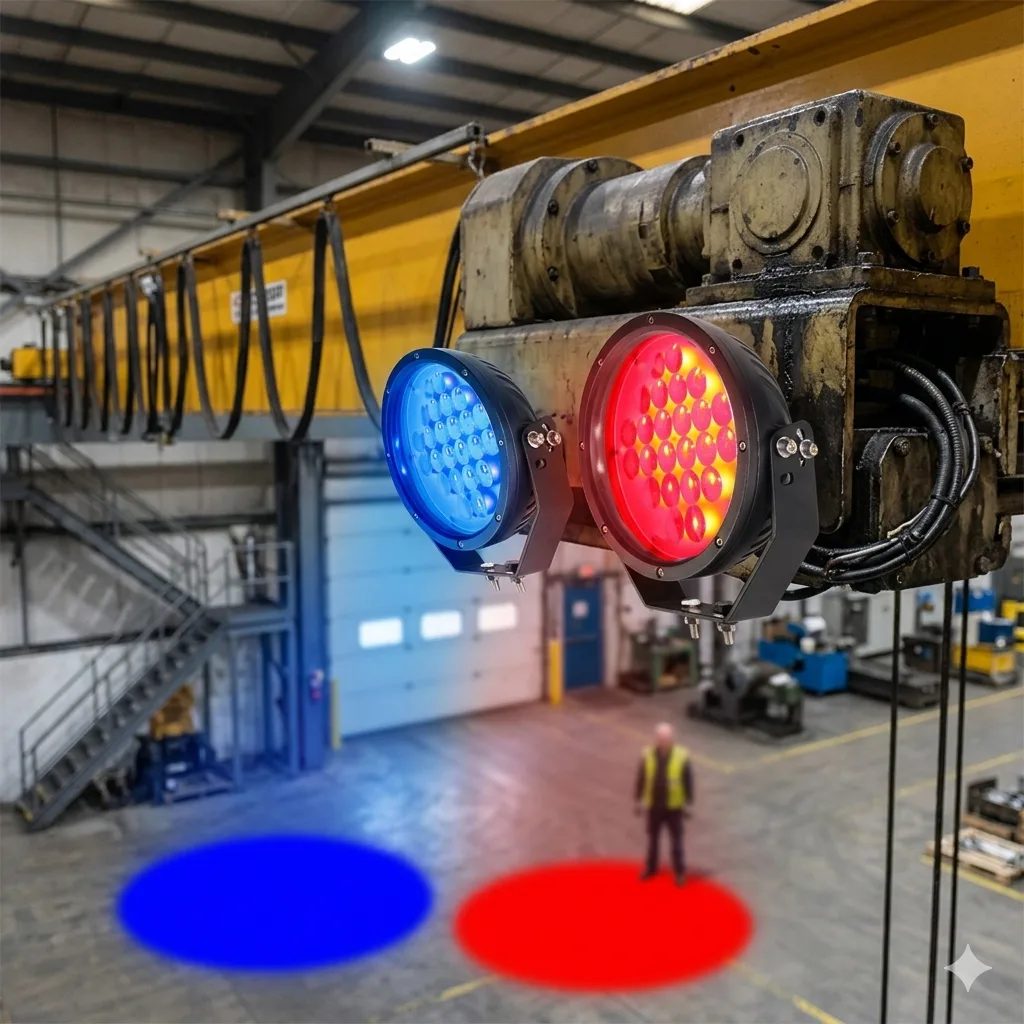
Without clear visual cues, ground personnel may not recognise the immediate danger. This is where a properly configured overhead crane light becomes essential. It provides continuous indication of crane activity, independent of human input.
The Role of Always-Active Lighting Systems
One of the most common weaknesses in crane safety systems is reliance on operator-activated controls. If warning systems depend on manual activation, they are vulnerable to human error—particularly during shift transitions.
Always-active overhead crane lighting eliminates this risk. These systems operate continuously whenever the crane is powered, ensuring that hazard communication does not lapse.
Key advantages include:
- No reliance on operator memory or procedure compliance
- Immediate visibility of crane movement at all times
- Consistent performance across all shifts and personnel
During handovers, this consistency is critical. Workers entering the area can instantly identify active crane operations, even if verbal communication has not yet occurred.
In high-traffic industrial environments, this level of reliability significantly reduces the likelihood of struck-by incidents.

Automation vs Operator Discretion
The case for automation is clear. Safety-critical systems should not depend on individual behaviour, particularly during periods of reduced attention.
By linking lighting activation to the crane’s power-on state, you ensure that overhead crane lights are always operational when the equipment is in use. This approach aligns with HSE guidance on reducing human error through system design.
Operator discretion introduces variability. One operator may consistently activate warning systems; another may forget under pressure or during routine tasks.
Automation removes that variability. It standardises safety performance across your entire operation.
From a compliance perspective, this also strengthens your position. You can demonstrate that controls are embedded in the system, rather than reliant on procedural adherence alone.
Communication Protocols During Handover
Lighting systems are most effective when integrated with structured communication protocols. Shift handovers should not be informal—they require clear, documented procedures.
A robust handover process should include:
- Confirmation of crane status (active, idle, under maintenance)
- Identification of any suspended or partially secured loads
- Communication of any restricted or high-risk zones
- Verification that all safety systems, including lighting, are operational
Within this framework, crane safety lights serve as a visual reinforcement of verbal communication. They provide immediate confirmation of crane activity, reducing reliance on memory or interpretation.
HSE Human Factors guidance emphasises the importance of redundancy in safety systems. Combining verbal, procedural, and visual controls creates a more resilient approach.
UK Guidance and Human Factors Considerations
HSE publications on shift work and human factors highlight the increased risk associated with fatigue, cognitive overload, and communication breakdowns. These factors are particularly relevant during shift transitions.
Your responsibility under the Health and Safety at Work Act 1974 is to manage these risks proactively. This includes implementing controls that account for predictable human limitations.
Effective use of crane warning lights aligns with this approach. They provide a simple, reliable method of maintaining situational awareness, even when human performance is compromised.
In environments where DSEAR or other regulatory frameworks apply, consistent hazard communication becomes even more critical. Lighting systems must operate reliably under all conditions, including transitional periods.

Embedding Lighting into Shift Handover Policy
To maximise effectiveness, crane lighting must be formalised within your shift handover procedures. It should not be treated as a standalone feature.
Safety managers should:
- Specify that lighting systems must remain active whenever cranes are powered
- Include lighting checks as part of handover verification
- Train operators and ground staff on interpreting visual signals
- Document lighting systems as part of risk assessments and safety audits
By embedding overhead crane warning lights into your operational policy, you ensure that they are consistently used and maintained.
This approach also provides clear evidence of compliance during inspections. It demonstrates that you have considered both technical and human factors in your safety strategy.
Conclusion
Shift changeovers will always present a degree of risk. Human factors—fatigue, distraction, and communication gaps—cannot be eliminated entirely. What you can control is how your systems respond to those vulnerabilities.
By implementing always-active, automated lighting systems and integrating them into formal handover procedures, you create a consistent layer of protection. This reduces reliance on individual behaviour and strengthens your overall safety framework.
As industrial operations become more complex, designing systems that account for human limitations will be essential. For further insight into how lighting enhances hazard visibility, Recommended read: OSHA-Approved Crane Safety Lights: Boost Visibility & Reduce Risks in Ports