
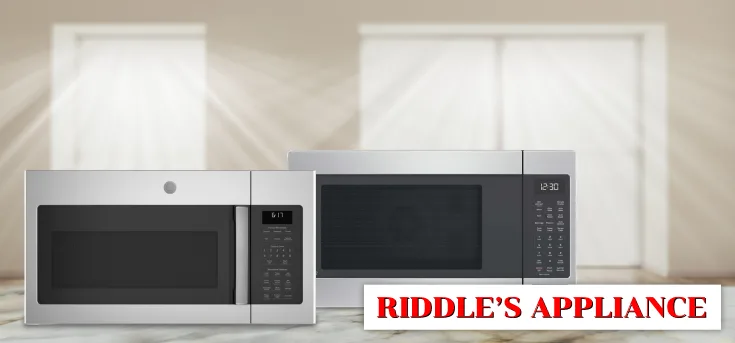
Microwave placement can make a bigger difference in a kitchen than most homeowners expect. A countertop microwave may be simple to use, but it can take up space you could otherwise use for food preparation. An over-the-range model moves the appliance upward and can also provide ventilation above the cooking surface.
The right choice depends on your kitchen layout, available counter space, cooking habits, and installation plans. At Riddle Appliance, we help homeowners compare these practical differences before choosing a microwave that fits their kitchen.
What Is an Over-the-Range Microwave?
An over-the-range microwave is installed above the cooking range or cooktop. Instead of taking up countertop space, it uses vertical space and typically combines microwave cooking with ventilation and cooktop lighting.
That combination is one of the biggest advantages of Over-the-Range Microwave Ovens. Riddle Appliance's current GE selection includes models with built-in ventilation systems, including the GE JVM3160DFBB with a 1.6 cu. ft. capacity, 1,000 watts, and a 2-speed 300-CFM venting system.
For kitchens where countertop space is limited, moving the microwave above the range can immediately create a more open work surface.
Why Homeowners Choose Over-the-Range Models
An over-the-range microwave can provide:
- More usable countertop space
- Built-in ventilation
- Cooktop lighting
- A cleaner, integrated appearance
- Convenient access while cooking
It is particularly useful when you're remodeling a kitchen or replacing both a range hood and microwave.
What Are Countertop Microwaves?
Countertop Microwave Ovens are designed to sit directly on a counter, island, shelf, or other suitable surface. Their biggest advantage is flexibility.
Installation is generally much simpler because the microwave does not need to be mounted above a range. You can place it where it is easiest for everyone in the household to reach.
This makes countertop models particularly practical for apartments, rental homes, offices, dorms, guest kitchens, and homes where cabinetry is not being modified.
Riddle Appliance's current countertop selection includes the GE Profile PCHK11S1W, a 1.1 cu. ft., 800-watt model with sensor cooking and built-in capability, as well as several General Electric countertop models.
Which One Saves More Kitchen Space?
If your main concern is countertop space, the answer is generally an over-the-range microwave.
A countertop model requires a dedicated surface. Depending on the microwave's dimensions, that can mean losing a significant section of usable preparation space.
An over-the-range model moves that appliance off the counter completely. It also combines microwave functionality with ventilation, potentially eliminating the need for a separate hood in an appropriate installation.
Over-the-Range Microwave
Best for: Kitchens where countertop space is limited.
Space advantage: Frees the countertop and uses vertical space.
Additional function: Can provide ventilation and cooktop lighting.
Countertop Microwave
Best for: Kitchens where flexibility and simple installation are priorities.
Space consideration: Requires dedicated counter or shelf space.
Additional advantage: Can be moved or replaced without modifying cabinetry.
So, if you're asking strictly which option saves more counter space, Over-the-Range Microwave Ovens have the clear advantage.
Space Maker Microwaves: A Practical Space-Saving Solution
Space Maker Microwaves are particularly useful for homeowners who want to reduce countertop clutter without giving up microwave convenience.
The concept is straightforward. Instead of placing the microwave below eye level on the counter, the appliance is positioned above the cooking range. This makes use of an area that would otherwise remain largely unused.
For example, the GE JVM3160DFBB offers 1.6 cu. ft. of capacity, 1,000 watts, a 13.5-inch turntable, convenience cooking controls, auto and time defrost, and 2-speed 300-CFM ventilation.
For homeowners who cook regularly, that combination can make the kitchen feel less crowded.
GE Profile OTR Sensor Microwave Oven
Model: PVM9215SKSS
The GE Profile PVM9215SKSS provides a larger 2.1 cu. ft. capacity and 1,000 watts of power. It also includes sensor cooking controls and a 4-speed, 400-CFM ventilation system.
This type of model is worth considering when you want the space-saving benefits of an over-the-range microwave but also want additional capacity and ventilation performance.
GE Profile OTR Sensor Advantium Microwave Oven
Model: PSA9120SPSS
For homeowners looking beyond basic microwave cooking, the GE Profile PSA9120SPSS combines microwave functionality with Speedcook capabilities. The model listed by Riddle Appliance has a 1.7 cu. ft. capacity, 925 watts, a 120V Speedcook oven, removable wire racks, halogen heat, and more than 175 pre-programmed menu selections.
This can be appealing when you want to get more cooking functionality from the same overhead space.
Tabletop Microwaves: When Flexibility Matters More
Not every kitchen needs an over-the-range installation.
Tabletop Microwaves can be the better choice when you want simple placement, easy access, or the ability to move the appliance later.
A countertop model also avoids the need to mount a microwave above the range. That's important for renters and homeowners who are not planning a kitchen remodel.
GE Profile Countertop Microwave Oven
Model: PCHK11S1W
The GE Profile PCHK11S1W offers 1.1 cu. ft. of capacity and 800 watts of cooking power. It includes sensor cooking controls, weight and time defrost, and is listed as built-in capable with an optional hanging kit.
This gives homeowners flexibility beyond simply placing the microwave on a countertop.
General Electric Countertop Microwave / Air Fry Oven
Model: GCST10A1WSS
If you want more than traditional microwave cooking, the GE GCST10A1WSS combines microwave cooking with air fry, convection, and broil functions. The model has a 1.0 cu. ft. capacity and 1,050 watts.
For a homeowner who wants additional cooking versatility without installing another built-in appliance, this configuration can be worth considering.
General Electric Countertop Microwave Oven
Model: GCST11N1W
The GCST11N1W provides a straightforward countertop solution with 1.1 cu. ft. of capacity, 950 watts, and a turntable.
It is a good example of why countertop microwaves remain popular. You can get dependable everyday microwave functionality without undertaking an installation project.
Key Features to Compare Before Buying
Space is important, but it should not be the only factor.
Capacity
Consider the size of the dishes you normally use. Larger families may appreciate a larger microwave cavity.
Wattage
Higher wattage can provide faster cooking and reheating, although actual results depend on the food and cooking setting.
Ventilation
If you're replacing a range hood, pay close attention to the ventilation system on an over-the-range model.
Sensor Cooking
Sensor cooking can help simplify reheating and cooking by adjusting the process based on moisture levels.
Additional Cooking Functions
Some countertop and over-the-range models offer convection, air fry, or Speedcook capabilities, which can expand what you can prepare.
Installation: The Major Difference
Installation is one of the biggest distinctions between these two microwave styles.
An over-the-range microwave requires careful attention to mounting height, electrical requirements, clearances, and ventilation. The installation should match the manufacturer's specifications and your kitchen's configuration.
A countertop microwave is considerably simpler. You need an appropriate, stable surface, adequate clearance, and a suitable electrical connection.
That simplicity is a major reason Countertop Microwave Ovens continue to make sense for many kitchens.
Which Microwave Is Best for a Small Kitchen?
For a kitchen where every inch of counter space matters, an over-the-range model is usually the stronger choice.
A Space Maker Microwave can remove the microwave from the counter while also providing ventilation above the cooking surface.
For an apartment, rental property, office, or kitchen where installation changes are not practical, Tabletop Microwaves offer more flexibility.
The decision ultimately comes down to what kind of space you have available.
Common Mistakes to Avoid
Before choosing a microwave, avoid these common mistakes:
- Measuring only the microwave and not the installation area
- Forgetting about door clearance
- Ignoring ventilation requirements
- Choosing an over-the-range model without considering mounting height
- Placing a countertop model where it blocks important workspace
- Buying based only on appearance
- Overlooking capacity and cooking features
A few measurements and some planning can prevent an appliance that looks good on paper from becoming inconvenient in daily use.
Final Verdict: Which Saves More Space?
If your primary goal is to free up countertop space, an Over-the-Range Microwave Oven is usually the better option. It uses vertical space and can combine microwave cooking with ventilation and lighting.
If your priority is easy installation, flexibility, or accessibility, a Countertop Microwave Oven or Tabletop Microwave may be the smarter choice.
For homeowners remodeling their kitchens, Space Maker Microwaves can offer a particularly effective way to create a cleaner, less cluttered countertop without giving up microwave functionality.
The best choice is not necessarily the model with the most features. It is the one that works naturally with your kitchen layout and the way you cook every day.
Need Help Choosing the Right Microwave?
Whether you're looking for an Over-the-Range Microwave Oven, Countertop Microwave Oven, Space Maker Microwave, or Tabletop Microwave, our team can help you compare the options based on your available space, installation needs, and cooking habits.
Explore the microwave selection at Riddle Appliance or contact the team directly to find a model that makes better use of your kitchen space.
Originally Posted At : Over-the-Range Microwave vs. Countertop: Which Saves More Space?