
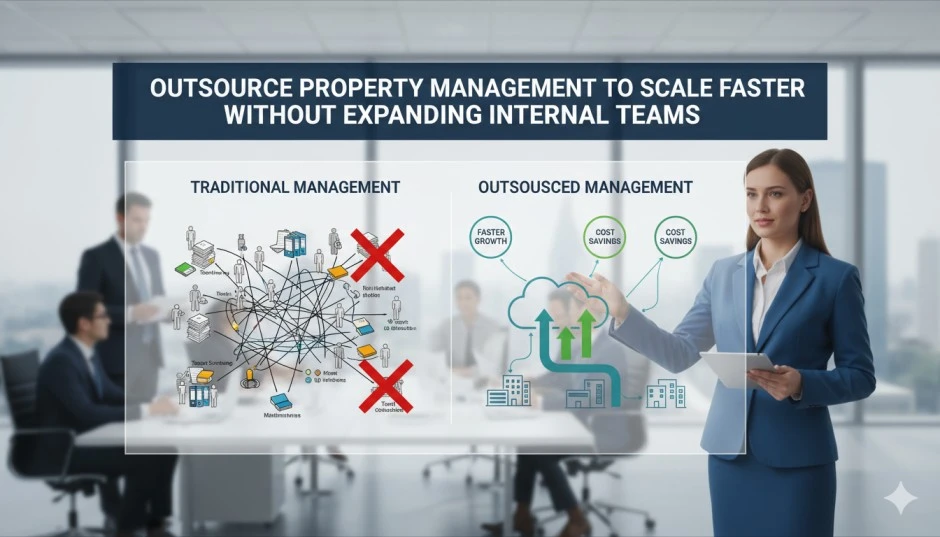
In today’s competitive real estate environment, growth is no longer limited by market demand—it is limited by operational capacity. Many property owners, asset managers, and real estate firms discover that as portfolios expand, internal teams become overwhelmed by administrative pressure. Lease administration, accounting entries, reporting cycles, compliance documentation, and vendor coordination quietly consume time that leadership should be using to drive asset performance. This is why forward-looking organizations increasingly choose to outsource property management as a strategic move rather than a short-term fix.
Outsourcing is not about giving up control. It is about redesigning how work flows through the organization so that high-volume, execution-driven tasks are handled efficiently, consistently, and at scale.
The Operational Reality Behind Portfolio Growth
Every additional property introduces recurring back-office demands. Rent roll updates, CAM reconciliations, invoice processing, financial reporting, tenant data management, and compliance tracking all grow in complexity as portfolios diversify across locations and asset classes. When these responsibilities remain entirely in-house, firms often respond by hiring more staff, adding supervisors, and expanding office infrastructure.
This traditional approach creates a linear cost structure: more properties mean more people and higher fixed expenses. Over time, leadership focus shifts inward toward managing teams instead of outward toward acquisitions, investor communication, and value enhancement. The result is slower decision-making and reduced agility.
This is where property management back office support becomes a competitive advantage.
What Outsourced Back Office Support Actually Covers
Modern outsourcing goes far beyond basic data entry. Comprehensive property management back office support includes lease abstraction, rent posting, accounts payable and receivable, bank reconciliations, financial statement preparation, budget tracking, variance analysis, compliance reporting, and vendor documentation. These functions are process-driven, repeatable, and ideal for execution by specialized teams operating within clearly defined workflows.
By outsourcing these activities, firms ensure that daily operations continue smoothly while internal teams concentrate on strategy, oversight, and relationship management.
Why More Firms Outsource Property Management Today
The decision to outsource property management is driven by several structural advantages. First, it converts fixed staffing costs into flexible operational expenses. Instead of committing to long-term payroll obligations, firms pay for services aligned with portfolio size and transaction volume.
Second, it introduces process discipline. Outsourced teams work within documented procedures, service-level benchmarks, and quality controls. This consistency reduces errors, improves reporting accuracy, and supports cleaner audit trails.
Third, outsourcing reduces dependency on individual employees. Knowledge is embedded in processes rather than people, creating operational resilience even during periods of growth or internal turnover.
The Strategic Role of Technology and Oversight
One misconception about outsourcing is loss of visibility. In reality, modern property management back office models enhance transparency. Cloud-based systems, secure access controls, real-time dashboards, and structured approval workflows allow leadership to maintain full oversight.
Execution happens externally, but authority remains internal. Senior teams approve payments, review reports, and set policies, while outsourced professionals handle the execution steps efficiently and consistently.
This model allows organizations to scale without sacrificing governance or compliance.
How iRapidO Enables Smarter Scaling
iRapidO delivers end-to-end property management back office solutions designed for growing real estate portfolios. Rather than offering generic staffing, iRapidO provides structured support built around process optimization, trained global talent, and technology-aligned execution.
Clients gain access to dedicated teams experienced in U.S. property management standards, accounting practices, and reporting requirements. Workflows are customized to align with existing systems and internal controls, ensuring seamless integration rather than disruption.
This approach allows firms to expand portfolios without expanding internal headcount, while maintaining accuracy, consistency, and speed.
From Operational Burden to Strategic Leverage
When property management back office work is handled externally, internal teams regain time and focus. CFOs can concentrate on forecasting and capital planning. Asset managers can analyze performance trends instead of reconciling data. Leadership can pursue acquisitions and investor relationships without being constrained by operational bottlenecks.
Outsourcing transforms the back office from a cost center into a source of operational leverage.
The Long-Term Advantage
As real estate markets evolve, firms that rely solely on traditional in-house models will find it increasingly difficult to compete on speed and efficiency. Those that adopt outsourced property management back office support gain flexibility, scalability, and resilience.
The future of property management is not about building larger internal teams. It is about building smarter operating models. For organizations focused on sustainable growth, choosing to outsource property management is no longer optional—it is a strategic necessity that supports long-term performance and competitive advantage.