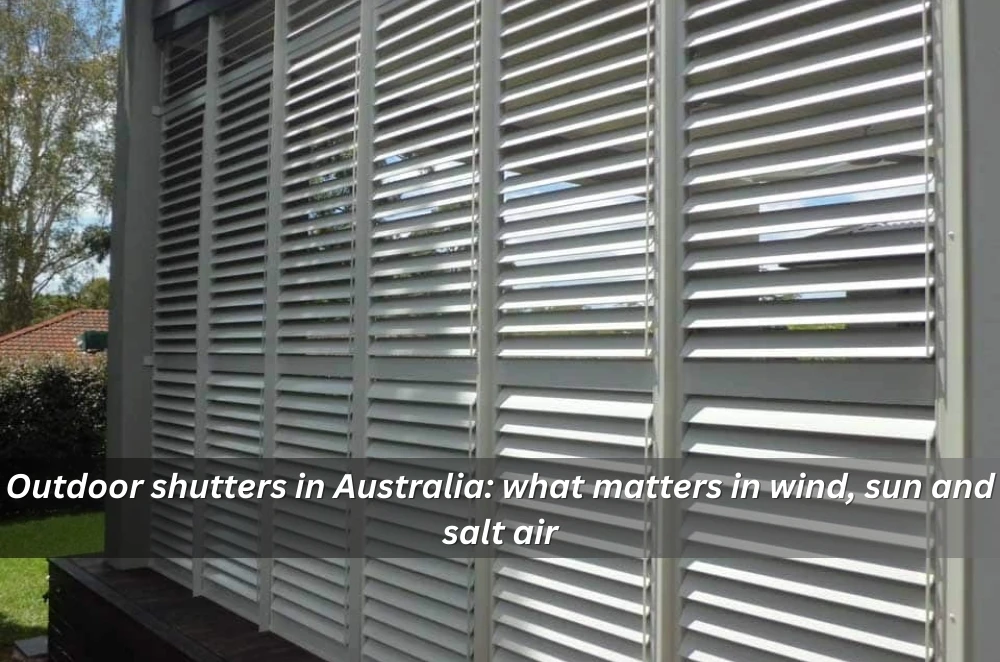
Outdoor shutters sit at the intersection of design and durability. They can create shade where awnings fall short, add privacy to exposed balconies, and make outdoor areas feel more usable through summer glare and shoulder-season wind. But because they live outside, the usual “window furnishings” questions expand into more serious ones: fixing points, corrosion resistance, drainage paths, and whether the shutter system is actually designed for the way your home is built.
For people searching for local outdoor shutter specialists across Australia, the challenge is that the category is broad. “Outdoor shutter” can mean anything from decorative panels through to engineered aluminium systems designed for exterior openings. The details matter, and they’re easiest to evaluate when you start from your conditions—sun angle, wind exposure, coastal air, and how you want to use the space—then work back to materials and design.
This guide explains what to look for in outdoor shutters in an Australian context, with practical checkpoints that apply whether you’re in a humid coastal suburb, a windy elevation, or a more sheltered inner-city courtyard.
What outdoor shutters can (and can’t) do
Outdoor shutters are often considered for three overlapping goals:
- Shade and glare control: reducing harsh afternoon sun so patios and rooms stay more comfortable.
- Privacy and screening: especially on balconies, near neighbours, or street-facing outdoor areas.
- Weather management: creating a more protected edge around an outdoor room.
Where expectations can go wrong is assuming shutters do everything equally well. A system designed primarily for shade might not offer the same privacy or rain protection as one built for screening. Likewise, a product that looks suitable in a brochure may not be appropriate for a location with strong prevailing winds or salt exposure unless it’s specified and installed accordingly.
A useful starting question is: Is the shutter meant to screen, shade, protect, or do a balanced mix of all three? The answer influences how the frame is built, how panels move, and what materials make sense.
Why aluminium is common for exterior shutters
For exterior applications, aluminium is a frequent choice because it’s stable, relatively low-maintenance, and well suited to outdoor environments when properly finished and installed. The key phrase there is “properly”—because performance outdoors is as much about coatings, fixings, and design details as the base material itself.
If you want a clearer sense of how aluminium exterior shutter systems are typically presented and applied, you can see an example in this overview of aluminium shutters for exterior use (Shutters Australia).
Exposure first: the three conditions that drive the spec
Before you compare styles or colours, it helps to map your exposure. Three factors do most of the heavy lifting:
1) Sun and heat load
West-facing openings and upper-level balconies can experience intense heat and glare. Shutter design choices that can matter here include louvre shape, the ability to angle blades, and whether the system creates a breathable screen or a more sealed barrier.
A practical tip: if the goal is to use a patio in late afternoon, prioritise shade control and airflow over a “solid wall” feel.
2) Wind and pressure
Open sites, corners, and elevated homes see higher wind pressure. This affects not only the shutter panels but also tracks, frames, and fixings. Even a well-made shutter can underperform if it’s mounted into weak substrate or fixed without enough anchoring points.
If wind is a factor, ask how the system is designed to handle movement and load—especially for larger spans.
3) Salt and corrosion risk
Coastal suburbs introduce salt into the equation. Aluminium can be suitable, but you’ll want to pay attention to surface finishing, dissimilar metal contact (which can accelerate corrosion), and ongoing cleaning routines.
In coastal settings, the “right” shutter is often the one that’s easiest to rinse, inspect, and maintain—without hidden cavities that trap moisture and salt.
Shutter styles: fixed, hinged, sliding, and bi-fold
Outdoor shutters often fall into a few operating styles. The best choice is usually the one that matches how you move through the space.
- Fixed panels: good for consistent screening on boundary lines or where you don’t need regular access.
- Hinged shutters: simple to use; practical on windows and smaller openings where you want occasional full access.
- Sliding shutters: useful on wide openings, patios, and balconies; requires good track design and clean run paths.
- Bi-fold systems: can open up larger spans; more moving parts means the quality of engineering and installation matters more.
If you’re deciding between sliding and hinged on a patio, consider traffic patterns. Sliding can keep panels out of the way without swinging into walkways; hinged can be easier when you want to open the whole opening quickly.
Louvre and blade design: privacy without losing airflow
One of the main benefits of louvred outdoor shutters is that they can deliver privacy without turning a balcony into a closed box. The details to look at include:
- Angle range: how far blades can open and close.
- Sightline control: whether you can block views from neighbouring windows while still letting light in.
- Ventilation: whether the system encourages airflow or traps heat.
A good real-world check is to imagine a warm evening where you want privacy but still want a breeze. If the shutter can’t deliver both, it may not be the right design for that location.
Installation and fixing: where outdoor projects succeed or fail
Exterior shutters need a stronger “building” mindset than indoor window coverings. The two major questions are:
What are you fixing into?
Brick, concrete, timber framing, steel, and rendered substrates all behave differently. Fixing into the wrong layer (or relying on a thin surface layer) can cause problems later, especially with wind load and repeated movement.
How does water move around the system?
Outdoor openings are exposed to rain and wash-down. Good design anticipates water paths and avoids creating traps where water sits against frames, tracks, or fixings.
If a space is partly enclosed (for example, a balcony with a roof but exposed sides), water can still be driven in by wind. It’s worth thinking about how often the shutters will get wet, and how quickly they can dry.
Noise, movement, and day-to-day feel
Outdoor shutters are used in a more dynamic environment—wind, temperature changes, and outdoor traffic. Small quality differences become noticeable over time:
- Rattle and vibration: can occur if tolerances are loose or tracks aren’t well suited to the span.
- Smooth operation: depends on hardware quality and installation alignment.
- Cleaning access: you’ll want to be able to clean blades and tracks without a complicated routine.
If the shutters will be close to living spaces or bedrooms, consider how the system behaves on windy nights.
A practical comparison checklist
When you’re speaking with providers, these questions tend to surface the most useful information without getting lost in jargon:
- What problem is the shutter solving here—shade, privacy, weather, or a mix?
- What exposure factors matter most for this opening (sun, wind, salt), and how does the design respond?
- How is the system fixed, and what is the structural substrate?
- How will water drain and dry around tracks and frames?
- What’s the maintenance routine in this environment (especially coastal)?
- How will the shutters operate with foot traffic and furniture placement in the outdoor area?
You don’t need technical answers; you’re listening for whether the provider is thinking in “site conditions and structure,” not just “style and colour.”
Key Takeaways
- Outdoor shutters need to be assessed like an exterior building element: exposure, fixing, and water paths matter.
- Aluminium is commonly used outside, but coatings, hardware, and installation details influence long-term performance.
- Wind, sun, and coastal salt are the three conditions that most affect what’s appropriate for a given opening.
- Operating style (fixed, hinged, sliding, bi-fold) should match how you move through and use the space.
- A short checklist of practical questions helps you compare options without relying on marketing language.