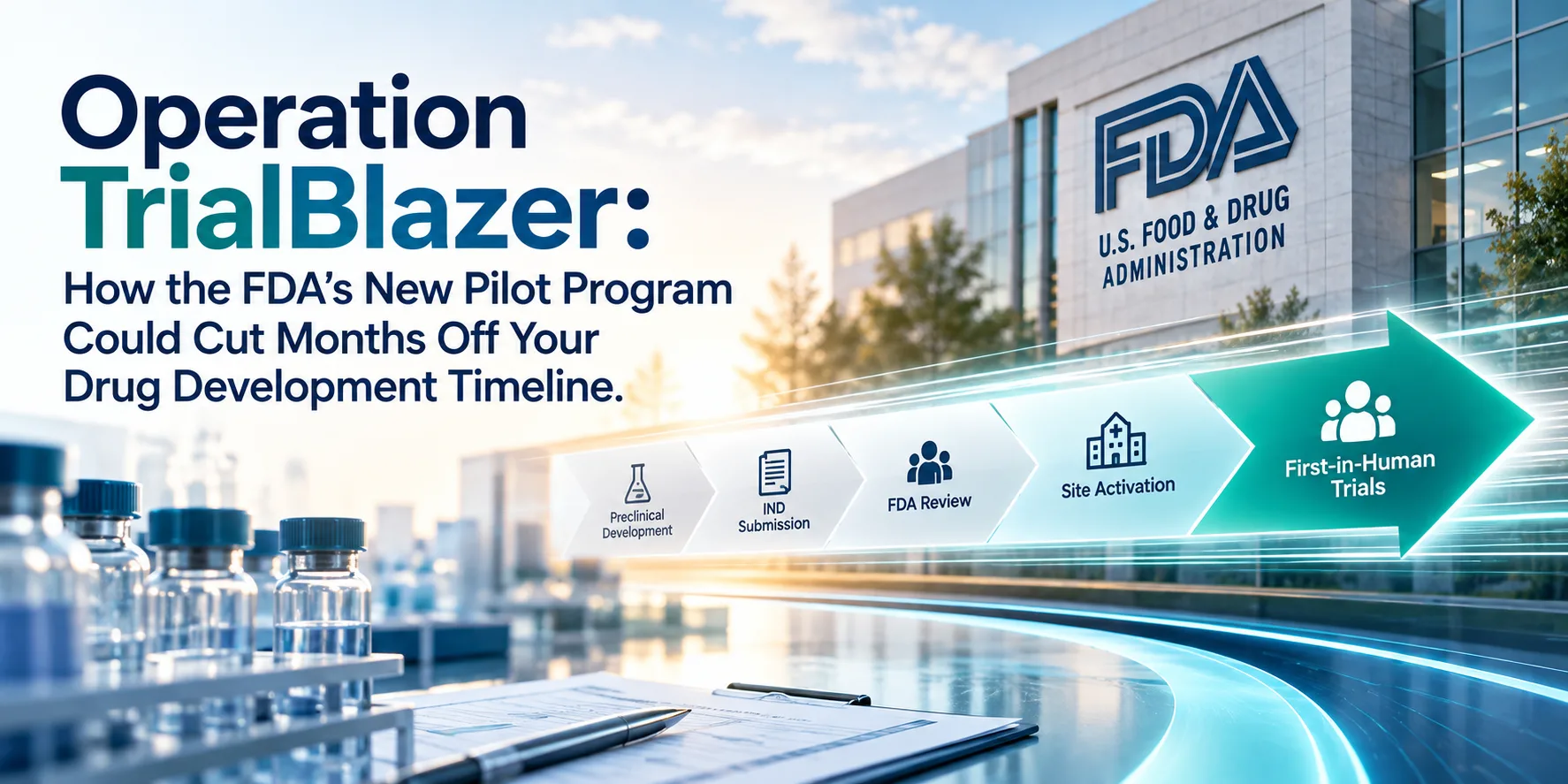
Drug development timelines are shaped by more than scientific discovery. Before a promising therapy can reach its first patient, sponsors must complete nonclinical studies, prepare Chemistry, Manufacturing and Controls (CMC) information, develop clinical protocols, assemble regulatory documentation, obtain reviews and coordinate trial activation.
When these activities happen one after another, waiting time accumulates.
The U.S. Food and Drug Administration is now testing whether some of that waiting can be removed.
In September 2026, the FDA launched its Expedited Investigational New Drug (IND) Pilot Program, part of the broader Operation TrialBlazer initiative. The program is designed to explore ways to accelerate the path to first-in-human Phase 1 trials while maintaining FDA standards for participant safety and scientific oversight.
The significance is not simply faster FDA review. TrialBlazer is testing a different way of organizing the work that happens before a clinical trial begins.
What Is Operation TrialBlazer?
Operation TrialBlazer is a U.S. Department of Health and Human Services initiative focused on modernizing and accelerating clinical drug development in the United States.
The Expedited IND Pilot is one of its early components and specifically addresses the path toward first-in-human Phase 1 clinical trials.
Under the pilot, the FDA plans to work with a small initial group of approximately eight to 10 sponsor–Qualified Research Institution pairs. The goal is to test whether earlier regulatory interaction, rolling submission of IND components and better coordination of trial-startup activities can reduce unnecessary delays.
That could represent an important change for pharmaceutical and biotechnology companies.
Instead of asking only how quickly the FDA can review a completed IND, the program asks a broader question:
Can the entire process leading to a first-in-human study be organized more efficiently?
Rolling IND Submission Could Change the Timeline
One of the most important elements of the pilot is rolling submission.
Normally, substantial work goes into preparing the different components of an IND before the complete application moves through the regulatory process.
Under the pilot, participating sponsors can submit individual IND components as they become available. The FDA can begin reviewing those components earlier rather than necessarily waiting for the complete package.
This matters because regulatory questions can potentially be identified sooner.
Consider a situation where an issue exists within part of the CMC documentation. Under a more sequential process, the issue might not become apparent until later in IND preparation or review.
With rolling interaction, questions could potentially surface while other development activities are still progressing.
The potential time saving therefore doesn't necessarily come from doing the scientific work faster. It can come from reducing the periods when one activity is waiting for another to finish.
Qualified Research Institutions Have a Key Role
Another notable feature of the pilot is the involvement of Qualified Research Institutions (QRIs).
The FDA describes prospective QRIs as organizations with scientific and regulatory expertise capable of supporting efficient IND development. These may include academic medical centers, health networks, contract research organizations and regulatory advisory organizations.
Relevant expertise can span nonclinical development, CMC, clinical development, clinical pharmacology and regulatory affairs, together with Phase 1 trial capabilities or partnerships.
This creates a collaborative model involving the sponsor, an experienced research institution and the FDA.
However, the QRI does not replace FDA oversight. The agency retains its regulatory responsibilities, including decisions about whether a clinical study can proceed safely or should be placed on clinical hold.
The potential advantage lies instead in preparation and coordination.
If experienced institutions can help sponsors anticipate requirements, prepare information appropriately and resolve questions earlier, fewer problems may remain when a study is ready to begin.
Parallel Work Could Be the Bigger Opportunity
Submitting an IND is only one part of starting a clinical trial.
Sponsors also have to coordinate activities involving Institutional Review Boards, clinical sites, contracts, operational preparation and ultimately patient enrollment.
When these activities happen sequentially, delays compound.
Operation TrialBlazer is exploring whether appropriate activities can instead happen in parallel.
Think about the difference between these two approaches.
A sequential process can resemble:
IND preparation → submission → regulatory process → IRB and site activities → trial activation
A more parallel approach could allow appropriate regulatory and operational activities to progress at the same time.
The FDA is therefore looking beyond IND review time toward the total interval between identifying a drug candidate and beginning the first human trial.
That is an important distinction.
Removing two weeks from an individual regulatory activity is useful. Removing repeated periods of waiting across an entire development process can have a much larger cumulative effect.
Why Is the FDA Focusing on Speed?
The international clinical development environment has become increasingly competitive.
BioPharma Dive reports that countries including Australia and China have become increasingly attractive locations for early clinical research. The publication notes that trials in Australia can, in some circumstances, begin less than 70 days after protocol submission.
It also reports substantial growth in China's clinical trial activity over the past decade.
For pharmaceutical and biotechnology companies, these timelines matter.
Every month spent before a therapy reaches clinical testing affects development costs, financing, intellectual property timelines, development milestones and the time required to generate human evidence about whether a therapy works.
Operation TrialBlazer is therefore also connected to a broader effort to make the United States more competitive as a location for early-stage clinical development.
Who Can Participate?
The Expedited IND Pilot is not an automatic accelerated pathway available to every drug developer.
The FDA is selecting a limited initial cohort.
Programs must involve first-in-human Phase 1 submissions falling within relevant FDA review structures. Selection considerations include the characteristics and complexity of the IND, readiness of the nonclinical and CMC programs, suitability for the pilot model, unmet medical need and potential public-health impact.
The initial size of the program is important when evaluating its impact.
This is not yet a wholesale replacement for the existing IND process. It is an experiment designed to determine whether a different regulatory-development model works.
What Could TrialBlazer Mean for CMC and Quality Teams?
Faster regulatory interaction creates another requirement: information has to be ready earlier.
If an IND component can enter review while other sections are still being developed, teams need controlled, current and review-ready information when that component is submitted.
For CMC, quality and regulatory teams, this places greater importance on documentation readiness, version control, data traceability, review processes and cross-functional coordination.
A faster FDA pathway provides limited benefit if a sponsor still needs weeks to locate information, reconcile different document versions, obtain internal approvals or resolve inconsistencies between teams.
Regulatory acceleration therefore should not be interpreted as a reason to reduce controls.
It increases the importance of having those controls working efficiently.
TrialBlazer Does Not Mean Lower Standards
This is one of the most important points for drug developers.
The purpose of the pilot is not to bypass scientific or safety requirements.
The FDA states that the initiative is intended to accelerate development while maintaining its standards for participant safety and scientific oversight. The agency also retains its existing regulatory authority over whether clinical studies are permitted to proceed.
Nor does participation guarantee that a company will save a specific number of months.
The first cohort is small, and actual results will be necessary to determine how much time rolling review and parallel activities save across different types of development programs.
The word pilot matters.
Could Operation TrialBlazer Really Cut Months From Drug Development?
Potentially.
Rolling submissions can allow regulatory review to begin earlier. Earlier interaction can expose issues before they become late-stage bottlenecks. Qualified research institutions can provide additional scientific and regulatory coordination. Parallel trial-startup activities can reduce periods when one team is simply waiting for another.
Together, those changes could compress the journey toward a first-in-human trial.
But the more important lesson may extend beyond the FDA program itself.
Drug development has traditionally contained many sequential handoffs. Data moves from one team to another. Documents wait for review. Regulatory teams wait for information. Clinical teams wait for regulatory milestones.
Operation TrialBlazer is testing what happens when some of those dependencies are reorganized.
For pharmaceutical and biotech companies, that puts a premium on regulatory readiness, CMC data readiness, controlled documentation, traceable information and cross-functional collaboration.
The companies best prepared for faster regulatory pathways will not simply be those that work faster.
They will be those that can provide the right information, in the right state of readiness, when regulators need it.
If Operation TrialBlazer proves successful, that could be its lasting effect: not lowering the bar for drug development, but reducing the amount of time everyone spends waiting to clear it.
References: FDA Expedited IND Pilot Program · Targeted Oncology coverage · BioPharma Dive analysis