
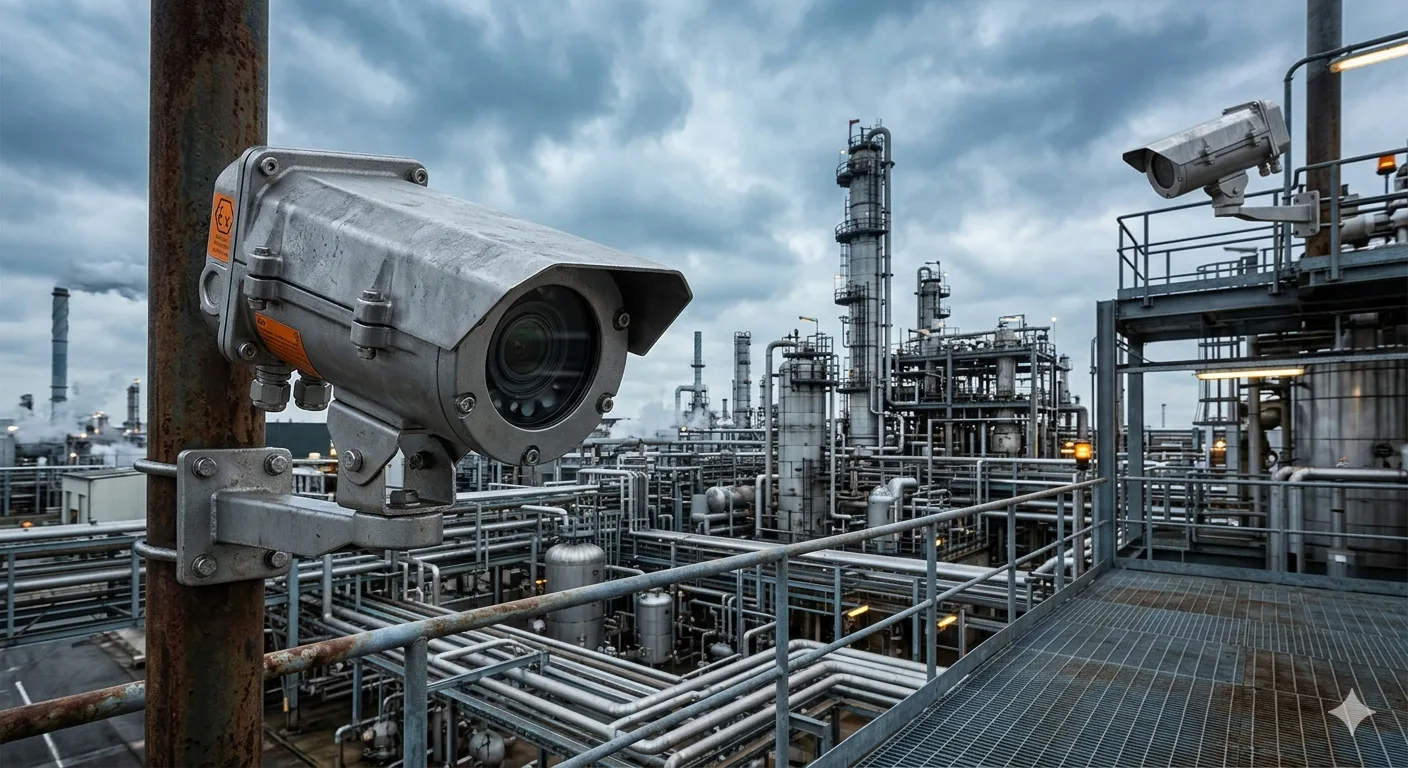
Same Certification, Very Different Environments
ATEX certification tells you a camera is safe for a classified hazardous atmosphere. It does not tell you whether the camera will last eighteen months or eighteen years in your specific operating environment. Two facilities can both require Zone 1 certified equipment and face entirely different physical stressors — stressors that, if not accounted for in the specification, will degrade performance, accelerate failure, and ultimately compromise the safety monitoring capability the camera was installed to provide.
Onshore refineries and offshore platforms share a regulatory framework. They do not share an environment. The specification decisions that follow from that difference are consequential, and facilities that treat ATEX certification as the only selection criterion routinely pay for that oversight in maintenance costs and premature equipment replacement.

The Onshore Environment: Heat, Dust, and Abrasion
UAE onshore oil and gas facilities — refineries, processing plants, pipeline infrastructure — present a surveillance challenge defined primarily by thermal extremes, airborne particulate, and in desert-adjacent locations, abrasive sand-laden wind.
Ambient temperatures in exposed outdoor areas regularly exceed 50°C during summer months. Inside enclosed process buildings, radiant heat from equipment can push operational temperatures significantly higher. Standard camera housings — even those carrying basic weatherproofing — are not engineered to perform reliably across this range. Thermal throttling, seal degradation, and lens fogging are common failure modes in inadequately specified onshore installations.
ATEX-certified solutions for onshore deployment should be evaluated against the following criteria:
- Temperature class (T-class) rating — The camera's maximum surface temperature must remain below the auto-ignition temperature of the substances present in your classified zones; for onshore hydrocarbon facilities, T3 or T4 classification is typically the minimum
- IP66 ingress protection minimum — Dust-tight and jet-water resistant; IP66 should be considered the floor, not the target, in sand-exposed outdoor installations
- UV-stabilised housing materials — Prolonged direct sunlight degrades polymer components in housings not specifically formulated for high UV exposure
- Passive thermal management — Housing design should dissipate internal heat without requiring active cooling systems, which introduce additional maintenance complexity in classified areas
Onshore facilities also tend to have more established infrastructure — cable routes, junction box positions, power supply points — which simplifies installation planning. The challenge is environmental endurance, not installation complexity.
The Offshore Environment: Salt, Humidity, Vibration, and Access Constraints
Offshore platforms introduce a fundamentally different set of physical stressors. Salt-laden marine air is persistently corrosive. Humidity is consistently high. Sea-state and mechanical vibration from platform operations creates cyclic stress on housing seals, mounting brackets, and cable connections. And critically, equipment access for maintenance is constrained in ways that onshore facilities rarely experience — a camera failure on a platform may not be addressable for days or weeks depending on weather conditions and crew rotation schedules.
These factors combine to demand a higher baseline specification. An ATEX-certified explosion proof camera deployed offshore must account for:
- Marine-grade corrosion resistance — 316L stainless steel housing or equivalent; standard aluminium alloy housings will corrode in continuous salt air exposure faster than any reasonable maintenance interval can manage
- IP68 ingress protection — Wash-down decks, sea spray, and occasional wave contact require submersion-rated protection; IP66 is insufficient for the most exposed offshore locations
- Vibration-rated mounting and internal components — IEC 60068 vibration testing compliance should be confirmed; cyclic vibration from platform machinery and sea movement will loosen inadequately rated mounts and stress internal camera components
- Extended MTBF (Mean Time Between Failure) — Given the access constraints inherent in offshore deployment, cameras that fail frequently create operational blind spots that cannot be quickly remediated; reliability data from the manufacturer should be requested and reviewed
Ex-Proof CCTV Solutions specified for offshore environments also need to account for IECEx co-certification alongside ATEX, since vessels and installations operating internationally may be subject to port state control or flag state requirements that reference IECEx rather than the European ATEX Directive alone.
Where Both Environments Converge: Installation Integrity
Regardless of whether your facility is onshore or offshore, one principle applies without exception: the camera is only as compliant as the full installation around it. Under DSEAR and UAE HSE workplace safety standards, zone integrity must be maintained throughout the entire electrical assembly — from the camera housing through every cable gland, conduit run, and junction box back to the control system.
This is where many procurement decisions that appear sound on paper produce non-compliant installations in practice. Specifying a certified camera and leaving the installation design to a contractor unfamiliar with zone requirements is a consistent source of audit findings and insurance complications.
Your specification document — whether for an onshore refinery or an offshore platform — should require that the full installation pathway carries the same zone rating as the camera itself, with documented certification at every connection point.

Specification Precision Is the Differentiator
The right ATEX-certified explosion proof camera solution for your facility is not the one with the most features or the lowest unit cost. It is the one whose full specification — housing material, ingress protection, temperature class, vibration tolerance, and installation compatibility — is matched precisely to the physical environment where it will operate.
An explosion-proof CCTV camera that performs flawlessly in a controlled onshore process building may fail within a season on an offshore deck. Getting that match right from the outset, supported by a supplier with documented installation experience in your environment type, is the procurement decision that determines whether your surveillance infrastructure performs for years or requires repeated intervention. For those evaluating certified suppliers across the GCC region, this comparative resource is a useful reference: Top 5 ATEX Certified Explosion Proof Camera Companies in Saudi Arabia
Standalone Summary — For Publication Submission
This article provides a practical comparative guide for industrial decision-makers selecting ATEX-certified surveillance systems across onshore and offshore oil and gas environments. It outlines the distinct physical stressors — thermal extremes, dust, and abrasion onshore; salt corrosion, humidity, vibration, and access constraints offshore — and maps these to specific specification requirements for housing materials, ingress protection, temperature class, and installation integrity. Drawing on ATEX Directive, DSEAR, IECEx, and UAE HSE standards, it is written for procurement leads, safety managers, and operations directors responsible for hazardous area surveillance decisions.