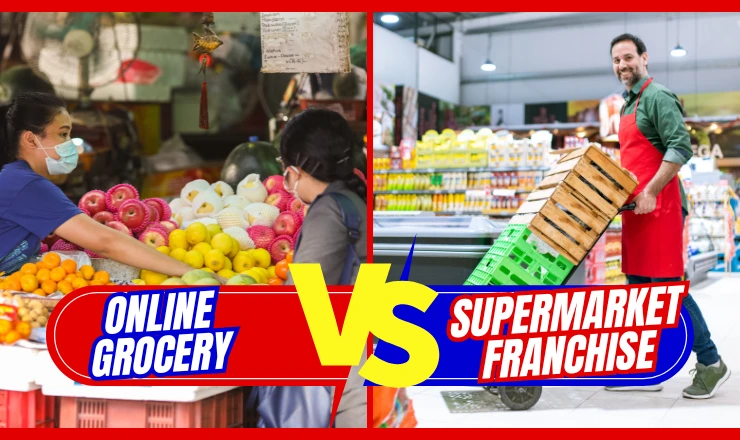
As long as supermarket aisles are designed for the initial carts in India, there are electrifying moments in which grocery retailing in India becomes digitally revolutionised. Fostered very rapidly with the emergence of new online grocery stores and several well-organised chains of supermarkets, retailers are faced with the dilemma of analysis-whether to venture into the business of online grocery stores or to establish a Supermarket Franchise, and the choice will be made by 2025. There is a thorough need for knowledge of the competitive environment in planning for this choice, as well as an evaluation of the desirability of both models in terms of start-up costs, scalability, customer loyalty, profitability, and long-term growth potential.
Investment and Setup
An online grocery store can be quite a cost-effective venture. You can even start off small with a website, a small number of vendor tie-ups, and minimum inventory. Some businesses even use dark stores or leverage hyperlocal delivery to minimise costs. But if you're looking to scale, you will need a good app, delivery fleet, and tech support.
On the other hand, starting a Supermarket Franchise - particularly with a reputable name like BigDeal Supermart - is going to be more expensive to open. You'll need a lease, fixtures, interior, inventory, labour, etc. As a franchise, you also benefit from an established supply chain, operational support, and brand trust, which allow you to cut down the trial-and-error period of starting up a new business.
Customer Trust and Experience
Although online grocery platforms are growing, there is still a major obstacle around trust in non-metro areas. Furthermore, broken orders, damages, and erratic quality will regularly impact repeat orders.
Supermarket Franchises, on the other hand, are closer to a true shopping experience but offer a more trustworthy experience to the consumer. You receive hand-picked, customisation, and staff support in real-time, plus refunds or returns are easy. Of course, at least in 2025, trust is still an important issue for all purchases, particularly in Tier 2 and Tier 3 cities, where the physical presence means a great deal.
Also Read: How to Pick the Best Supermarket Franchise for Your City
Profit Margins and Revenue Predictability
Online grocery stores run at very thin margins due to high logistics costs, returns, and price competition, and they have to sell a large volume through their online front end and develop efficiencies in their backend systems to get into positive margins.
Franchise stores, especially those run under an organised retail brand like BigDeal, can manage the price at the point of sale, and take advantage of margin opportunities to multiply income streams through in-store promotional sales programs, customer loyalty & gifts programs, and private label products. In addition, reliable footfalls in stores with good locations allow for more predictable revenue planning and inventory cycles.
Tech and Operational Complexity
Operating an online grocery is a tech-intensive business, and you need tech professionals who can develop apps, set up payment gateways, build inventory sync, GPS tracking, and customer service tools. You're also going to need an adequate warehouse and trained delivery staff to make your online grocery successful.
Supermarket Franchises provide a plug-and-play solution. The franchisor provides backend software solutions for billing, inventory, etc., so you can spend less time focusing on tech headaches and operational logistics and more time training staff and providing customer service. Many brands, including BigDeal, have great training and marketing strategies to help partners succeed.
Customer Loyalty and Brand Recall
Customers are changing their shopping apps on a daily basis based on the discounts offered. Brand loyalty is rare because many people's shopping experiences are transaction-oriented. You are always needing to push offers, notifications, and firmware to retain customers.
Franchise supermarkets, however, are able to build relationships. Local shoppers recognise the staff at their store, develop shopping habits around that store, and integrate a loyalty program into their shopping journey. With a well-known brand such as BigDeal, consistent footfall is easier to come by and long-lasting brand loyalty can be achieved.
Market Reach and Scalability
Online grocery retailers can claim a wider potential reach, particularly if they expand regionally through a digital platform. But the realities of that reach will depend on app installation, internet penetration and effective delivery.
Supermarket Franchise engages a specific locality. While that can severely limit geographic reach, it increases local brand presence. While gaining experience, you can expand by developing multiple outlets under the same franchisee. Franchising may, however, provide the lowest-risk scaling options in a manageable period for young entrepreneurs.
Risk Factors
The online merchant could be impacted by technological breakdowns, hardware and applications not working, cyber fraud, and delivery failures. In addition to this, they face immense competition from technology giants and low barriers to customers switching
Franchise supermarkets would have a more stable model. They still risk high rent or sudden downturns in the marketplace, but they normally have a physical asset to fall back on and public awareness of the brand. For example, franchise partners of "bigdeal" are mostly larger supermarkets; therefore, they get bulk buying rates, plus some marketing assistance and validation through operational auditing, which means the risk is reduced.
Final Thoughts: Which One Is Better for You?
For individuals comfortable with technology, with previous exposure to logistics, and wanting a flexible business approach with little capital needed, online grocery could be your business. You will need to keep learning and improving through constant monitoring and upgrading your systems, though.
If you want a stable business model, brand support, consistent foot traffic, and a more predictable future growth trajectory, a Supermarket Franchise is much safer. Especially with a brand like BigDeal, which has copied and made a more efficient end-to-end business model, the franchise option is preferred both in tier 1 and tier 2 cities.
Ultimately, the choice between the two will depend on your strengths, willingness to invest and the control you would like over your business. Both models have a role in India's fast-changing grocery retail future; however, only one may suit your entrepreneurial approach.
Check out this: Smart Investment? Understanding Supermarket Franchise Cost
FAQs
Q1. Is online grocery encroaching on supermarket franchisee revenues?
Not necessarily. While quick commerce is on an upward growth trajectory with urban consumers, there are still many consumers who prefer to touch and feel the grocery that they are purchasing, have a visual look at the overall freshness of categories, and enjoy a more customer service-based in-store experience.
Q2. Can supermarket franchises implement delivery options?
For sure. Many existing franchise outlets are trying delivery options where they partner with third parties for some type of delivery. Some supermarkets even offer delivery service as an extension of their in-store inventory, which can be delivered locally in a few hours.
Q3. Which format creates more loyalty?
Supermarket franchises create a level of familiarity and trust based on in-store experiences that online models can’t build. Online models require the shopper to rely on app-based experiences and even subscription-based programs to generate loyalty. Emotional intimacy always favours the physical shopping experience compared to online.