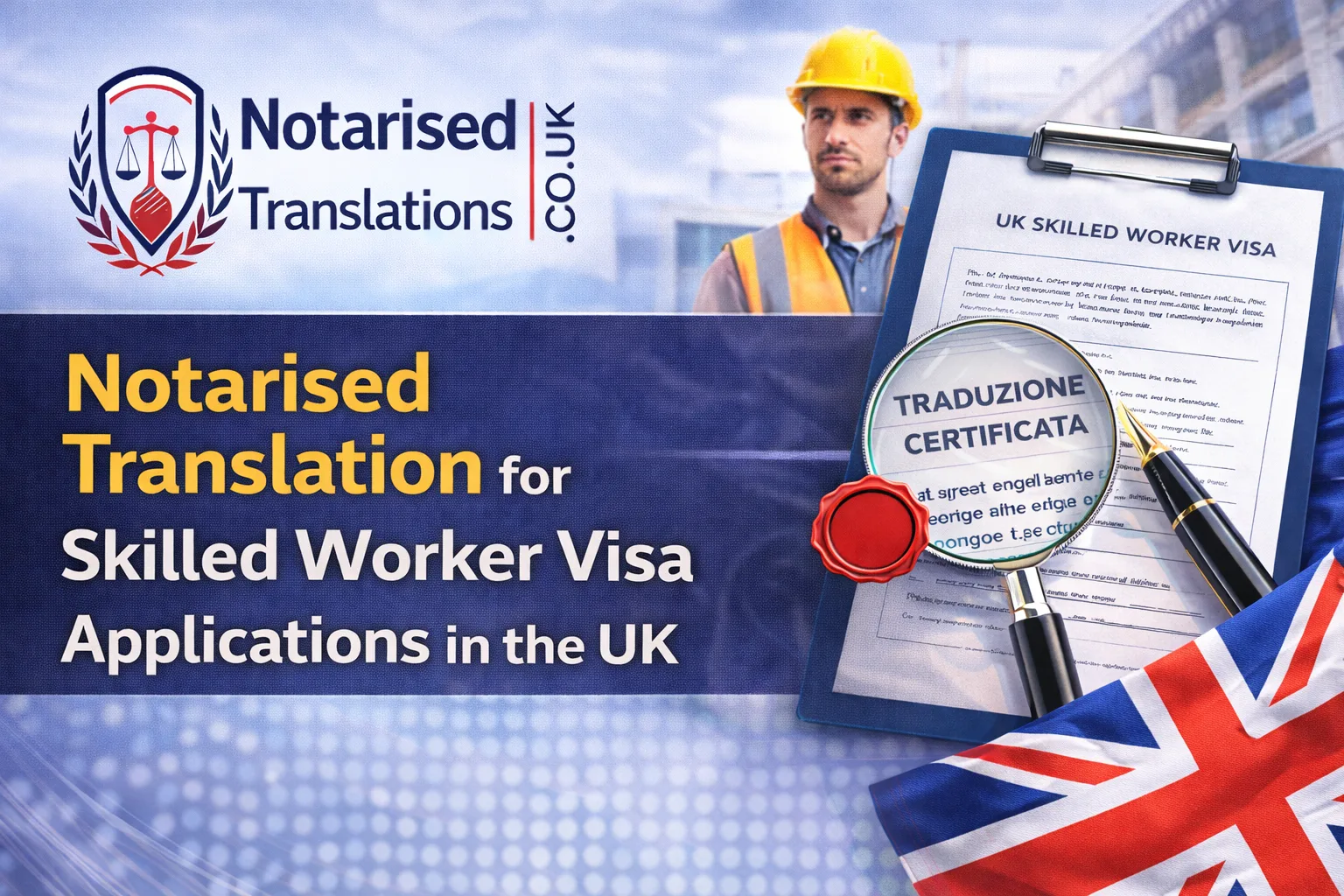
The UK's Skilled Worker visa route is one of the most significant immigration pathways into the country — and one of the most document-intensive. Employers, applicants, and immigration lawyers all know that a Skilled Worker application lives or dies on its paperwork. Every document needs to tell the same story, every claim needs to be substantiated, and every foreign-language document in that pile needs to be in English before UKVI will process it.
Translation is often one of the last things applicants think about — they're focused on the Certificate of Sponsorship, the salary threshold, the English language requirement. But a missing or inadequate translation can hold up an application just as effectively as any other gap. Legal document notarised translation UK is an essential component of a well-prepared Skilled Worker application, and understanding what's needed — and when — makes the whole process considerably more manageable.
Documents Required for Skilled Worker Visa Translation
The starting point is any document that exists in a language other than English. For Skilled Worker applications, the most commonly translated documents are academic and professional qualifications — degree certificates, diplomas, professional licences — issued in the applicant's home country.
Educational qualifications matter because the Skilled Worker route requires applicants to demonstrate that their role meets the skill level threshold (currently RQF Level 3 or above), and for some roles, specific qualifications are part of that demonstration. If the degree certificate is in Mandarin, Ukrainian, or Hindi, it needs to be in English before it can be evaluated.
Professional registration documents are another category. Healthcare workers — doctors, nurses, pharmacists — need to demonstrate registration with their home country's professional regulatory body as part of the evidence for UK professional registration. Those documents come in whatever language the home country's regulatory body uses.
Employment references and work history documents from previous employers abroad are sometimes required — particularly for senior roles where the applicant's experience level is being assessed. Bank statements in a foreign language may be needed for maintenance requirements in some cases. Marriage and birth certificates are required when dependants are being included in the application.
Why Skilled Worker Visa Applications Require Notarised Translation
Standard Skilled Worker visa applications to UKVI generally require certified translation rather than notarised translation. There's a meaningful difference between the two, and understanding it prevents unnecessary expense.
A certified translation carries a signed declaration from the translator confirming accuracy and competence. That's what UKVI's published guidance specifies — a translation "produced by a professional translator," with their credentials and declaration attached. For the majority of documents in a Skilled Worker application, this level of certification is sufficient.
Notarised translation — where a notary public has verified the translator's signature — is typically required for documents going to specific institutions that have their own higher authentication standards. The General Medical Council, for instance, has specific requirements for overseas medical qualifications that may go beyond standard certification. Some professional regulatory bodies similarly specify notarisation.
If an employer or a sponsoring organisation specifically requests notarised translations — which some larger organisations do as a matter of internal policy — then that's what you provide. But don't assume notarisation is required for UKVI itself unless it's explicitly stated in the guidance for your specific application category.
The sworn translation services UK route — where the translation is produced by a sworn translator with a formal declaration — is sometimes requested instead of or alongside notarisation. For most European applicants, this is the format their home country's translation conventions most closely match, and a good UK translation provider will be familiar with how to bridge between European sworn translation standards and what UK authorities actually require.
How Notarised Translations Support Skilled Worker Visa Approval
The practical contribution of a well-executed translation to a Skilled Worker application is more significant than it might appear.
UKVI caseworkers processing Skilled Worker applications are assessing a large volume of documentation under time pressure. A translation that's clear, professionally formatted, and clearly certified is easy to process — the caseworker can find what they're looking for quickly, cross-reference it against the original, and move on. A translation that's poorly formatted, missing the certification statement, or inconsistent in how it renders names and dates creates friction — and friction creates delays, or triggers requests for additional information.
Translation quality also affects how the substantive content of a document is understood. If an applicant's degree certificate is translated in a way that obscures the level or field of study — because the translator didn't understand the academic grading system and didn't explain it — the qualification may not be properly credited in the application assessment. A translation that includes a brief explanatory note about the grading system, or that renders the qualification level in terms that map onto the UK's RQF framework, actively supports the application rather than simply satisfying a procedural requirement.
Choosing a Translation Provider for Skilled Worker Visa Documents
The most important factor is experience with UK immigration translation specifically. Not just legal translation, not just certified translation generally — UK immigration translation, with knowledge of what UKVI expects and how different types of documents need to be presented.
Ask the provider directly: do they handle Skilled Worker visa documents regularly? Are they familiar with the certification format that UKVI accepts? Can they explain the grading system in a translated academic certificate if needed?
Turnaround time matters for Skilled Worker applications because these are often time-sensitive — there may be a start date with the employer, a Certificate of Sponsorship expiry window, or a visa priority service timeline to work within. Most professional services can complete standard document translations within 24 to 48 hours. For more complex documents — lengthy professional registration files, multi-page employment records — allow three to five working days.
Cost is a factor, but it shouldn't be the primary one. Skilled Worker visa applications involve an application fee of £719 for up to three years, employer sponsor costs, and potentially immigration lawyer fees. The translation is a small fraction of the total cost. Getting it right is worth paying for.
One last thought. A Skilled Worker visa isn't just a document submission — it's a person's career trajectory, their UK future, their family's plans. The translation that supports it deserves to be treated with the same care as the rest of the application.