
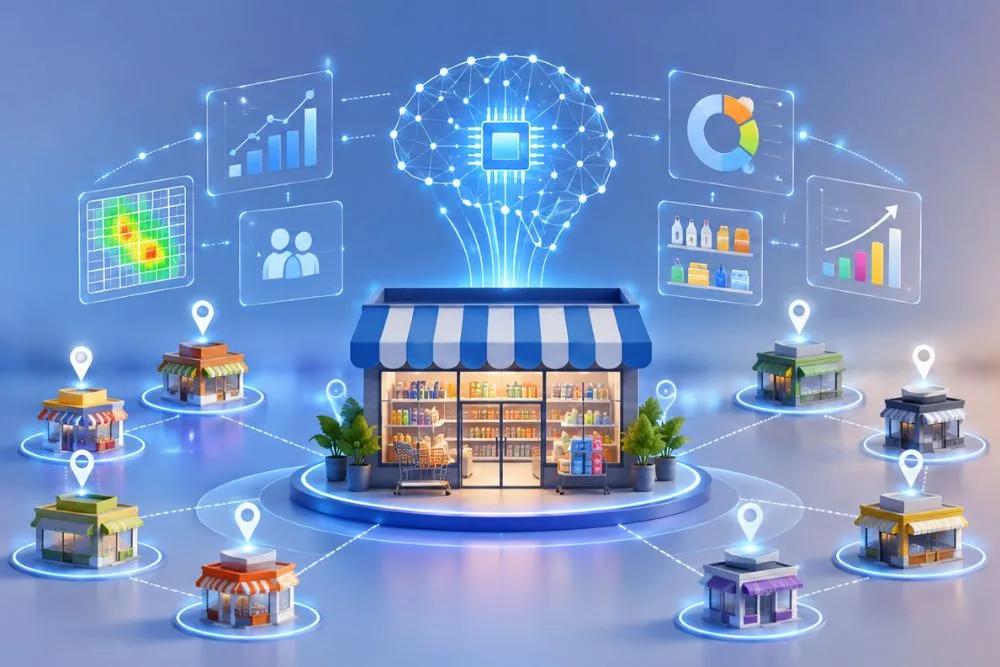
Walk into two general stores on the same street and you will find two different businesses. One sells more biscuits because of the school around the corner. The other moves more paint thinner because of a workshop nearby. Same beat, same distributor, same catalog. Completely different demand.
Most sales planning still ignores this. Forecasts get built at a national or regional level, then divided down by territory, then finally pushed to the store, losing accuracy at every step. According to IHL Group's inventory distortion research, global retailers lose close to $1.7 trillion a year to out-of-stocks and overstocks, a figure equal to more than 6 percent of worldwide retail sales. That is not a small forecasting error. That is the cost of planning for an average store that does not actually exist.
For FMCG, FMEG, and building materials companies operating across thousands of outlets, this gap between the planned number and the real one shows up every single day, in every single territory. The fix is not a better average. It is treating every store as its own decision point, and using AI to make that possible without adding headcount.
The Average Store Is a Planning Fiction
Averaging makes sense on a spreadsheet. It falls apart on the ground.
A regional sales manager might plan for 500 units of a SKU across 50 outlets in a territory. In reality, five outlets will sell 80 percent of that volume, twenty will sell a little, and the rest will barely move it at all. When the same order quantity gets pushed to every outlet anyway, two things happen at once:
- High-velocity stores run out of stock while demand is still strong, losing sales to the store next door or a competing brand
- Low-velocity stores sit on excess inventory that ties up distributor capital and eventually gets pushed back or heavily discounted
Both outcomes hurt the same P&L. Out-of-stocks lose today's sale. Overstocks lose margin on tomorrow's sale. Averaging does not split the difference. It loses on both ends at the same time.
Why This Hits FMCG, FMEG, and Building Materials Differently
Each of these sectors deals with the same core problem, store-level demand variation, but the pressure points are not identical. A useful strategy has to account for that.
FMCG: High Velocity, High Frequency, Zero Patience
FMCG runs on speed. A shopper who does not find their preferred pack size will usually buy a substitute or walk to the next shop, often within the same visit. There is no waiting list for shampoo sachets.
This means the cost of a stock-out is immediate and largely unrecoverable. A store's velocity can also shift fast, a nearby event, a local festival, a competitor's promotion. Planning built on last quarter's average simply cannot react in time. Store-level demand signals, updated frequently, are the only way to keep pace.
FMEG: Long Tail SKUs, Seasonal Spikes, and Warranty Complexity
Fast-moving electrical goods sit in an odd middle ground. Purchase frequency is lower than FMCG, but the SKU count per category is often higher, multiple wattages, colors, and models of the same fan or switch. Demand also spikes hard around specific seasons, summer for cooling appliances, festive months for lighting and appliances.
Here, the risk of averaging is different. A distributor stocking the "average" mix across the year will carry dead stock in the off-season and run short during the spike. Store-level intelligence needs to account for seasonality and SKU-level history together, not just overall category volume.
Building Materials: Project-Based Demand, Heavy Logistics, and Credit Cycles
Building materials, cement, pipes, tiles, sanitaryware, hardware, follow project cycles rather than daily footfall. A single large order tied to a construction project can distort an outlet's average completely. Add in bulky, high-value logistics and extended credit terms with dealers, and the cost of a wrong call is much higher per transaction than in FMCG.
For this sector, store-level intelligence has to weigh dealer-level credit exposure and project pipeline alongside historical sales, not just repeat purchase patterns. A dealer near an active construction site needs a very different stocking and credit conversation than one in a quiet residential lane.
The common thread across all three sectors is this: the variables differ, but the failure mode is identical. Plans built on a network average will always be wrong for most individual stores.
What Store-Level Signals Actually Look Like
Every outlet generates information that describes exactly what it needs. Most of it goes unused because nobody is collecting or connecting it consistently. Broadly, it falls into four buckets.
Demand signals
- Historical sell-through by SKU and pack size
- Local seasonality and event-driven spikes
- Category growth or decline trends at that specific outlet
Execution signals
- Shelf availability and visibility during the last few visits
- Competitor activity noticed in the store
- Promotional compliance and display presence
External signals
- Local weather patterns affecting category demand
- Nearby institutions, construction activity, or footfall drivers
- Regional festivals or events
Supply chain signals
- Distributor stock health and days of cover
- Lead times from the depot or warehouse to that outlet
- In-transit inventory and pending order status
Individually, none of these are new. A good field rep has always noticed some of them. What changes with AI is the ability to combine all four for every outlet, continuously, and turn the pattern into a specific action before the sale is lost, not after.
From Reporting to Next-Best Action
Most sales dashboards today answer one question well: what happened. A report tells you that Outlet 214 ran out of a fast mover last Tuesday. That is useful for a monthly review. It does nothing for the revenue that already walked out the door.
The real shift underway in retail execution is from reporting to next-best action. Instead of surfacing a chart, the system tells the rep, the distributor, or the planner exactly what to do next, for that specific outlet.
In practice, this looks like:
- A replenishment quantity calculated from that store's actual velocity, not a territory average
- A visit priority that moves an outlet up the list because it is trending toward a stock-out this week
- A flag on a slow-moving SKU at one specific dealer, even while the same SKU sells well two outlets away
- An early alert when a dealer's order pattern suggests a project has started or paused
Gartner's research on next-best-action systems describes this as moving from descriptive analytics to prescriptive, action-triggering intelligence, and companies applying this well in retail environments have reported measurable gains in both sales and margin. This is not about replacing the field team's judgment. It is about arming that judgment with the specific context of the outlet they are standing in, updated in real time rather than reviewed a month later.
Why Unified Data Is the Real Prerequisite
Store-level recommendations are only as reliable as the data feeding them. If order-booking data, distributor stock data, and field visit data live in three disconnected systems, no algorithm can stitch together an accurate picture. The result is a recommendation built on partial information, which is often worse than no recommendation at all.
This is where the underlying technology stack matters more than any single feature. A sales force automation software platform that captures the order is only half the picture. It needs to sit on the same data layer as a distribution management system that tracks distributor and dealer stock, alongside a mobile point-of-sale application that records what actually happened during the visit.
Retail execution teams, in-store promoters and merchandisers, add another layer through an in-store promoter app, capturing shelf and display conditions that pure order data cannot show. Bring all of it together in a business analytics dashboard, and the store-level picture finally becomes complete enough to act on with confidence.
Without that unification, "AI-powered" recommendations are really just guesses dressed up in better software.
What This Looks Like on the Ground
Consider a distributor covering 40 outlets across a mixed urban and semi-urban beat.
Under a network-average model, every outlet on that beat gets a similar suggested order, adjusted only by whatever the rep remembers from the last visit. Under a store-level model:
- A general store near a school gets a higher suggested order on snack SKUs ahead of the exam season, based on last year's actual pattern at that outlet
- A hardware dealer near a new residential project gets flagged for a credit and stock review before the project's peak material phase, not after a payment issue arises
- An electrical goods outlet gets a seasonal restock recommendation for ceiling fans two weeks before the historical demand curve typically turns, instead of reacting once shelves are already empty
- A slow-moving pack size at one specific outlet gets rotated out automatically, while the same SKU stays fully stocked at a better-performing outlet nearby
None of this requires the field rep to become a data analyst. It requires the system behind them to stop treating every outlet the same way.
Building Toward Store-Level Intelligence: A Practical Roadmap
Most organizations cannot flip a switch and get here overnight. A realistic path usually looks like this.
- Unify the data first. Bring order booking, distributor stock, and field visit data onto one platform before attempting any predictive layer. Fragmented data produces fragmented recommendations.
- Segment stores by behavior, not just geography. Group outlets by actual sales pattern and velocity, not only by territory boundaries drawn for administrative convenience.
- Automate the small, repeatable decisions first. Start with replenishment quantities and visit prioritization before attempting more complex recommendations like assortment or promotional targeting.
- Close the feedback loop. Track whether the recommended action actually improved the outcome, and let that result refine future suggestions. A system that does not learn from its own recommendations will stay static while store behavior keeps changing.
Done in that order, the shift from average planning to store-level planning becomes manageable rather than overwhelming.
The Takeaway
Scale used to mean standardization, one plan, rolled out everywhere, applied evenly. AI reverses that logic. Scale now means the ability to make a different, correct decision for every single outlet, without needing an analyst assigned to each one.
FMCG, FMEG, and building materials brands that build this into daily operations will not just execute better on paper. They will stop losing revenue in the gap between what the network plan assumed and what each store actually needed.
Frequently Asked Questions
What is store-level sales planning, and how is it different from territory-based planning?
Store-level planning builds a demand and stocking recommendation for each individual outlet based on its own sales history and signals. Territory-based planning applies one average number across many outlets, which works only for the few stores that happen to match that average.
Why do FMCG companies lose sales even when overall demand forecasts are accurate?
An accurate overall forecast can still be wrong at the outlet level. If the total number is right but distributed evenly across all stores, high-demand outlets will still run out of stock while low-demand outlets sit on unsold inventory, even though the network total looked correct on paper.
How does AI actually help field sales teams without replacing them?
AI processes far more store-level signals than a rep can track manually, historical sales, stock levels, seasonal patterns, and visit history, and turns that into a specific suggested action. The rep still makes the final call and builds the relationship. AI simply removes the guesswork from what to prioritize.
Is store-level intelligence realistic for smaller distributors, or only large FMCG companies?
It scales down well. A distributor with a few hundred outlets benefits from the same core idea, order and stocking decisions based on each outlet's actual pattern rather than a flat average, without needing enterprise-level infrastructure to get started.
What data does a business need before implementing store-level AI recommendations?
At minimum, consistent order history, distributor or dealer stock levels, and field visit records. These typically come from a sales force automation software platform paired with a distribution management system. Without this baseline, any AI layer is working with incomplete information.
How is this different from a Perfect Store or shelf compliance strategy?
Shelf compliance focuses on execution at the point of sale, planogram accuracy, stock visibility, promotional placement. Store-level intelligence goes a layer deeper, into demand forecasting, replenishment, and stocking decisions for that specific outlet. The two work best together rather than as substitutes for each other.