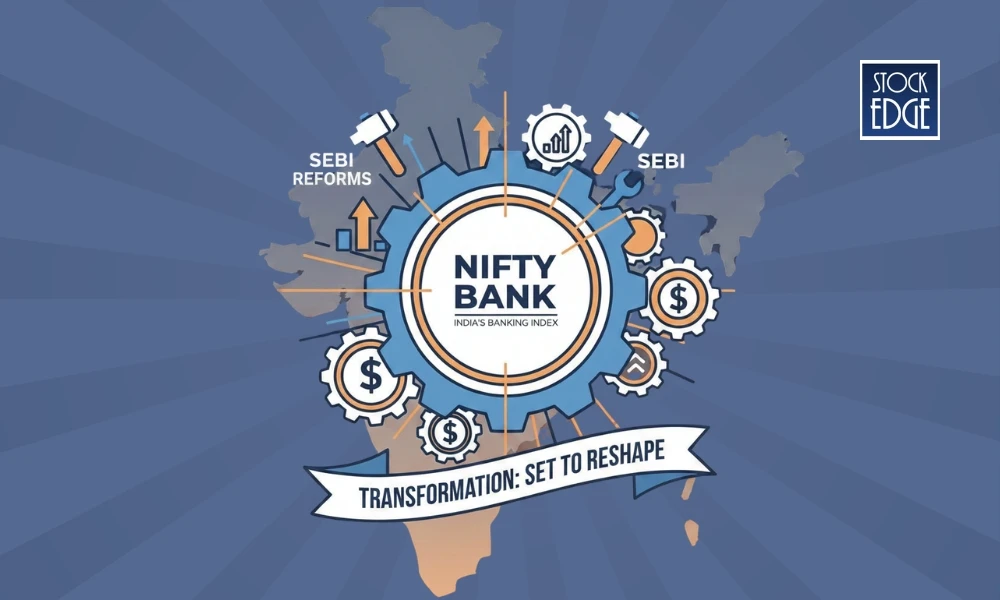
The Nifty Bank index stands at a critical juncture as February 2026 unfolds, with regulatory reforms, sector rotation dynamics, and individual bank performance creating a complex landscape for investors and traders.
It demonstrates both the strengths and challenges currently impacting India's banking sector, as it reaches ₹60,120.
Market Snapshot: Nifty Bank Today
Today, the Nifty Bank share price reached ₹60,120.55, up 0.09%. The index has demonstrated remarkable resilience over the past year after it moved through a 52-week trading range between ₹47,702.90 and ₹61,764.85. The banking sector has experienced 30% price swings because of shifting macroeconomic conditions and new regulatory measures.
Nifty Bank today has maintained its price level at 60,000, which serves as an important support point for technical analysts who study this significant psychological trading level. It has maintained its price stability, while the India VIX today, which serves as the market's fear measurement tool, has decreased to reach ₹11.55 on February 12, 2026.
Investors have reduced their anxiety about near-term market movements because the India VIX share price has dropped from its previous high points. Investors consider a lower VIX level as a sign that banking stocks will perform better because the market shows stable conditions.
The SEBI Revolution: Restructuring Nifty Bank
The Securities and Exchange Board of India (SEBI) introduced its complete reform package, which will serve as the primary factor that determines Nifty Bank share prices until October 2025. The system of landmark changes establishes new guidelines that will decrease concentration risk while enabling more companies to join the index.
The new SEBI guidelines require the Nifty Bank index to maintain a minimum stock count of 14 constituent stocks, which currently operates with 12 stocks. The new weight limits, which show maximum reduction, have created more stringent restrictions. The top constituent's weight will be capped at 20%, down from 33%, while the top three constituents' combined weight limit will now remain at 45%, in contrast to the earlier 62% limit.
The limit for individual non-F&O stocks will remain at 4.5%, while the overall limit for all stocks will reach a maximum of 10%.
The restructuring will fundamentally change how passive funds, ETFs, and index-tracking strategies operate. The three major index banks, HDFC Bank, ICICI Bank, and State Bank of India, will experience decreased market power as time progresses.
Sector Rotation: PSU Banks Stage Dramatic Comeback
The public sector unit banks have made a remarkable comeback, which has become one of the most important market stories in 2025. The Nifty Bank index continues to track this theme, which brings back public sector banks to market performance after they had been inactive for multiple years.
PSU banks draw interest from investors because their asset quality improved, their profit growth increased, and their operational efficiency enhanced. The Nifty PSU Bank index has reached its highest point in several years because it has outperformed private banking companies during specific times.
The State Bank of India has become the main example that shows how public sector banks have restored their banking operations. The market capitalization of SBI reached ₹10.9 trillion on February 11, 2026, which made it the fourth most valuable company in India after it surpassed IT giant Tata Consultancy Services.
The achievement followed SBI's outstanding Q3 FY26 results, which showed the bank had achieved its best quarterly profit of ₹21,028 crore, which represented a 24.5% increase over the previous year. The bank's net interest income increased by 9% to reach ₹45,190 crore, while the bank's asset quality improved when the gross NPA ratio dropped from 1.73% to 1.57% during the previous quarter.
Nifty Bank today shows outperformance in its main operations because multiple sectors show fluctuating performance.
Volatility Dynamics: The India VIX Factor
Traders and investors need to understand how Nifty Bank share price movements interact with volatility indicators. The India VIX today reading of ₹11.55 shows a major drop from its 52-week peak of ₹23.19, which signals that market conditions have shifted from extreme uncertainty to normal operations.
Investor confidence increases when VIX falls below 15, which it has done at present, because this pattern usually leads to stock market gains. The current India VIX share price suggests that market participants expect relatively calm conditions over the next 30 days.
The current Nifty Bank low-volatility environment has benefited the market today; however, investors should exercise caution because extremely low VIX readings indicate market complacency, which may lead to unexpected market changes.
Technical Outlook and Trading Levels
Nifty Bank maintains its overall bullish trend today, although market sell pressure has occurred in the 60,700-60,800 price range. The primary support level exists at 60,300, while the essential demand zone extends from 59,800 to 60,200. A sustained breakout above 60,700 could lead to 61,000 and higher levels if banking stocks experience new buying activity.
Investment Implications and Strategic Takeaways
The combination of SEBI reforms, together with PSU bank recovery and better volatility indicators, creates an exceptional market condition that affects Nifty Bank stock prices today. Investors should consider several strategic implications: The SEBI-mandated diversification will create a more balanced, representative index over time. The approach decreases single-stock concentration risk while opening possibilities to explore mid-cap and PSU banks that have been neglected.
ETF and index fund holders will experience portfolio rebalancing throughout the period, which extends until March 2026. The short-term tracking error will increase because of this process, but it will improve index stability and broad market coverage.
The phased implementation provides active traders with multiple tactical opportunities. Stocks that are expected to enter the market will experience increased buying activity before their official introduction, while major stocks that will lose weight will face selling pressure.
Conclusion: A Transformative Period Ahead
The current Nifty Bank share price shows an index that is currently changing. The banking sector has reached a critical point because regulatory changes have transformed its structure, public sector banks have shown strong recovery, and market conditions show low volatility.
Market participants need to stay informed about changing market conditions because SEBI-required changes will be implemented until March 2026. The Nifty Bank index will change its benchmark and trading functions because its components will increase from 12 to 14, while new weight restrictions will be introduced.
The banking sector shows strong potential for medium-term growth because the India VIX shows low values, and banking fundamentals exhibit great improvement. Investors need to practice risk management because global macroeconomic uncertainties continue to exist despite their optimism about the future. The Nifty Bank transformation involves more than technical index changes because it demonstrates how India's financial markets have developed and how regulatory systems now protect investors while enhancing market stability.