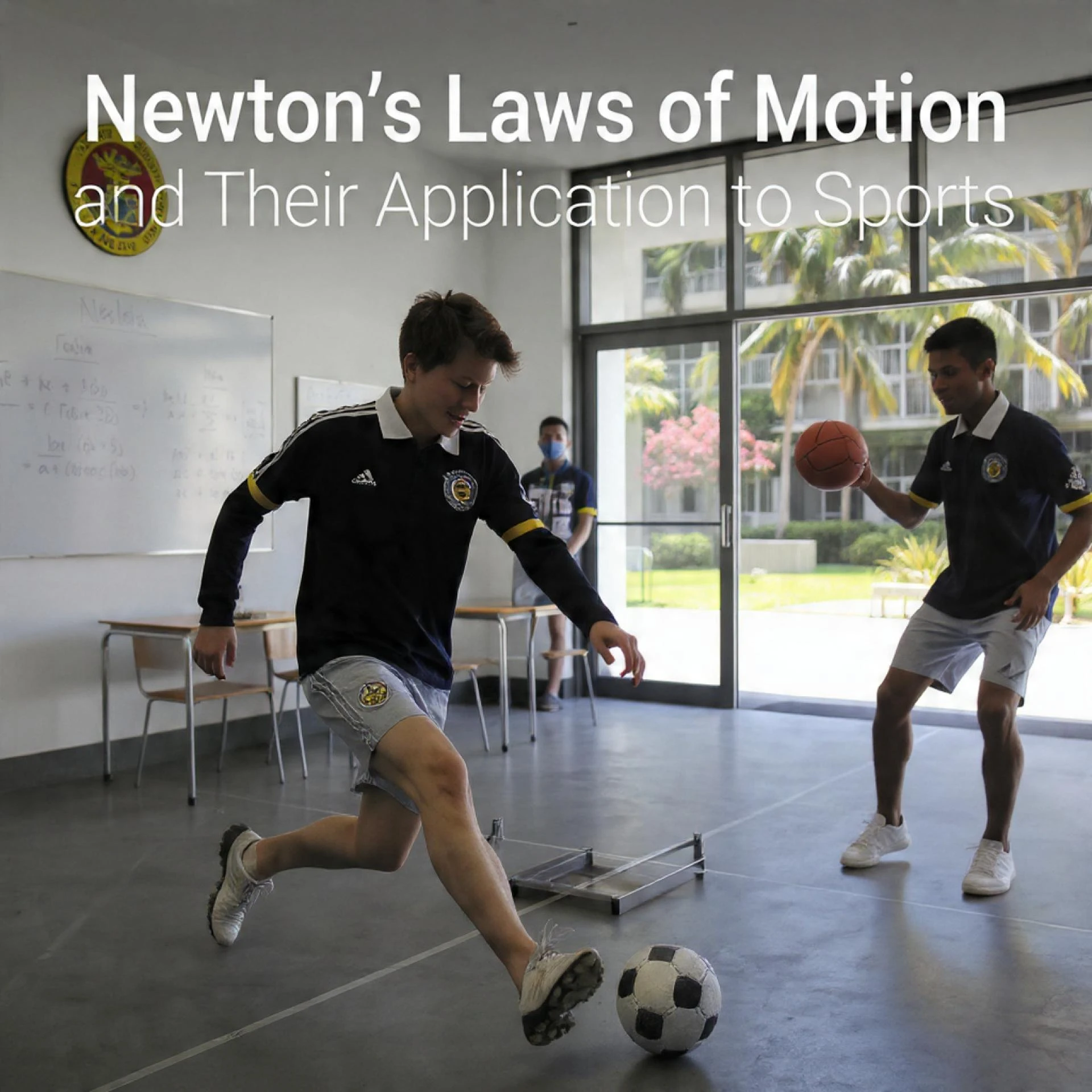
Sir Isaac Newton's groundbreaking work in the 17th century laid the foundation for classical mechanics, introducing three fundamental principles that describe the relationship between a body and the forces acting upon it. These principles, known as Newton’s Laws of Motion, are pivotal in understanding the mechanics of everyday life, including the dynamic world of sports. Athletes, coaches, and sports scientists leverage these laws to enhance performance, improve safety, and refine techniques.
Understanding Newton’s Laws of Motion
1. First Law – Law of Inertia
An object at rest will stay at rest, and an object in motion will stay in motion unless acted upon by an unbalanced external force. This principle explains why a soccer ball remains stationary on the field until a player kicks it, and why a moving car continues forward until the brakes are applied.
2. Second Law – Law of Acceleration
The acceleration of an object is directly proportional to the net force acting upon it and inversely proportional to its mass. Mathematically, this is expressed as:
F=maF = maF=ma
This law is crucial in sports biomechanics, as it quantifies how the force applied by an athlete translates into acceleration, affecting speed and direction.
3. Third Law – Action and Reaction
For every action, there is an equal and opposite reaction. In sports, this manifests when a swimmer pushes against the water, propelling themselves forward, or when a basketball player jumps off the ground, with the ground exerting an equal and opposite force to launch them into the air.
Applications in Sports
1. Enhancing Performance
Understanding Newton’s 3 Laws of Motion allows athletes to optimize their movements. For instance, sprinters apply maximum force against the track to achieve rapid acceleration, as dictated by the second law. Similarly, basketball players utilize the third law when pushing off the ground to jump higher.
2. Improving Safety
The first law explains the importance of seat belts in vehicles; they prevent passengers from continuing forward motion during sudden stops. In sports, this concept is applied in designing protective gear like helmets and pads, which help absorb and distribute forces during impacts, reducing the risk of injury.
3. Technique Refinement
Coaches analyze the forces involved in various sports techniques using Newton's laws. For example, in tennis, understanding the angle and force applied to the racket can help players hit the ball with optimal speed and spin. Similarly, in football, the trajectory of a kicked ball is studied to improve accuracy and distance.
4. Equipment Design
Sports equipment manufacturers apply Newton's laws to design gear that enhances performance and safety. The materials and structure of a tennis racket, for instance, are designed to maximize the transfer of force to the ball, while minimizing vibrations that could affect the player's arm.
5. Injury Prevention
By applying Newton's laws, sports scientists can predict the forces involved in various movements and design training programs that minimize the risk of injury. For example, understanding the forces during a high jump can lead to training that strengthens the muscles used, improving performance and reducing strain.
Real-World Examples
- Football: When a player kicks the ball, the force applied (action) propels the ball forward, and the ball exerts an equal and opposite force (reaction) on the player's foot.
- Basketball: Jumping involves applying force against the ground (action), with the ground providing an equal and opposite force (reaction) that propels the player into the air.
- Swimming: Pushing against the water with the hands and feet generates a forward motion due to the action-reaction force pair.
Conclusion
Newton’s Laws of Motion are not just theoretical concepts but practical tools that influence every aspect of sports. From enhancing performance to ensuring safety, these laws provide a framework for understanding and improving athletic activities. By applying these principles, athletes and coaches can make informed decisions that lead to better outcomes both in terms of performance and injury prevention.
Incorporating the understanding of Newton’s 3 Laws of Motion into training and equipment design continues to propel the evolution of sports, making them safer and more exciting for participants and spectators alike.