A network cable tester is one of the most essential tools any network engineer or cabling technician can have on the job. Whether you are executing a new structured cabling project, troubleshooting an existing network, or verifying cable quality before connecting active equipment, a network cable tester gives you the complete picture of every cable's condition before problems escalate into costly downtime.
This complete guide covers all types of network cable testers, what each type detects, how to choose the right tester for your project, and best practices for professional cable testing in Saudi Arabia.
Professional rule: test every cable immediately after termination, before closing walls or replacing ceiling tiles. Finding a fault during installation takes seconds to fix. Finding the same fault after the site is finished can take hours and cost significantly more in rework and site visits.
What Is a Network Cable Tester?
A network cable tester is a diagnostic instrument that verifies the electrical integrity, wiring configuration, and performance capability of copper Ethernet cables. The tester sends a controlled electrical signal through each wire in the cable and measures the response to detect any fault in connectivity, wiring sequence, or performance.
Network cable testers are essential in structured cabling environments because visual inspection of a terminated cable cannot reveal the most common and damaging wiring faults. A cable can look perfectly terminated and still contain a split pair that degrades 10 Gigabit performance, or a marginally seated conductor that passes light traffic but fails under sustained load. Only a tester reveals these invisible faults with certainty.
In Saudi Arabia, with the rapid expansion of network infrastructure projects under Vision 2030 initiatives, professional cable testing has become a standard requirement on government and enterprise projects. For network cable testers and structured cabling tools available in the Kingdom, visit Zorins Technologies.
Types of Network Cable Testers
Network cable testers are divided into several categories, each designed for a specific level of verification and diagnostic depth. Choosing the right type depends on the nature of your project, the size of the installation, and the level of technical detail your work requires.
1Basic Wire Map TesterEntry Level
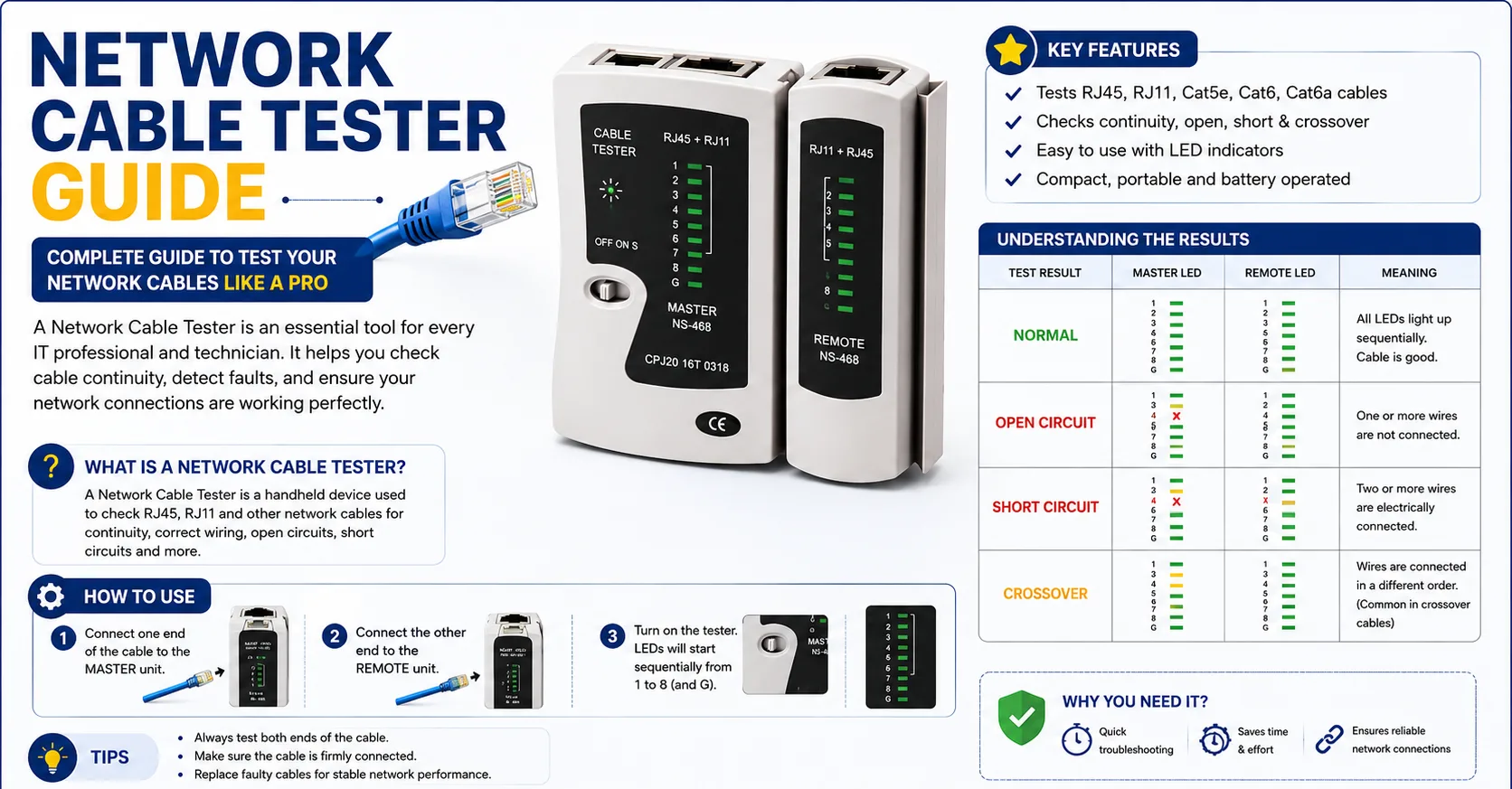
The most common and affordable type of network cable tester. A wire map tester checks that all eight conductors in a Cat5e, Cat6, or Cat6A cable are connected to the correct pin positions at both ends. It detects open circuits, short circuits, crossed wires, and reversed pairs by illuminating LED indicators for each conductor in sequence. Basic wire map testers are lightweight, portable, battery-powered, and require no technical setup. They are ideal for field technicians performing daily cable verification in small to medium office installations, home networks, and any environment where quick continuity confirmation is the primary requirement. The main limitation is that they cannot detect split pairs, measure cable length, locate fault positions, or confirm performance capability for high-speed applications.
2LAN Test Kit with Remote UnitsMulti-Drop Testing
A LAN test kit consists of a main tester unit and multiple numbered remote units that are placed at the far ends of different cable runs simultaneously. The main unit tests each cable and identifies it by the remote number at its far end, allowing a single technician to test and map multiple cable runs from a central patch panel location without an assistant at each outlet. For example, in a room with 24 cables running to wall ports throughout a floor, the technician places one remote at each outlet, returns to the patch panel, and tests all 24 runs in a single session. Each cable is identified by its remote ID number, which maps directly to its physical wall port location. Most LAN test kits also include a tone generator for tracing unknown cable paths through walls, above ceiling tiles, and through cable bundles by listening for the audio signal with a compatible probe.
3TDR Cable TesterFault Location Precision
TDR stands for Time Domain Reflectometry. A TDR tester sends a short electrical pulse down the cable and measures the time it takes for the reflected signal to return when the pulse encounters any change in electrical impedance, such as an open circuit, a short, a bad splice, or the end of the cable. Because the pulse travels at a known velocity through the cable, which is expressed as the Nominal Velocity of Propagation or NVP and typically ranges from 60 to 80 percent of the speed of light depending on the cable type, the tester calculates the distance to the fault with meter-level precision. While a basic wire map tester tells you that conductor 4 is open, a TDR tester tells you that conductor 4 is open at exactly 23 meters from the test point. On a cable run buried inside a wall or above a ceiling, this precision means you know exactly where to open the surface rather than cutting blindly at multiple points. TDR testers can also measure total cable length without a remote unit at the far end, making them valuable for verifying that runs comply with the 90-meter permanent link limit defined by TIA-568 before connecting active equipment.
4PoE TesterPower over Ethernet
A PoE tester is a specialized instrument that verifies and measures the Power over Ethernet being delivered through an Ethernet cable to connected devices such as IP security cameras, VoIP phones, and wireless access points. PoE testers identify which PoE standard is being supplied by the switch port, whether 802.3af at 15.4 watts, 802.3at at 30 watts, or 802.3bt at up to 90 watts, and measure the actual voltage and current at the point of installation to confirm that the device will receive adequate power at the end of the cable run. In Saudi Arabia, where IP camera installations and high-density wireless access point deployments are common across commercial and government buildings, PoE testers are essential tools for any professional network installation team. Discovering that a camera or access point is not receiving sufficient PoE power after full installation is significantly more disruptive than verifying power delivery before terminating the final connection.
5Qualification TesterProfessional Grade
A qualification tester combines wire map testing, TDR-based cable length measurement, PoE detection, and link speed verification into a single professional instrument. Qualification testers verify that a cable installation meets a defined performance standard for a specific application, confirming for example that a Cat6A installation can support 10 Gigabit Ethernet at the planned channel length. Advanced qualification testers also generate detailed test reports that can be saved, exported, and delivered to clients as part of project handover documentation. In Saudi Arabia, government and large enterprise projects typically require documented cable test reports as part of formal project delivery requirements. This documentation serves as both proof of compliance with international standards and a reference baseline for future maintenance and expansion work. For certified networking solutions and professional cable testing services across the Kingdom, see Zorins Technologies networking solutions.
6Fiber Optic Cable TesterFiber Testing
With the rapid expansion of fiber optic installations across Saudi Arabia as part of national digital infrastructure projects, fiber optic testers have become an essential specialized category. Fiber optic testers measure optical power loss, signal integrity, and transmission quality across fiber cable runs. Advanced models include OTDR capabilities that locate breaks, bad splices, and high-loss connectors along the fiber with meter-level precision using optical pulses rather than electrical signals. Many fiber testers also include a VFL or Visual Fault Locator, which injects visible red laser light into the fiber to identify breaks or tight bends that cause signal loss. Fiber optic testing is a completely separate discipline from copper cable testing and requires dedicated fiber instruments regardless of how advanced the copper tester is.
What Faults Does a Network Cable Tester Detect?
A professional network cable tester detects a wide range of faults that directly impact network performance. Understanding what each fault type means helps technicians diagnose and resolve problems faster.
- Open Circuit - a complete break in one or more conductors preventing signal transmission through that wire
- Short Circuit - two conductors making unintended contact, causing signal interference and potential equipment damage
- Crossed Wires - conductors connected to incorrect pin positions at one or both ends of the cable
- Reversed Pair - both conductors within a pair are swapped at one end, reversing polarity
- Split Pair - a wiring fault where conductors from two different pairs are used together, causing severe crosstalk that basic continuity testing cannot detect because all pins appear correctly connected
- Length Violation - cable run exceeding the 90-meter permanent link maximum defined by TIA-568, which causes signal degradation at high speeds
- PoE Faults - insufficient voltage or current reaching a PoE-powered device due to cable resistance or switch port configuration issues
How a Network Cable Tester Works
A basic wire map tester works by sequentially energizing each of the eight conductors in the cable and measuring which pin receives the signal at the remote unit. The main unit compares the received pin sequence against the expected sequence for the configured wiring standard, either T-568A or T-568B, and reports any deviation as a specific fault type.
A TDR tester operates on a fundamentally different principle. It injects a very short electrical pulse into the cable and monitors the returning reflections. When the pulse reaches a point of impedance change, whether from an open, a short, a bad connector, or the cable end, a portion of the pulse energy reflects back to the source. The tester measures the exact time between transmission and reflection and converts that time to distance using the cable's NVP value. This distance-to-fault capability is what makes TDR an indispensable tool for troubleshooting installed cable runs that cannot be physically accessed along their entire length.
TIA-568 Standard and Cable Testing in Saudi Arabia
TIA-568 is the international reference standard for structured cabling in network environments. It defines installation requirements and performance specifications for both copper twisted-pair and fiber optic cables. Understanding the key TIA-568 requirements that affect cable testing is essential for any professional network installer working in Saudi Arabia.
The maximum horizontal permanent link length is 90 meters for fixed cabling, with up to 10 meters of patch cords allowed for a total channel length of 100 meters. Exceeding this limit causes signal degradation and instability, particularly for Gigabit Ethernet and 10 Gigabit Ethernet applications. TDR testers allow you to verify this requirement with precision before connecting active equipment, rather than discovering a length violation after a full installation is complete.
On government and enterprise projects in Saudi Arabia, TIA-568 compliance verification through documented cable testing is typically a contractual requirement. Zorins Technologies engineers use professional certified testing equipment on all structured cabling projects in Riyadh, Al Khobar, and across the Kingdom, with detailed test reports delivered as part of formal project handover. For professional cabling services, visit Zorins Technologies networking solutions.
How to Choose the Right Network Cable Tester for Your Project
Small Offices and Home Networks
A basic wire map tester is fully adequate. It detects the most common wiring faults at an affordable price with minimal setup. IT help desk staff and small office technicians who need to quickly confirm whether a cable is the source of a connectivity problem before escalating will find a basic tester covers their daily needs completely.
Medium Installations and Multi-Drop Projects
A LAN test kit with multiple remote units is the right choice. The ability to test and identify multiple cable runs simultaneously from a single patch panel location saves significant time compared to testing each cable individually. The tone generator capability adds cable tracing for runs that are not clearly labeled or documented.
Enterprise and Data Center Projects
A qualification tester with TDR, PoE detection, and report generation capability is the professional standard. The combination of fault detection, length verification, PoE confirmation, speed qualification, and documented reporting satisfies both technical and contractual requirements for large-scale commercial and government installations in Saudi Arabia.
Fiber Optic Installations
A dedicated fiber optic tester with OTDR and VFL capabilities is required for any fiber project regardless of scale. Copper cable testers have no capability to test fiber optic cables. For comprehensive fiber and copper networking solutions in Saudi Arabia, Zorins Technologies provides both the equipment and the certified engineering expertise to deliver professional results.
Best Practices for Professional Cable Testing
- Test every cable immediately after termination, before closing walls or replacing ceiling tiles, to enable immediate remediation of any fault found
- Verify the wiring standard configured in the tester, either T-568A or T-568B, matches the standard used for termination before testing
- Document the test result for every cable and store reports for client handover and future maintenance reference
- Check battery charge before arriving at the site to prevent unexpected shutdowns during testing sessions
- Use only compatible, genuine remote units with the main tester to ensure accurate readings and avoid false results
- Calibrate TDR testers regularly if cable length readings seem inconsistent with known measurements
- Label every cable with its test ID immediately after testing to eliminate confusion during documentation
- Test 100 percent of cable terminations, not a sample, because faults are random and can affect any run regardless of how carefully it was installed
Network Cable Tester Quick Selection Guide
Choose the Right Tester for Your Needs
Wire Map TesterSmall offices - basic continuity and wiring verification
LAN Test KitMulti-drop installations - cable tracing and identification
TDR TesterFault location by distance - large or complex installations
PoE TesterIP cameras - VoIP phones - wireless access points
Qualification TesterEnterprise projects - documented reports - standards compliance
Fiber Optic TesterFiber installations - power loss measurement - OTDR
Max Cable Length90m permanent link plus 10m patch cords equals 100m total
Frequently Asked Questions
Final Thoughts
A network cable tester is not optional equipment for professional network installers. It is the tool that protects the quality of every installation, confirms that work meets international standards, and prevents the expensive callbacks that result from faults discovered after a project is complete.
Investing in the right cable tester for your project scale returns its cost immediately through faster fault detection, fewer site revisits, and the ability to deliver documented proof of compliance that clients and project managers increasingly require on professional installations in Saudi Arabia.
For network cable testers, structured cabling tools, and certified networking solutions across Saudi Arabia, Zorins Technologies networking solutions provides the equipment and the engineering expertise to deliver professional results on every project in Riyadh, Al Khobar, and across the Kingdom. Talk to a certified network specialist at Zorins Technologies to find the right solution for your specific project requirements.