
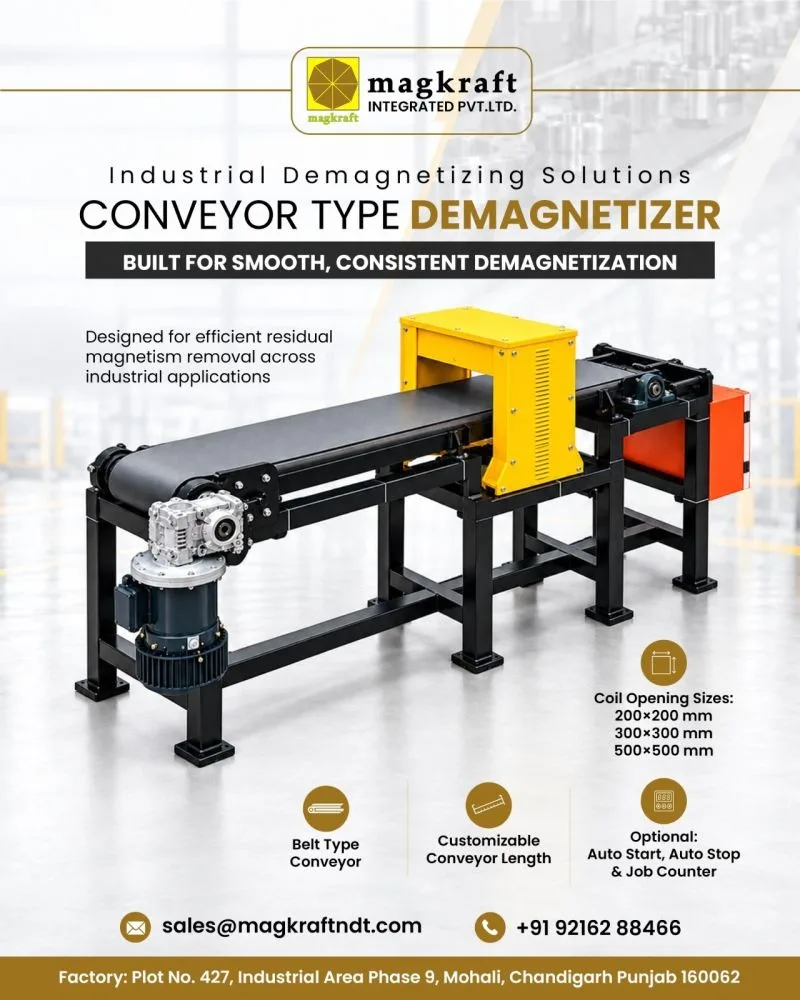
Magnetic particle inspection is a useful method for finding surface and near-surface defects in ferromagnetic components. But once the inspection is completed, there is one more step that should not be ignored — removing the unwanted magnetism left inside the component.
This is where an NDT Demagnetizer becomes important. Proper demagnetization helps prepare inspected parts for their next manufacturing, assembly, or service stage. The right type of demagnetizer depends on the component size, shape, material, production volume, and the level of residual magnetism that needs to be removed.
MagkraftNDT provides demagnetizing solutions for different industrial inspection and production requirements.
Why Demagnetization Matters After MPI
During magnetic particle inspection, a magnetic field is intentionally applied to the component so that defects can be detected. After testing, some residual magnetism may remain in the part.
In certain applications, this residual magnetism can create problems during later processes. It may attract metallic particles, affect machining or assembly, or interfere with other operations.
An NDT Demagnetizer helps reduce this residual magnetism and gives manufacturers better control over the complete inspection process.
The important point is that demagnetization is not simply an additional machine operation. For many applications, it is part of maintaining the quality and usability of the inspected component.
Different Types of Demagnetizers
There is no single demagnetizer that is ideal for every component or production line. Different manufacturing situations require different equipment arrangements.
1. Chute Type Demagnetizer
A chute type demagnetizer is useful when components can be moved through a defined demagnetizing path.
Parts are guided through the chute while the required magnetic field is applied and gradually reduced according to the machine configuration. This arrangement can be suitable for production environments where parts need to move continuously or in batches.
It can also reduce unnecessary manual handling when the component flow is already organized around a fixed path.
2. Trolley Type Demagnetizer
A trolley type demagnetizer provides a practical solution when components need to be transported to and through the demagnetizing area.
The trolley arrangement can be helpful for larger or heavier components that are not convenient to handle manually. Parts can be positioned on the trolley and moved through the required demagnetizing zone.
For workshops handling different component sizes, this type of setup can offer greater flexibility in day-to-day operations.
3. Stationary Type Demagnetizer
A stationary type demagnetizer is generally installed at a fixed location within the inspection or production area.
This can be a good option when components follow a regular inspection route and the demagnetizing operation needs to remain at one dedicated workstation.
The machine can be selected according to the component dimensions and application requirements, making it suitable for controlled and repeatable demagnetization.
4. DC Reversing Demagnetizer
A DC reversing demagnetizer uses reversing DC current to reduce residual magnetism. The direction and strength of the magnetic field are controlled so that the remaining magnetism can be progressively reduced.
This type of system can be useful for applications where controlled demagnetization is required, particularly for components that retain stronger magnetic fields after inspection.
For manufacturers dealing with demanding NDT applications, understanding the difference between AC-based and DC reversing approaches can be important when selecting equipment.
Which Demagnetizer Should You Choose?
The best choice depends on more than just the component material.
Before selecting an NDT Demagnetizer, manufacturers should consider:
- Size and weight of the components
- Component shape and geometry
- Level of residual magnetism
- Required production speed
- Batch or continuous processing
- Available floor space
- Manual or automated material handling
- Required demagnetization performance
- Integration with the existing MPI process
For example, a small component production line may have completely different requirements from a facility handling large shafts, heavy forgings, or other industrial parts.
Demagnetization as Part of the Complete NDT Process
A good NDT setup should look at the complete workflow rather than focusing only on defect detection.
The process may involve:
Inspection → Defect identification → Evaluation → Demagnetization → Cleaning/handling → Next production stage
Including demagnetization within this workflow can make the overall inspection process more organized.
MagkraftNDT offers NDT equipment and solutions designed around practical industrial inspection requirements, helping manufacturers select equipment according to their component and production needs.
What Makes a Good Demagnetizing Setup?
A useful demagnetizing system should fit naturally into the manufacturing process. Operators should be able to handle components safely and efficiently, while the equipment should provide the required level of demagnetization for the application.
The right setup can help with:
- Better control of residual magnetism
- Smoother post-MPI processing
- Reduced manual handling
- More consistent demagnetization
- Easier integration into production workflows
- Improved handling of inspected components
An NDT Demagnetizer therefore plays an important role beyond simply switching off the magnetic field used during inspection.
Why Consider MagkraftNDT?
Different components demand different approaches to magnetic inspection and demagnetization. A practical solution should take the actual application into account instead of treating every production environment in the same way.
MagkraftNDT manufactures NDT equipment and has experience in magnetic particle inspection technology and related processes. This allows manufacturers to consider demagnetization as part of their overall NDT setup rather than as a separate afterthought.
Whether the requirement is for a chute type demagnetizer, trolley type demagnetizer, stationary type demagnetizer, or DC reversing demagnetizer, the equipment should be selected according to the component and production requirements.