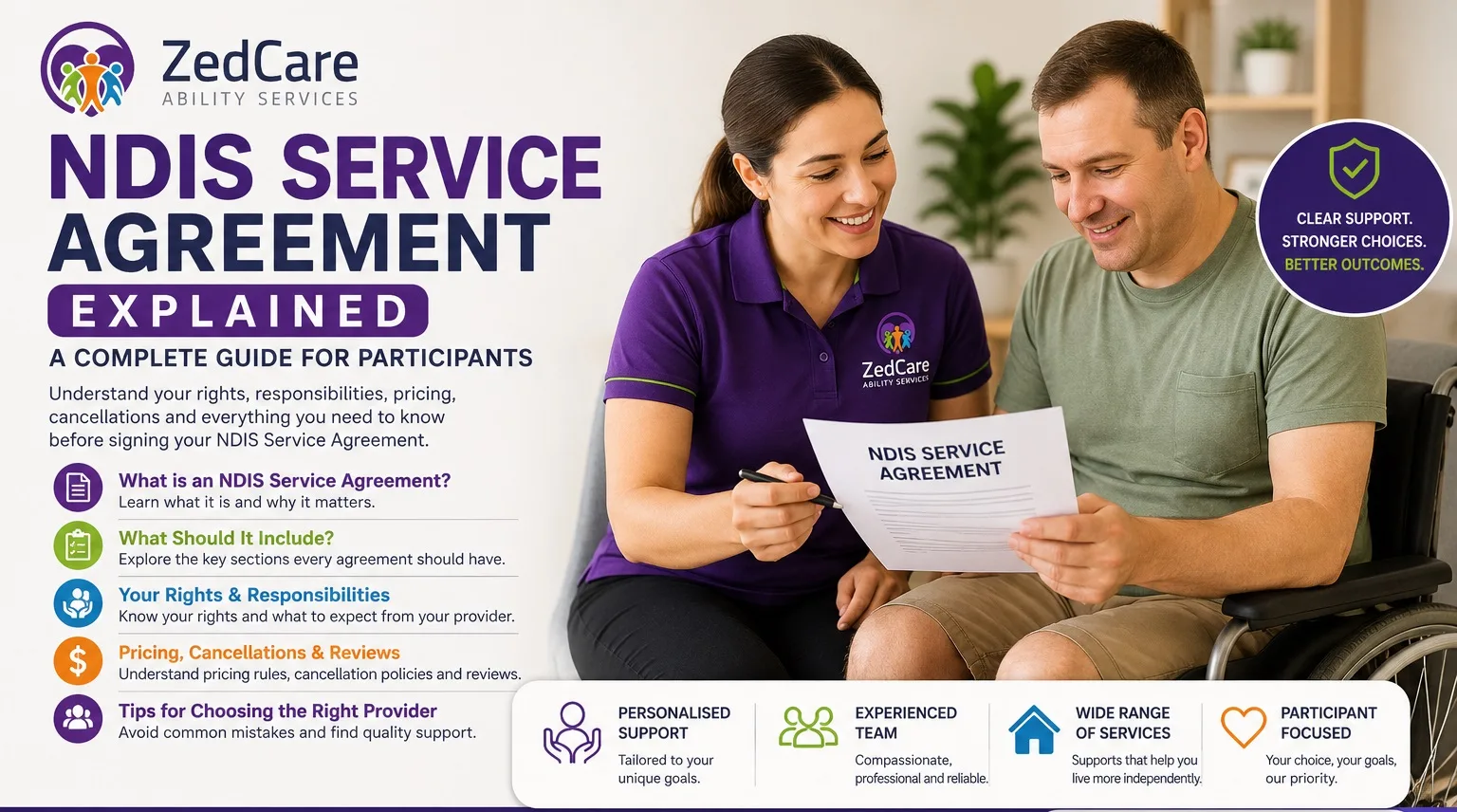
Quick Answer: An NDIS Service Agreement is a written agreement between an NDIS participant and their chosen provider that outlines the supports to be delivered, service schedules, pricing, responsibilities, cancellation policies, and how either party can end the agreement. While a Service Agreement is generally not compulsory, it helps set clear expectations, protects both parties, and creates a strong foundation for quality disability support.
Introduction
Starting your NDIS journey is an important step towards achieving greater independence and reaching your personal goals. Whether you're accessing supports for the first time or changing providers, you'll likely be asked to review and sign an NDIS Service Agreement before services begin.
If you've never seen one before, it's normal to have questions.
- Is it mandatory?
- What should it include?
- Can I negotiate the terms?
- Will it affect my NDIS funding?
- What happens if I want to change providers later?
Understanding how Service Agreements work can help you make informed decisions, avoid misunderstandings, and build a positive relationship with your provider.
In this guide, we'll explain everything you need to know before signing, including your rights, funding options, key sections to review, and practical tips for choosing the right NDIS provider.
Why an NDIS Service Agreement Matters
Although the NDIS doesn't always require a written Service Agreement, many providers use one because it creates clarity and transparency from the beginning.
A well-prepared agreement helps:
- Clearly define the supports being provided
- Explain service schedules and locations
- Outline pricing and payment arrangements
- Set expectations for both the participant and provider
- Reduce misunderstandings
- Explain cancellation and review processes
- Provide a clear pathway for raising concerns or complaints
Rather than being viewed as paperwork, a Service Agreement should be seen as a practical guide that supports a successful working relationship.
What Is an NDIS Service Agreement?
An NDIS Service Agreement is a written contract between an NDIS participant (or their nominee or guardian) and an NDIS provider.
While every provider may use a different format, most agreements explain:
- The supports being delivered
- Service schedules
- Locations where supports will take place
- Pricing and payment arrangements
- Participant and provider responsibilities
- Cancellation policies
- Review dates
- Complaint procedures
- How the agreement can be ended
The purpose is simple—to ensure everyone understands what has been agreed before services begin.
Is an NDIS Service Agreement Mandatory?
In most cases, no.
The NDIS does not generally require participants to sign a written Service Agreement before receiving supports. However, many registered and unregistered providers include one as part of their onboarding process because it helps reduce confusion and protects both parties.
You should never feel pressured to sign immediately.
Take the time to read the agreement carefully, ask questions, and request changes if something doesn't suit your circumstances. A reputable provider will be happy to explain the document and ensure you understand every section before signing.
Who Can Sign the Agreement?
Depending on the participant's circumstances, an NDIS Service Agreement may be signed by:
- The participant
- A parent (for children)
- A legal guardian
- An appointed nominee
- Another authorised representative
The person signing should have the legal authority to make decisions on behalf of the participant where required.
How Funding Management Affects Your Service Agreement
One area that often causes confusion is how your NDIS funding is managed. While the purpose of the Service Agreement remains the same, the billing process differs depending on your funding arrangement.
Funding TypeHow Payments Are ManagedNDIA ManagedProviders generally claim payments directly from the NDIA.Plan ManagedProviders invoice your Plan Manager, who pays using your NDIS funding.Self ManagedYou receive invoices directly, pay the provider, and then claim reimbursement through the NDIS.Regardless of how your funding is managed, your Service Agreement should clearly explain pricing, payment arrangements, and responsibilities.
Service Agreement vs Service Booking
Many participants confuse a Service Agreement with a Service Booking, but they serve different purposes.
Service AgreementService BookingAgreement between participant and providerAdministrative funding arrangementExplains supports and responsibilitiesAllocates funding in the NDIS systemIncludes pricing and cancellation policiesDoes not explain service expectationsSigned by the participantUsually created electronicallyIn simple terms, a Service Agreement explains how your supports will be delivered, while a Service Booking helps manage how your funding is allocated.
What Should an NDIS Service Agreement Include?
Although each provider has their own template, a quality Service Agreement should contain the following information.
Participant and Provider Details
The agreement should clearly identify both the participant and the provider, along with relevant contact information.
Description of Supports
This section should explain:
- What supports will be delivered
- How often services will occur
- Where supports will be provided
- The duration of each service
The more detailed this section is, the less likely misunderstandings are to occur.
Service Schedule
Your agreement may include:
- Regular support days
- Start and finish times
- Frequency of services
- Public holiday arrangements
Having these details in writing helps everyone stay organised.
Pricing and Payment
The agreement should explain:
- Hourly rates
- Travel costs (where applicable)
- Non-face-to-face supports (where applicable)
- How invoices will be managed
Where applicable, pricing should align with the current NDIS Pricing Arrangements and Price Limits.
Cancellation Policy
One of the most important sections explains:
- How much notice is required to cancel a service
- Whether cancellation fees apply
- What happens if either party needs to reschedule
Always read this section carefully before signing.
Responsibilities
A good agreement outlines responsibilities for both the participant and the provider.
Participants are generally expected to communicate changes, provide a safe environment, and treat staff respectfully.
Providers should deliver services professionally, respect participant choice, protect privacy, and communicate openly.
Complaints and Ending the Agreement
Your Service Agreement should explain how to raise concerns, make complaints, and end the agreement if your circumstances change.
Understanding Your Rights
One of the core principles of the NDIS is choice and control.
Your Service Agreement should support these principles by helping you understand the services you'll receive while respecting your preferences and decisions.
As an NDIS participant, you generally have the right to:
- Choose your preferred provider
- Receive information in a way you understand
- Ask questions before signing
- Be treated with dignity and respect
- Have your privacy protected
- Request changes if your needs change
- Raise concerns or complaints without fear of discrimination
- End your Service Agreement according to its terms
You should never feel rushed into signing an agreement you don't fully understand.
A professional provider will encourage questions, explain the document clearly, and ensure you feel confident before services begin.
How ZedCare Ability Services Supports Participants
At ZedCare Ability Services, we believe every participant deserves to understand their Service Agreement before supports begin.
Our team takes the time to explain each section in plain language, answer your questions, and ensure you understand your rights, responsibilities, and available support options.
Whether you're accessing Core NDIS Supports, Support Coordination, Supported Independent Living (SIL), or other disability services, we work collaboratively with you to develop support arrangements that reflect your goals, preferences, and lifestyle.
We believe that clear communication and transparency are the foundation of quality disability support.
Common Mistakes to Avoid Before Signing
Even with a clear Service Agreement, overlooking small details can lead to confusion later. Before signing, take a few minutes to review the document carefully and ask questions if anything is unclear.
Some of the most common mistakes participants make include:
Signing Without Reading the Entire Agreement
It's tempting to focus only on the services you'll receive, but important details are often found in sections covering cancellation policies, pricing, review dates, complaints, and ending the agreement.
Always read the entire document before signing.
Assuming Every Provider Uses the Same Agreement
Every NDIS provider has their own Service Agreement. While many contain similar information, they can differ in areas such as cancellation notice periods, scheduling arrangements, communication methods, and service flexibility.
Comparing agreements from different providers can help you make a more informed decision.
Not Checking Service Details
Before signing, confirm that the agreement accurately reflects what you've discussed, including:
- Support days and times
- Frequency of services
- Service locations
- Pricing
- Preferred support worker (if applicable)
Correcting these details before services begin helps prevent misunderstandings.
Forgetting to Keep a Copy
Always keep a signed copy of your Service Agreement. It provides a useful reference if you need to review your supports, discuss changes, or compare services during future NDIS plan reviews.
Red Flags to Watch For
Most NDIS providers are committed to delivering high-quality support, but it's still important to review every agreement carefully.
Be cautious if you notice:
- Services are described vaguely.
- Pricing is unclear or incomplete.
- Important sections have been left blank.
- Cancellation policies aren't explained.
- The written agreement doesn't match what was discussed.
- You're being pressured to sign immediately.
- Your questions are avoided or dismissed.
A trustworthy provider will encourage you to review the agreement, ask questions, and make sure you're comfortable before signing.
Can You Negotiate a Service Agreement?
Yes.
Although many providers use standard templates, a Service Agreement isn't always fixed. Many aspects can be discussed before it's signed.
You may be able to negotiate:
- Preferred support days and times
- Communication preferences
- Service review dates
- Scheduling arrangements
- Support worker preferences
- Additional or reduced support hours
The goal is to create an agreement that works well for both you and your provider while supporting your NDIS goals.
What Happens If You Want to Change Providers?
Your support needs may change over time, or you may decide another provider is a better fit.
Changing providers is generally possible, but it's important to:
- Review your current Service Agreement.
- Check the required notice period.
- Inform your current provider.
- Arrange new supports before ending existing services where possible.
- Keep copies of important documents.
Planning ahead can help ensure a smooth transition without disrupting your supports.
What Happens If There's a Disagreement?
Most concerns can be resolved through open and respectful communication.
If an issue arises:
- Discuss your concerns directly with your provider.
- Follow the complaints process outlined in your Service Agreement.
- Seek assistance from your Support Coordinator, Local Area Coordinator (LAC), advocate, or the NDIS Quality and Safeguards Commission if the issue remains unresolved.
Keeping records of conversations and correspondence can be helpful if further assistance is needed.
NDIS Service Agreement Checklist
Before signing, use this simple checklist to make sure everything is in order.
Checklist✓My personal details are correct☐Services are clearly described☐Support schedule is accurate☐Pricing is clearly explained☐Cancellation policy is understood☐Review date is included☐Notice period is acceptable☐Complaint process is explained☐I have received a signed copy☐Taking a few extra minutes to review these items can help you avoid problems later.
Sample NDIS Service Agreement
Although every provider uses a different format, a section of your agreement may look something like this:
ItemExampleSupportPersonal CareFrequencyMonday to FridayTime8:00 am – 9:00 amLocationParticipant's HomeFunding CategoryCore SupportsCancellation NoticeTwo business daysReview DateEvery six monthsThis example illustrates the level of detail you should expect to see in your own agreement.
Frequently Asked Questions
Is an NDIS Service Agreement compulsory?
Not always. While the NDIS generally doesn't require participants to have a written Service Agreement, many providers use one because it clearly outlines services, responsibilities, and expectations.
Can I take the agreement home before signing?
Yes. You should never feel pressured to sign immediately. Take the time to read the agreement carefully, discuss it with family or your Support Coordinator if needed, and ask questions about anything you don't understand.
Can I request changes before signing?
Yes. Many providers are happy to discuss reasonable changes before the agreement is finalised.
Does signing a Service Agreement affect my NDIS funding?
No. Your funding is determined through your approved NDIS plan. The Service Agreement simply explains how your provider will deliver those funded supports.
Can I end my Service Agreement?
Yes. Most agreements explain how either party can end the arrangement, including any notice period that applies.
Choosing the Right NDIS Provider
A clear Service Agreement is important, but choosing the right provider involves much more than paperwork.
When comparing providers, ask yourself:
- Do they listen to my goals?
- Do they communicate clearly?
- Are they reliable and respectful?
- Do they offer flexibility if my needs change?
- Will they involve me in decisions about my supports?
- Do they encourage questions before signing?
A provider should make you feel informed, respected, and confident from your very first conversation.
Why Choose ZedCare Ability Services?
At ZedCare Ability Services, we believe quality disability support starts with trust, transparency, and genuine partnership.
Before your supports begin, we take the time to explain your Service Agreement in plain language, answer your questions, and ensure you understand every aspect of your services. We believe participants should feel informed and empowered—not overwhelmed by paperwork.
Our experienced team provides personalised support tailored to your individual goals, preferences, and lifestyle.
Our services include:
- Core NDIS Supports
- Personal Care
- Domestic Assistance
- Community Participation
- Transport Assistance
- Meal Preparation
- Support Coordination
- Supported Independent Living (SIL)
Whether you're new to the NDIS or looking for a provider that better meets your needs, we're committed to delivering compassionate, person-centred support that promotes independence, confidence, and meaningful participation in everyday life.
Final Thoughts
An NDIS Service Agreement is much more than an administrative document. It's a practical guide that helps establish clear expectations, protects both participants and providers, and supports a positive working relationship.
Before signing, take the time to read the agreement carefully, ask questions, and make sure you understand your rights and responsibilities. If something isn't clear, don't hesitate to seek clarification or request changes.
Choosing a provider that values transparency, communication, and participant choice can make a significant difference to your NDIS experience.
If you're looking for reliable, person-centred disability support, ZedCare Ability Services is here to help. Our friendly team is ready to answer your questions, explain your Service Agreement, and provide tailored supports that help you achieve your goals with confidence.
Contact ZedCare Ability Services today to learn more about our NDIS services and discover how we can support you on your journey towards greater independence and a better quality of life.