
What Is a MySQL Deadlock?
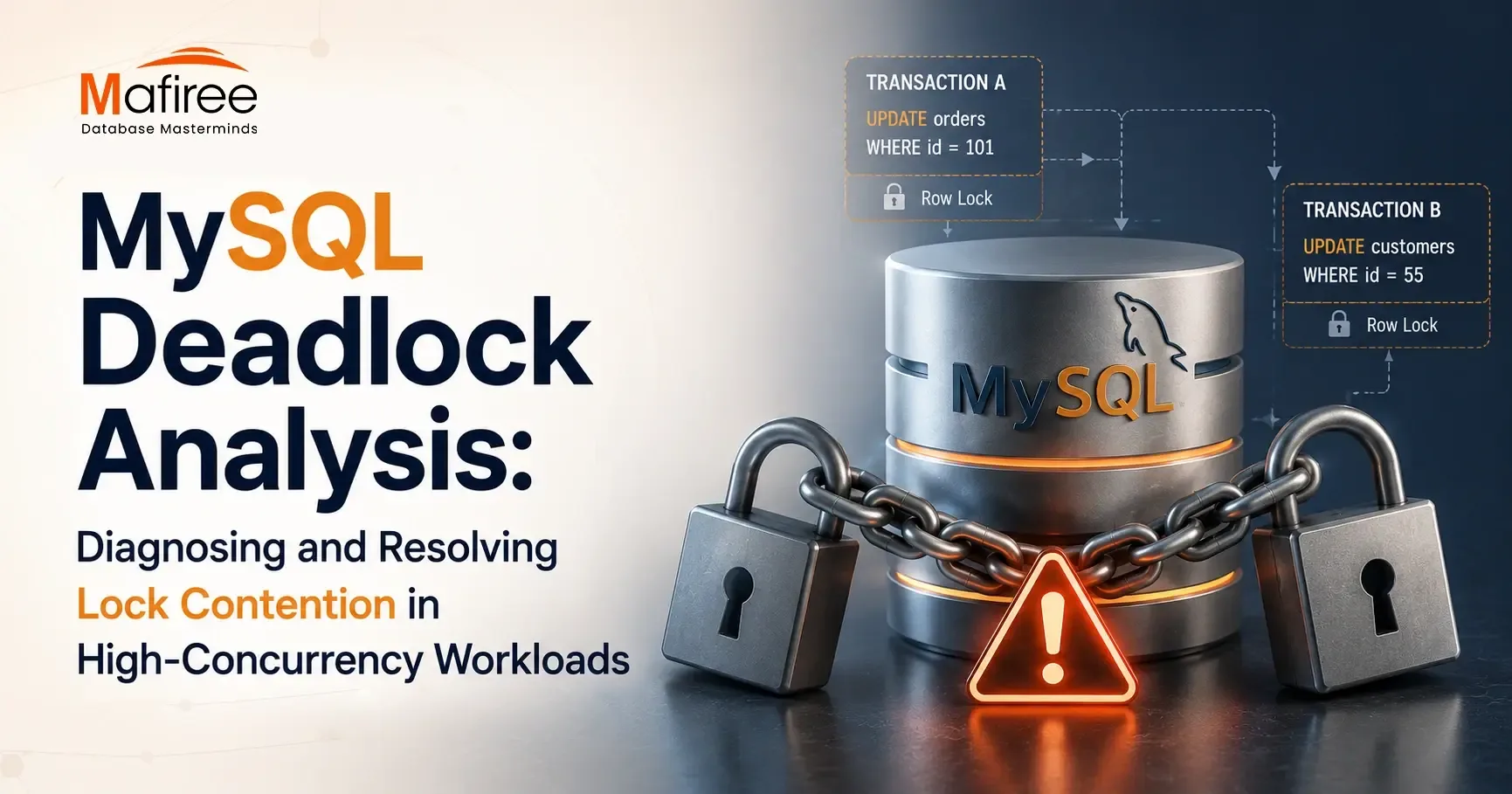
A MySQL deadlock happens when two or more transactions each hold a lock that another transaction needs, forming a circular dependency that stops all of them from moving forward. InnoDB automatically spots these cycles and rolls back one of the transactions, sending back error 1213 to the affected application, which should be built to retry safely. This isn't a bug - it's an expected outcome of concurrent writes competing for the same data, and it becomes a real concern only when it happens too often under heavy load.
How Do You Diagnose a MySQL Deadlock?
Diagnosis starts with running SHOW ENGINE INNODB STATUS\G and examining the "LATEST DETECTED DEADLOCK" section, which shows the transactions involved, the locks they held and wanted, and the SQL that triggered the conflict. For ongoing monitoring, MySQL exposes live lock data through system tables, but the right ones depend on version: MySQL 8.0+ uses performance_schema.data_locks, performance_schema.data_lock_waits, and information_schema.INNODB_TRX, while MySQL 5.7 and earlier relies on the now-removed INFORMATION_SCHEMA.INNODB_LOCKS and INNODB_LOCK_WAITS. Turning on the slow query log (with long_query_time = 0 and log_slow_admin_statements) also helps catch long-running queries that contribute to lock contention.
Why Do MySQL Deadlocks Happen?
Common causes include: transactions reaching the same rows through different indexes (creating inconsistent lock order), transactions that stay open too long and hold locks longer than necessary, and applications that access tables in inconsistent orders across different code paths.
How Do You Fix a MySQL Deadlock?
InnoDB's deadlock detector watches for cycles in the wait-for graph. When one appears, it picks a "victim" transaction to roll back, weighing it by how many rows it has modified and how much work it has already done — generally sparing the transaction with more invested work. This is described as a heuristic rather than a guarantee, so applications shouldn't assume they can predict which transaction will be chosen.
How Should an Application Handle MySQL Error 1213?
Once a transaction is rolled back, the app receives error 1213. This should be treated as a normal, recoverable event, not a failure — the fix is to reissue the entire transaction using retry logic with exponential backoff.
How Can You Prevent Recurring MySQL Deadlocks?
Prevention comes down to three practices: keep queries consistent in which indexes they use (avoiding full scans), keep transactions short by committing early and often, and always access tables in the same order across all transactions to avoid circular waits.
MySQL Deadlock Diagnostic Workflow
A nine-step workflow is laid out: capture the deadlock evidence immediately (since it gets overwritten), identify the two transactions and note which was the victim, map out each transaction's held versus requested locks, trace those locks back to the actual SQL and indexes via EXPLAIN, confirm there's a genuine circular dependency (otherwise it may just be a lock wait timeout, error 1205), apply the appropriate fix, test the fix under real concurrent load, keep monitoring with innodb_print_all_deadlocks enabled, and maintain retry logic as an ongoing safety net.
MySQL Deadlock Troubleshooting Example
A quick-reference table matches symptoms to causes: an isolated error 1213 usually points to inconsistent index usage; deadlocks clustering during peak load usually mean long transactions under concurrency; and deadlocks recurring across varied queries usually mean inconsistent lock ordering.
Mafiree Verdict: What Should You Fix First?
The recommended fix order is: enforce consistent locking order first, then shorten long transactions, then align index usage - with retry logic always present as a backstop, not a primary solution. This kind of structured diagnostic discipline is also central to how Mafiree's Managed Database Services team approaches recurring lock contention issues for clients.
Case Study: Resolving High-Concurrency Deadlocks at Scale
A case study describes an e-commerce client whose deadlocks stemmed from inconsistent index usage during peak hours. Mafiree standardized locking order, broke slow transactions into smaller pieces, and added monitoring/alerting, resulting in roughly a 70% drop in deadlock occurrences (results specific to that engagement, varying by workload).
What Are the Limitations of Deadlock Prevention?
Deadlocks can never be fully eliminated - even well-tuned systems will occasionally hit one so the real goal is making them rare and predictable, with safe retries covering what slips through.
Conclusion
Deadlock analysis is essential for stable, high-performance MySQL systems. Understanding why deadlocks happen and using the right diagnostic tools lets teams address issues proactively, whether running a small app or a large enterprise system.