A Minimum Viable Product (MVP) is the first version of a digital product built with only the essential features needed to solve a specific user problem. Instead of developing a complete product from the beginning, startups launch an MVP to test their idea, gather customer feedback, and validate market demand.
MVP development companies help businesses reduce risks, optimize costs, and improve product-market fit before investing in large-scale development. In today’s fast-moving startup ecosystem, building an MVP has become one of the smartest ways to launch innovative products quickly and efficiently.
Startups across industries such as SaaS, fintech, healthcare, eCommerce, and AI are using MVP strategies to stay competitive and adapt to changing customer expectations.
Why MVPs Are Essential for Modern Startups
Launching a product without testing market demand can lead to wasted resources and failed business ideas. MVPs help startups avoid this problem by focusing on validation and learning.
Key benefits of MVP development include:
- Faster product launch
- Lower development costs
- Real user feedback
- Improved scalability planning
- Better investor confidence
- Reduced business risks
An MVP allows startups to understand customer behavior early and make informed decisions before scaling their products.
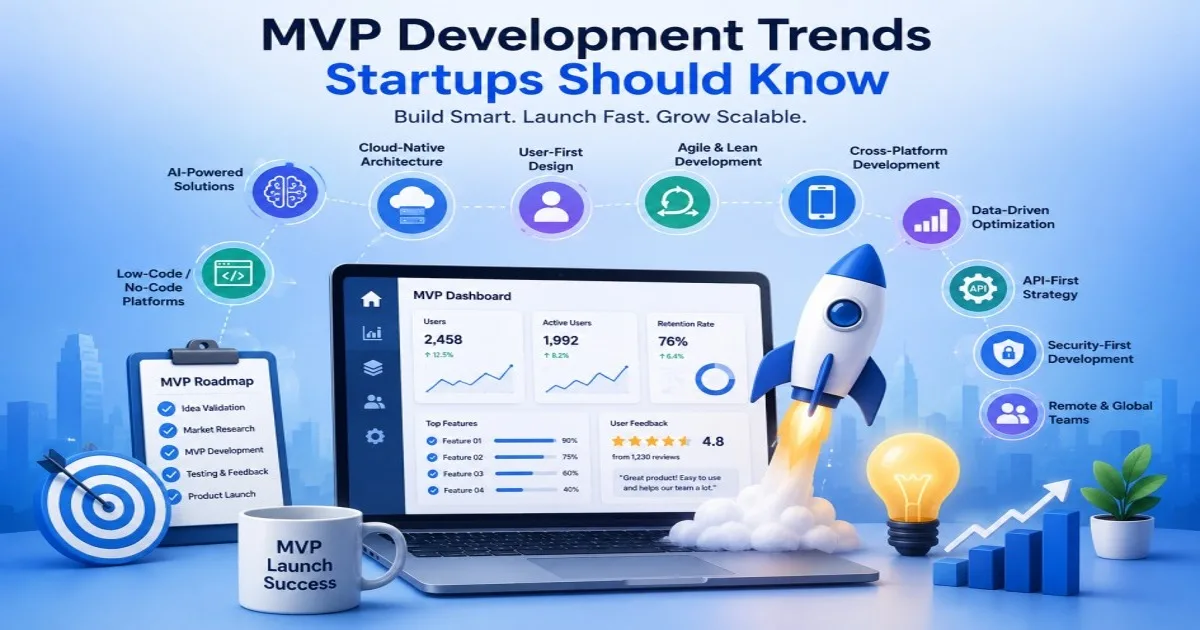
Emerging MVP Development Trends in 2026
The MVP development landscape continues to evolve due to advancements in technology and changing market demands. Startups that understand these trends can improve their chances of success and build more competitive products.
AI-Powered MVP Solutions
Artificial Intelligence is becoming a major part of MVP development. Startups are integrating AI-powered features into their products to enhance automation, personalization, and customer engagement.
AI technologies are helping startups with:
- Smart chatbots
- Predictive analytics
- Automated workflows
- Personalized recommendations
- AI-driven customer support
AI tools are also assisting developers with faster coding, testing, and bug detection, reducing overall development time.
As AI adoption continues to grow, startups using AI-powered MVPs are gaining a competitive advantage in the digital market.
Rise of Low-Code & No-Code Platforms
Low-code and no-code platforms are transforming how startups build MVPs. These platforms allow businesses to create applications with minimal coding knowledge using drag-and-drop interfaces and pre-built templates.
Benefits of low-code development include:
- Faster MVP creation
- Lower development costs
- Easier experimentation
- Reduced technical dependency
For early-stage startups with limited budgets, low-code tools offer an efficient way to validate ideas quickly before investing in custom development.
Although low-code solutions may not replace traditional development entirely, they are becoming highly useful for rapid prototyping and market testing.
Cloud-Native MVP Architecture
Cloud-native development has become a standard approach for building scalable MVPs.
Modern startups are using cloud services such as:
- AWS
- Microsoft Azure
- Google Cloud Platform
- Cloud-native architecture provides:
- Better scalability
- Faster deployment
- Reduced infrastructure costs
- Improved system reliability
- Flexible resource management
Cloud-based MVPs allow startups to scale their applications as user demand grows without requiring expensive hardware infrastructure.
This trend is especially important for SaaS startups and high-growth digital platforms.
User-First Product Design
User experience is now a major factor in MVP success. Startups are prioritizing simple, intuitive, and customer-focused product design instead of adding excessive features.
User-first MVP development focuses on:
- Simplicity
- Accessibility
- Faster onboarding
- Mobile responsiveness
- Customer satisfaction
- Modern startups use:
- User interviews
- Usability testing
- Interactive prototypes
Feedback loops to improve product experiences continuously.
A well-designed MVP improves customer retention and increases the likelihood of long-term product adoption.
Agile & Lean MVP Development
Agile and lean methodologies continue to dominate MVP development strategies in 2026.
Agile development involves:
- Short development cycles
- Continuous testing
- Rapid iterations
- Frequent product updates
Lean startup principles encourage businesses to validate assumptions quickly and minimize wasted effort.
Benefits of agile MVP development include:
- Faster product improvements
- Better team collaboration
- Greater flexibility
- Reduced development risks
Startups using agile methods can adapt to market changes more effectively than traditional development models.
Cross-Platform App Development
Cross-platform technologies are becoming increasingly popular among startups looking to reduce costs and accelerate development timelines.
Frameworks such as:
- Flutter
- React Native
- Ionic
allow developers to build applications for both Android and iOS using a single codebase.
Benefits include:
- Faster development
- Lower maintenance costs
- Consistent user experience
- Wider market reach
Cross-platform development is ideal for startups aiming to launch mobile MVPs quickly without hiring separate Android and iOS teams.
Data-Driven Product Optimization
Data analytics now plays a major role in MVP development.
Startups are using analytics tools to track:
- User behavior
- Conversion rates
- Feature engagement
- Customer retention
- User journey patterns
Data-driven insights help startups identify:
- Product weaknesses
- User preferences
- High-performing features
This allows businesses to make smarter product decisions and improve user experiences based on real-world interactions.
Data-driven MVP optimization is becoming essential for sustainable startup growth.
API-First Development Strategy
API-first development is gaining popularity among SaaS and enterprise startups.
This approach focuses on building flexible APIs before frontend development begins.
API-first architecture offers:
- Better scalability
- Easier third-party integrations
- Faster feature expansion
- Improved system flexibility
Modern startups frequently integrate APIs for:
- Payment gateways
- CRM systems
- AI tools
- Cloud services
- Marketing platforms
API-driven MVPs allow businesses to scale and integrate new technologies more efficiently.
Security-First MVP Development
Cybersecurity is becoming a top priority for startups.
Previously, many startups delayed security implementation until after product launch. Today, businesses are adopting security-first MVP development practices from the beginning.
- Important security measures include:
- Data encryption
- Secure authentication
- Cloud security
- GDPR compliance
- User data protection
Strong security practices help startups:
- Build customer trust
- Protect sensitive information
- Avoid legal risks
Investors and users now expect digital products to maintain high security standards, even at the MVP stage.
Remote & Global Development Teams
Remote work is reshaping software development across the world.
Startups are increasingly working with:
- Offshore developers
- Remote MVP agencies
- Distributed product teams
Benefits of remote development include:
- Access to global talent
- Lower operational costs
- Faster scaling
- Flexible collaboration
Remote-first development models allow startups to build high-quality MVPs without geographical limitations.
This trend is expected to continue growing in the coming years.
How These Trends Benefit Startups
Adopting modern MVP development trends provides several advantages for startups.
These trends help businesses:
- Launch products faster
- Reduce development expenses
- Improve product scalability
- Enhance customer experiences
- Stay ahead of competitors
Startups that embrace innovation and modern development practices are better positioned for long-term success.
Common MVP Development Mistakes to Avoid
Even with modern tools and strategies, startups can still make costly MVP mistakes.
Building Too Many Features
Adding unnecessary features increases complexity and delays product launch. Startups should focus only on core functionalities during the MVP stage.
Ignoring User Feedback
Customer feedback is essential for product improvement. Ignoring user insights can lead to poor product-market fit.
Lack of Market Validation
Skipping market research increases the risk of building products that users don’t actually need.
Poor Scalability Planning
An MVP should be designed with future growth in mind. Weak infrastructure planning can create scalability issues later.
Weak Security Practices
Neglecting cybersecurity can damage customer trust and create serious business risks.
Future of MVP Development for Startups
The future of MVP development will continue evolving with advancements in AI, automation, cloud computing, and data analytics.
Emerging technologies may lead to:
- AI-generated applications
- Hyper-personalized user experiences
- Voice-enabled products
- Blockchain-powered MVPs
- Advanced automation systems
As technology becomes more accessible, startups will be able to build smarter and more scalable products faster than ever before.
Final Thoughts
MVP development remains one of the most effective strategies for startups looking to validate ideas, reduce risks, and accelerate product launches. However, the development landscape is rapidly evolving with new technologies and methodologies.
From AI-powered applications and cloud-native infrastructure to low-code development and data-driven optimization, startups must stay updated with the latest MVP trends to remain competitive.
Businesses that adopt modern MVP development practices can improve scalability, enhance user experiences, reduce costs, and increase their chances of long-term success in the digital marketplace.