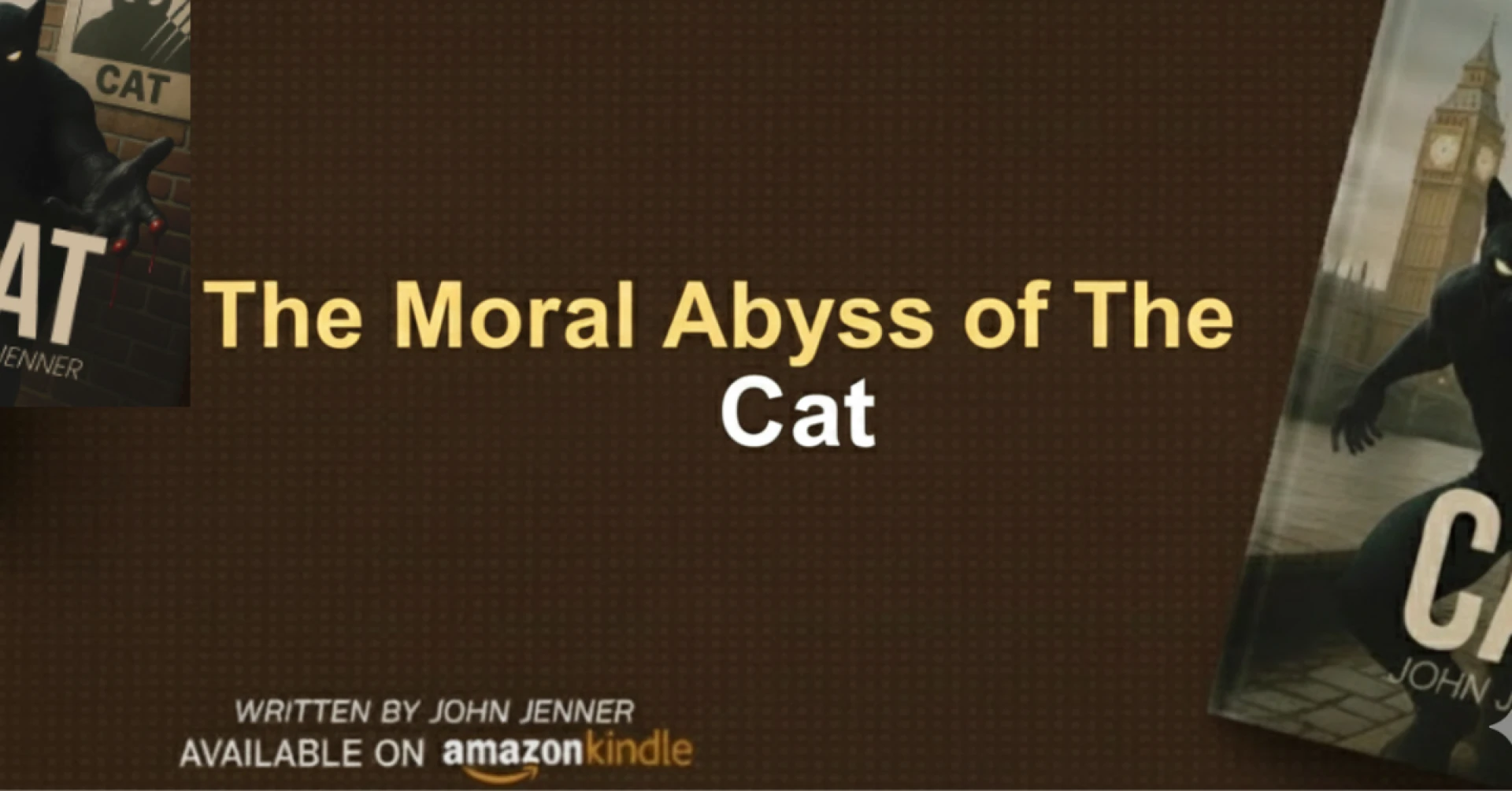
CAT by John Jenner isn’t just a vigilante thriller; it’s a mirror held up to a broken world. Beneath the explosions, masked confrontations, and silent hunts lies a story about the erosion of morality in a society that no longer knows what justice means. Jenner doesn’t deliver a typical good-versus-evil tale. Instead, he dives into the grey, where justice becomes a weapon and vengeance becomes an addiction. The Cat is not born a hero; he’s sculpted by pain, refined by loss, and released into a world that no longer deserves mercy.
In a decaying Britain where corruption festers at every level, Jenner introduces a man who decides that enough is enough. The Cat is a symbol not of hope, but of consequence. When institutions crumble, when courts are bought, and when the law turns its back on the innocent, something primal awakens. Jenner’s protagonist becomes that primal force, the embodiment of humanity’s suppressed instinct for balance. The Cat doesn’t seek approval; he seeks equilibrium through fear and punishment.
The panther mask is the most striking symbol of this transformation. It’s not a disguise, it’s an evolution. When he puts it on, the man beneath it sheds his identity, his hesitation, even his humanity. The mask becomes his truth, an outward reflection of the predator within. In Jenner’s world, this metamorphosis mirrors the one society itself undergoes when it abandons justice for survival. The Cat is, in a sense, the city’s dark echo; it created him, and through him, it’s punished.
Jenner layers this symbolism with haunting realism. The Cat’s actions are brutal and efficient, but every scene carries an undercurrent of tragedy. He doesn’t revel in the hunt; he endures it. Each strike against the criminal underworld pushes him deeper into isolation, stripping away the remnants of the man he once was. In one sense, The Cat is an avenger. In another, he’s a victim trapped in a cycle of violence that promises justice but delivers emptiness.
This is where Jenner’s storytelling excels: in moral ambiguity. The Cat’s world doesn’t allow for heroes, only survivors. Every act of vengeance carries moral weight, every confrontation raises questions about whether he’s delivering justice or becoming what he despises. Readers are torn between admiration and unease, cheering for The Cat’s war on crime while sensing that his actions come with an irredeemable cost. Jenner’s writing invites reflection: Is The Cat saving the city, or simply mirroring its cruelty?
The novel’s atmosphere amplifies this inner turmoil. Jenner’s depiction of Britain is not dystopian in a futuristic sense; it’s hauntingly present-day. The decay is political, social, and moral. It’s a place where the strong exploit the weak, where justice has a price tag, and where silence is safety. Within this chaos, The Cat emerges as both saviour and warning, a manifestation of what happens when good men stop waiting for permission to act.
The arrival of the American gangster introduces a contrasting ideology of control through fear versus justice through fear. Both men are predators, yet only one hides behind a cause. Their inevitable confrontation becomes more than a battle of strength; it's a collision of purpose. The gangster represents the perpetuation of corruption; The Cat embodies retribution. But as the story unfolds, Jenner forces readers to confront an unsettling realisation: both feed off the same darkness.
What makes CAT so compelling is that it doesn't glorify violence; it questions it. The Cat's every victory feels like a loss, another step down a path that may have no return. His brutality exposes the hypocrisy of a society that condemns him while benefiting from his results. In this sense, Jenner doesn't just tell a story about a vigilante; he exposes the uncomfortable truth that justice, when left unattended, will evolve into something unrecognisable.
Through sharp, cinematic prose and psychologically layered storytelling, Jenner crafts more than a thriller; he constructs a moral labyrinth. Readers aren't asked to choose sides but to reflect on how easily morality bends under desperation, and how quickly righteousness becomes obsession. The Cat may cleanse the streets, but every drop of blood reminds him and us that vengeance never truly ends. It only transforms.
By the end, Jenner’s message echoes with chilling clarity: The Cat is both saviour and symptom. He's the consequence of a world that traded compassion for control, law for apathy, justice for power. The Cat's claws are society's own, sharpened by neglect.
In CAT, John Jenner doesn’t simply explore darkness; he defines it. He shows that beneath every mask of justice lies the face of something far more human, and far more dangerous: the will to decide what’s right when no one else will.
Amazon Link: Cat