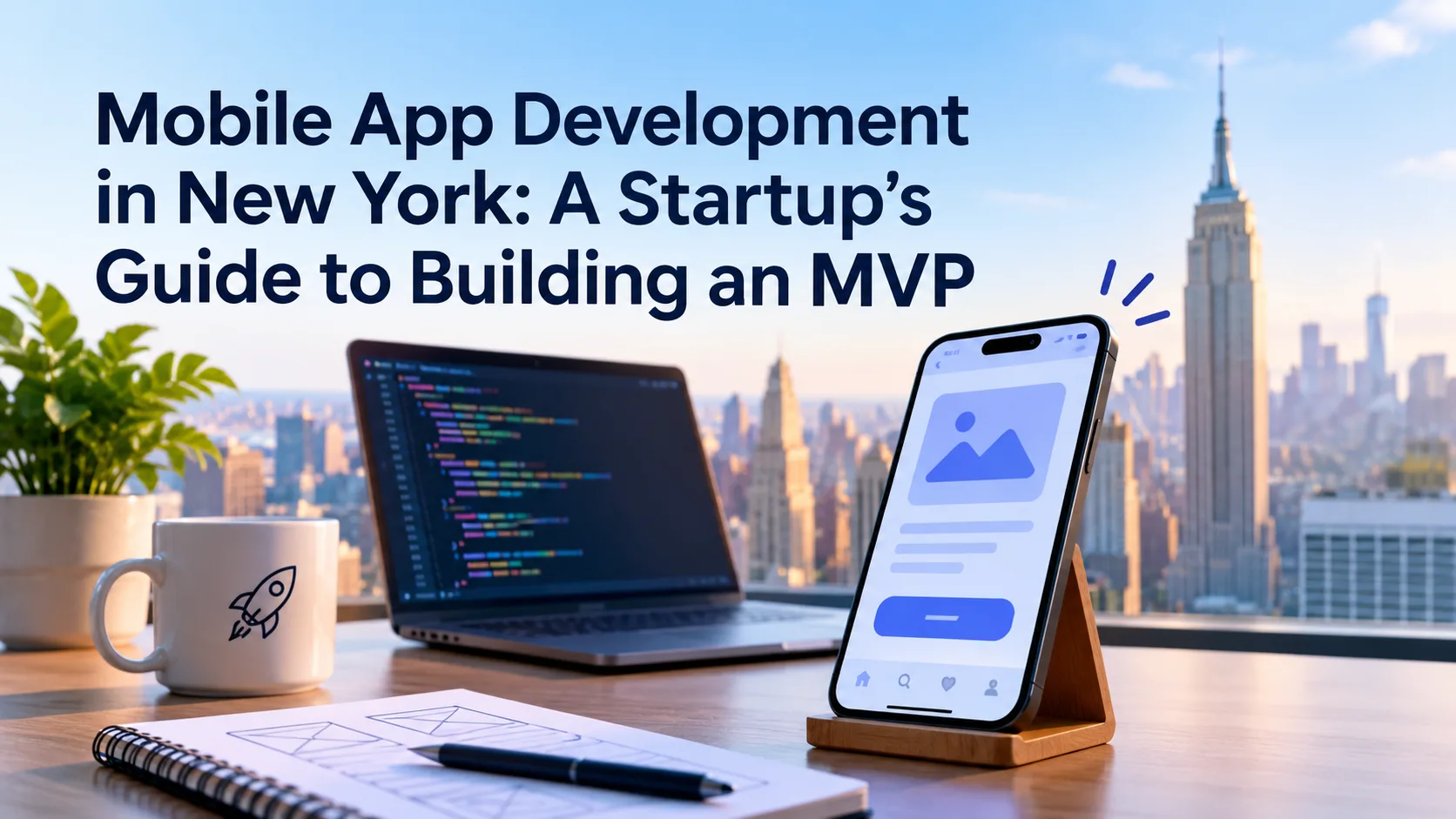
New York has no shortage of ambitious startup ideas. From fintech and healthcare to food delivery, SaaS, and on-demand services, founders are constantly looking for ways to solve everyday problems through technology. But turning an idea into a successful mobile application takes more than funding and a capable development team.
The challenge is getting the first version right without spending too much time or money. Development costs in NYC can add up quickly, investor expectations are high, and delaying a launch gives competitors more time to establish themselves. Spending six months building features nobody asked for is a risk most early-stage companies can't afford.
That’s where a Minimum Viable Product (MVP) makes a difference. With the right approach to Mobile App Development Services in New York, startups can test their ideas, understand customer behaviour, and build a product based on actual market demand rather than assumptions.
What Is an MVP (and Why Do Startups Get It Wrong)?
A Minimum Viable Product (MVP) is the first working version of an application, built with enough features to solve a specific customer problem and gather meaningful feedback. It allows startups to test their business idea with real users before investing in a complete product. The goal is to learn what works, identify what doesn’t, and decide what deserves further investment.
The word minimum often confuses. Some founders think an MVP should be little more than a basic prototype. Others try to squeeze their entire product roadmap into the first release, leaving very little out.
Both approaches miss the point.
An MVP should be simple, but it still needs to work properly. Users should be able to complete the main task without confusion or unnecessary steps. Whether someone is booking a service, making a payment, finding a professional, or managing a business operation, the core experience must deliver genuine value.
Take a New York startup planning an on-demand home services platform. The first release might include customer registration, service listings, appointment booking, payment processing, and notifications. Loyalty rewards, AI-powered recommendations, and advanced analytics can come later.
Why spend money developing those features before knowing whether customers even want the service?
A good MVP answers that question early.
Key Steps to Building a Mobile App MVP in New York
Building an MVP isn’t simply a matter of choosing Flutter or React Native and getting developers started. The decisions made before development often have a bigger impact on the final result.
Here’s how founders can approach the process.
1. Validate Your Startup Idea First
Before discussing screens, features, or development costs, spend time understanding the problem.
Talk to potential customers. Look at competing applications and pay attention to the complaints users repeatedly mention. If you’re targeting New York customers, speak with the people who might actually use your product, whether they’re local business owners, commuters, healthcare professionals, retailers, or service providers.
Don’t mistake encouragement for market validation. Someone saying your idea sounds interesting doesn’t necessarily mean they’ll download it or pay for it.
Ask questions that reveal actual customer behaviour:
- How do people currently deal with this problem?
- What frustrates them about existing solutions?
- Would they pay for an alternative?
- Which features would make them switch to a new application?
Customer interviews, landing pages, surveys, and clickable prototypes are useful ways to test demand without committing to a full development project.
2. Decide Which Features Actually Belong in the MVP
This is where founders need to be disciplined.
Everyone involved in a startup usually has a list of features they’d love to see in the final product. The problem is that every addition affects the budget, development schedule, testing requirements, and maintenance workload.
A simple way to prioritise features is to divide them into three categories:
- Must-have features: Functions required to deliver the application’s primary purpose.
- Useful features: Improvements that make the experience better but aren’t essential for the first release.
- Future features: Advanced capabilities that can be considered once real users start interacting with the product.
For example, a fintech MVP may need account registration, transaction history, payment functionality, and essential security controls. Automated financial insights, investment recommendations, and advanced dashboards can be introduced later.
Keep asking one question: Does this feature help validate the business idea? If not, it probably doesn’t belong in the first release.
3. Select a Technology Stack That Fits the Product
The right technology depends on what you’re building, how much you’re prepared to invest, and where you expect the application to go over the next few years.
Most mobile app projects fall into one of these approaches:
- Native development: Swift for iOS and Kotlin for Android. This approach suits applications that need deeper device integration, platform-specific functionality, or demanding performance.
- Cross-platform development: Flutter and React Native allow teams to build for iOS and Android using a shared codebase. This can reduce duplicated development work and make them attractive options for startups.
- Backend development: Technologies such as Node.js, Python, and Java, supported by cloud platforms like AWS and Google Cloud, can handle APIs, databases, application infrastructure, and integrations.
There’s no reason to choose a complicated technology stack just because it sounds impressive. A marketplace with standard booking and payment functionality may work perfectly well with cross-platform development. An application relying heavily on specialised device capabilities may need native engineering.
Think beyond the launch, too. Your technology choices should make future updates and maintenance manageable.
4. Design an Experience People Can Use Without Thinking Twice
An MVP doesn’t require dozens of screens or elaborate animations. It does need an interface that makes sense.
Start with wireframes and user flows. Work out how someone will register, find what they need, and complete the application’s main action. Once the structure is clear, create a clickable prototype and put it in front of potential users.
New York customers often use mobile applications while commuting, working, or moving between appointments. They don’t want to spend time figuring out where a button is or how to complete a booking.
Simple navigation, readable content, accessible layouts, and quick interactions should be part of the initial design, not improvements saved for later.
5. Build the Application in Manageable Development Sprints
Once the scope and design are approved, development can begin.
Rather than waiting until the entire application is complete, break the work into shorter development cycles. This gives founders a chance to review progress, raise concerns, and adjust priorities along the way.
Depending on the product, development may cover:
- Frontend and backend engineering.
- Database design and API integration.
- User registration, authentication, and permissions.
- Payment gateway and third-party integrations.
- Push notifications and essential app functionality.
- An admin dashboard for managing users and operations.
Regular sprint reviews are worth insisting on. They help prevent misunderstandings from turning into expensive rework.
6. Test Thoroughly Before the First Release
A working application isn’t automatically a launch-ready application.
Test it across different devices, operating systems, screen sizes, and network conditions. Check registration, navigation, payment processing, permissions, and error handling. Pay particular attention to the journeys users will rely on most.
Security also needs to be part of the development process. Fintech and healthcare applications, for example, may require encryption, secure authentication, access controls, privacy safeguards, and compliance with applicable regulations.
A smaller feature set doesn’t mean you can afford to compromise on reliability.
7. Launch, Study User Behaviour, and Keep Improving
The first release gives you something that early conversations and prototypes cannot: actual user behaviour.
Track the numbers that matter to your business. These might include onboarding completion, active users, feature adoption, customer retention, conversion rates, successful bookings, or completed payments.
Don’t get distracted by download numbers alone. An application can attract plenty of downloads and still struggle to retain users.
Combine analytics with customer interviews and support feedback. Look for patterns, identify friction points, and use those findings to decide what deserves attention in the next development cycle.
Common MVP Mistakes Startups Make
A startup doesn’t necessarily fail because its original idea was poor. Sometimes the problem is how the product was built.
A few mistakes appear repeatedly in early-stage projects.
Trying to build everything at once: Founders often want messaging, subscriptions, advanced dashboards, AI recommendations, referral programmes, and multiple user roles in the first release. That approach increases costs without necessarily improving the initial value proposition. Start with the core experience.
Developing without talking to customers: Internal discussions cannot replace real market feedback. If founders skip customer research, they risk building an application around assumptions that users don’t share.
Choosing a developer based entirely on price: A cheaper proposal may look attractive initially, but unclear requirements, poor communication, and unreliable code can create much larger expenses later. Evaluate technical capability and project management, not just the quotation.
Ignoring security and future maintenance: An MVP doesn’t need an unnecessarily complicated architecture. However, it should be built with sensible security practices and room for future improvements. This is particularly relevant for applications handling payments or personal information.
Assuming the job ends at launch: The first version will almost certainly need adjustments. Startups that don’t monitor performance or collect user feedback have little basis for deciding what to improve.
Leaving ownership unclear: Make sure the agreement covers source code, design files, documentation, cloud accounts, and intellectual property. These details should be settled before development begins.
Getting these decisions right early can save founders considerable time, money, and frustration.
How Much Does MVP Development Cost in New York?
MVP development costs in New York vary considerably. A straightforward application with a few essential screens is a very different project from a fintech platform with payment integrations, multiple user roles, and complex security requirements.
The local technology market also affects pricing. New York offers access to experienced product designers, engineers, and technical consultants, but hiring an entirely local team can cost more than working with a distributed development partner.
For initial budgeting, these ranges provide a useful starting point:
MVP CategoryEstimated CostDevelopment TimelineBasic MVP$15,000–$30,0006–10 weeksMid-level MVP$30,000–$60,00010–16 weeksComplex MVP$60,000–$120,000+16–24+ weeksThese are planning estimates, not guaranteed project quotations. Actual costs depend on the scope and technical requirements.
What makes one MVP more expensive than another?
- Feature requirements: Basic registration and listings are less demanding than real-time messaging, advanced booking, or recommendation engines.
- Platform choice: Separate native iOS and Android builds can require more development resources than a shared cross-platform approach.
- Design complexity: Custom interfaces, prototyping, and usability testing influence the overall budget.
- External integrations: Payment gateways, mapping services, CRM platforms, and third-party APIs add implementation and testing work.
- Security requirements: Fintech and healthcare applications often need additional engineering and compliance-related considerations.
- Maintenance: Hosting, monitoring, bug fixes, updates, and ongoing technical support should be included in the financial plan.
For many early-stage businesses, setting aside $25,000–$50,000 for a focused MVP can be a sensible starting point if the feature scope is well managed.
One recommendation: keep another 10–20% available as a contingency. Unexpected integrations, technical changes, and issues uncovered during testing can affect the original estimate. You also want enough money left after launch to improve the product based on customer feedback.
Code Brew Labs — Helping NYC Startups Build and Launch Faster
Building a startup product requires more than a promising idea. Founders need to make strategic decisions about product features, technology, user experience, and development costs while preparing for market entry.
Code Brew Labs helps startups and growing businesses navigate these challenges through comprehensive digital product development services. From initial concept planning to application launch, the company supports businesses in building solutions aligned with their goals, target audiences, and growth plans.
From Concept to Market-Ready Application
For businesses exploring Mobile App Development Services in New York, Code Brew Labs provides development capabilities across iOS, Android, Flutter, and React Native. These technologies enable businesses to develop native and cross-platform applications based on their product requirements and available resources.
The development process can include:
- Product discovery and requirement planning
- UI/UX design and interactive prototypes
- Mobile application development
- Backend systems and API integration
- Cloud infrastructure and deployment
- Quality assurance and application testing
- Post-launch maintenance and improvements
This approach helps businesses establish a structured development roadmap before investing in extensive engineering work.
Technology That Supports Business Growth
Different products require different technical foundations. A fintech application may prioritize transaction security and reliable integrations, while a healthcare platform may require careful handling of sensitive information and efficient workflows.
Code Brew Labs works across multiple technology areas, including artificial intelligence, machine learning, cloud computing, backend development, and enterprise software integration.
Its industry experience includes healthcare, fintech, SaaS, marketplaces, and on-demand applications, allowing development teams to consider industry-specific requirements when planning digital products.
Why Choose Code Brew Labs for Mobile App Development?
A development partnership should be judged by more than the number of technologies a company lists on its website. What matters is whether the team can understand your business requirements and turn them into a product that works.
Here are a few reasons startups may consider Code Brew Labs for their MVP development requirements:
End-to-end development capabilities: From product planning and wireframing to engineering, testing, deployment, and maintenance, the company supports multiple stages of the application lifecycle.
Experience across different industries: Its work spans fintech, healthcare, marketplaces, on-demand platforms, SaaS, and other business categories. This provides a broader understanding of different product requirements.
Flexible technology expertise: With experience in native and cross-platform development, AI/ML, cloud engineering, and backend technologies, the team can help identify an approach that suits the product rather than forcing every project into the same technical setup.
Focus on practical product development: Startups need to balance features, budgets, and launch schedules. A focused MVP scope and a clear development roadmap can help prevent unnecessary work during the early stages.
Support beyond the initial launch: Getting an application into the hands of users is only the beginning. Maintenance, performance improvements, feature updates, and technical support all matter as the business grows.
For founders, the value of a development partner comes down to one thing: having a team that can help turn an idea into a usable product while keeping business priorities in view.
Choosing the Right Mobile App Development Partner for Your MVP
Before signing a development agreement, spend time evaluating the people who will actually build your application.
A few questions can reveal a lot about a potential partner:
- Relevant portfolio: Have they delivered applications with functionality similar to yours?
- Product thinking: Will they help you prioritise features and question unnecessary requirements?
- Technical capability: Can they explain why a particular framework or architecture makes sense for your project?
- Clear pricing: Does the proposal outline development costs, deliverables, timelines, and possible additional expenses?
- Communication: Will you receive regular progress updates anIf you’re planning a new application and exploring Mobile App Development Services in New York, Code Brew Labs can help you assess your idea, define the right MVP scope, and put together a practical development roadmap.d opportunities to review working features?
- Ownership terms: Will you retain access to the source code, design assets, documentation, and intellectual property?
- Ongoing support: Can the team help with bug fixes, updates, performance monitoring, and future releases?
Ask for relevant project examples and, where possible, speak with previous clients. Request a roadmap that outlines milestones and explains what you’ll receive at each stage.
Be cautious of anyone promising unrealistic timelines or guaranteed business success. A dependable development partner should be honest about technical limitations, potential risks, and what your budget can realistically achieve.
Ready to Turn Your Startup Idea Into an MVP?
Building a mobile application in New York doesn’t mean you have to launch with every feature your competitors offer. In fact, trying to do so can be one of the most expensive mistakes an early-stage founder makes.
Start with a clear customer problem. Build the features that address it, release the product, and pay attention to how people use it. That’s how a startup moves from an interesting idea to a product with genuine market potential.
You don’t need to have every detail figured out before getting started. A clear problem, an understanding of your target users, and a realistic first-release goal are enough to begin the conversation.