<p><!-- wp:paragraph --></p>
<p> </p>
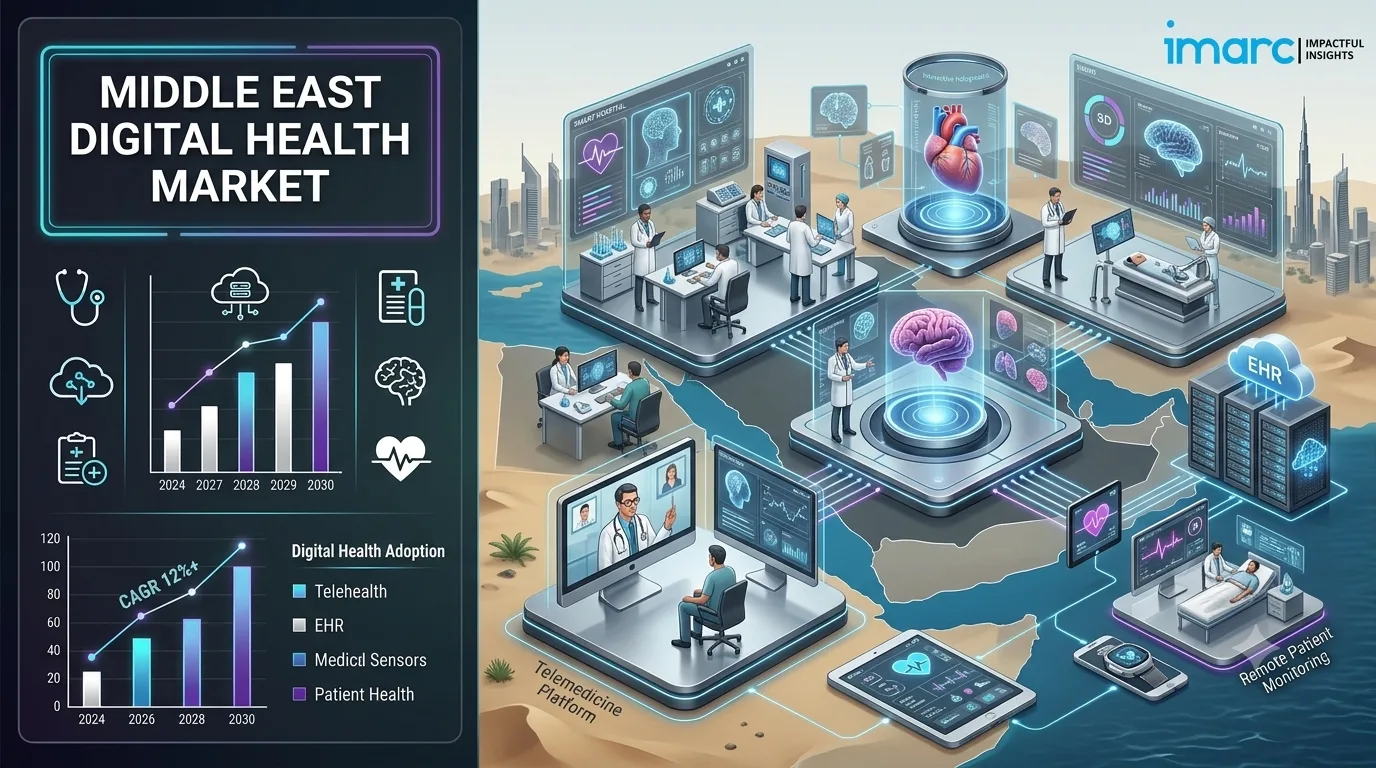
<p>IMARC Group, a leading global market research and management consulting firm, has published its latest market intelligence report on the Middle East digital health market. The Middle East digital health market size increased from USD 21,810.0 Million in 2024 to USD 23,365.0 Million in 2025 and is projected to reach USD 42,144.1 Million by 2034, exhibiting a CAGR of 6.77% during 2026-2034, driven by rising telehealth and telemedicine adoption, sustained government-backed digital transformation agendas, and the region's shift toward AI-enabled, preventive, and remote care models.</p>
<p>The market is riding sustained structural momentum as Gulf healthcare systems reposition themselves from paper-based, hospital-centric delivery toward connected, AI-augmented care ecosystems. Smartphone and internet penetration exceeding 90% in countries such as the UAE, Saudi Arabia, and Kuwait, a young and digitally native population, and a growing burden of chronic diseases including diabetes, hypertension, and cardiovascular conditions are widening the addressable market across teleconsultation, remote monitoring, and electronic health records. National digital health strategies anchored in Saudi Arabia's Vision 2030 and the UAE's National Strategy for Artificial Intelligence 2031 are reinforcing this shift, creating a healthcare base built for region-wide interoperability rather than isolated pilot projects.</p>
<p><strong>Middle East Digital Health Market at a Glance:</strong></p>
<ul>
<li><strong>Market Size (2024): </strong>USD 21,810.0 Million</li>
<li><strong>Market Size (2025): </strong>USD 23,365.0 Million</li>
<li><strong>Forecast Market Size (2034): </strong>USD 42,144.1 Million</li>
<li><strong>CAGR (2026-2034): </strong>6.77%</li>
<li><strong>Leading Type (2025): </strong>Telehealth, approximately 45% share</li>
<li><strong>Leading Component (2025): </strong>Software, largest share</li>
<li><strong>Dominant Country (2025): </strong>Saudi Arabia, approximately 35% share</li>
</ul>
<p><strong>How AI is Reshaping the Future of the Middle East Digital Health Market</strong></p>
<ul>
<li><strong>AI-Powered Diagnostics and Clinical Decision Support: </strong>Abu Dhabi-based Burjeel Holdings partnered with US artificial intelligence firm Paige to bring AI-driven pathology and cancer diagnostics into MENA hospitals, addressing the region's persistent shortage of specialist pathologists and compressing diagnostic turnaround times.</li>
<li><strong>AI Clinical Assistants and Administrative Automation: </strong>The UAE has deployed its first AI clinical intelligence platform across public hospitals, using a multilingual AI physician assistant to conduct pre-consultation interviews, reducing administrative workload for clinicians while improving patient engagement.</li>
<li><strong>AI-Enhanced Health Information Exchange: </strong>The Dubai Health Authority integrated AI capabilities into its NABIDH health information exchange, giving every patient a single, comprehensive electronic medical file accessible across all healthcare providers in the emirate and strengthening patient data security.</li>
</ul>
<p><strong>Grab a sample PDF of this report: </strong><a href="https://www.imarcgroup.com/middle-east-digital-health-market/requestsample">https://www.imarcgroup.com/middle-east-digital-health-market/requestsample</a></p>
<p><strong>Middle East Digital Health Market Trends and Drivers:</strong></p>
<p>Telehealth adoption is the single biggest structural shift in the market, commanding an estimated 45% share of the type mix in 2025 as patients across the Gulf increasingly consult physicians remotely for chronic-disease follow-up and routine care. Smartphone penetration exceeding 90% in the UAE, Saudi Arabia, and Kuwait is compounding this shift directly, driving demand for mobile health apps, e-pharmacy platforms, and app-based remote monitoring tools, while rising diabetes and cardiovascular disease prevalence keeps chronic-disease management the leading clinical use case across the region.</p>
<p>The region's demographic and regulatory profile is a structural, not incidental, advantage. A young, digitally native population is driving comfort with virtual care, while government-run health information exchanges such as Abu Dhabi's Malaffi, which connects 100% of hospitals and clinics across the emirate, and Dubai's NABIDH are removing the interoperability barriers that have historically slowed digital health adoption elsewhere. Saudi Arabia's Health Sector Transformation Program targets inclusive health services for 88% of the Kingdom's population and a unified digital medical records system nationwide, reinforcing the Kingdom's position as the region's largest single-country market.</p>
<p>Government-backed capital is the accelerant behind both trends. Qatar's Digital Agenda 2030 has earmarked roughly USD 2.5 Billion for data and AI initiatives plus a further USD 2.4 Billion package to build AI capability, and the UAE and US agreed in 2025 to build a 26-square-kilometer AI-focused campus in Abu Dhabi capable of housing 5 gigawatts of data center capacity, developed with OpenAI, Oracle, NVIDIA, and Cisco. Layered on top, venture and sovereign capital continues to flow into regional digital health platforms, with Alma Health raising USD 10 Million in 2025 to expand its chronic-care management platform from the UAE into Saudi Arabia and Egypt.</p>
<p><strong>Government Schemes and National Digital Health Initiatives Driving Demand:</strong></p>
<ul>
<li><strong>Saudi Vision 2030 and the Health Sector Transformation Program: </strong>Targets inclusive health services for 88% of the Kingdom's population and a unified digital medical records system covering the entire population, formally positioning digital health as a pillar of Saudi Arabia's non-oil healthcare transformation agenda.</li>
<li><strong>UAE National Strategy for Artificial Intelligence 2031: </strong>Places healthcare at the center of the UAE's digital innovation roadmap, underpinning initiatives such as Abu Dhabi's Malaffi health information exchange, which connects 100% of hospitals and clinics across the emirate, and Dubai's AI-enhanced NABIDH platform.</li>
<li><strong>Qatar Digital Agenda 2030 and Health Vision 2050: </strong>Qatar has committed roughly USD 2.5 Billion for data and AI initiatives alongside a further USD 2.4 Billion package to build AI capability and attract global tech talent, complementing Qatar's Health Vision 2050 focus on integrated health information exchanges.</li>
<li><strong>Bahrain National Policy on Artificial Intelligence: </strong>Launched in July 2025, the policy formalizes an ethical, principled approach to AI adoption in healthcare, building on Bahrain's earlier rollout of app-based platforms for diabetes tracking and patient engagement.</li>
<li><strong>Oman's eHealth Initiatives: </strong>Focused on building integrated health information exchanges and population health management platforms, extending digital health infrastructure investment beyond the Gulf's largest markets.</li>
</ul>
<p>We explore the factors propelling the <a href="https://www.imarcgroup.com/middle-east-digital-health-market">Middle East digital health market growth</a>, including technological advancements, consumer behaviors, and regulatory changes.</p>
<p><strong>Middle East Digital Health Industry Segmentation:</strong></p>
<p><strong>The report has segmented the market into the following categories:</strong></p>
<p><strong>Breakup By Type:</strong></p>
<ul>
<li>Telehealth</li>
<li>Medical Wearables</li>
<li>EMR/EHR Systems</li>
<li>Medical Apps</li>
<li>Healthcare Analytics</li>
<li>Others</li>
</ul>
<p>Telehealth commands the largest type share, with industry estimates placing it at approximately 45% in 2025, driven by rising demand for remote consultations, chronic-disease follow-up, and government-backed virtual care reimbursement frameworks, and is also expected to register the fastest growth through the forecast period as smartphone penetration and 5G rollout continue to expand access.</p>
<p><strong>Breakup By Component:</strong></p>
<ul>
<li>Software</li>
<li>Hardware</li>
<li>Services</li>
</ul>
<p>Software leads the component breakup, reflecting sustained investment in electronic health record platforms, AI-enabled clinical decision-support tools, and cloud-based health information exchanges, while the services segment, spanning implementation, integration, and analyst support, is gaining share as hospital systems scale multi-country digital health deployments.</p>
<p><strong>Breakup By Country:</strong></p>
<ul>
<li>Saudi Arabia</li>
<li>Turkey</li>
<li>Israel</li>
<li>United Arab Emirates</li>
<li>Iran</li>
<li>Iraq</li>
<li>Qatar</li>
<li>Kuwait</li>
<li>Oman</li>
<li>Jordan</li>
<li>Bahrain</li>
<li>Others</li>
</ul>
<p>Saudi Arabia dominates the Middle East digital health market with an estimated 35% share in 2025, anchored by Vision 2030's Health Sector Transformation Program and one of the region's largest healthcare budgets, while the United Arab Emirates follows closely and is expected to register the fastest growth through 2034, supported by Dubai's NABIDH and Abu Dhabi's Malaffi health information exchanges alongside a wave of venture-backed health-tech startups.</p>
<p><strong>Competitive Landscape:</strong></p>
<p>The report provides a comprehensive analysis of the competitive landscape in the Middle East digital health market with detailed profiles of all major companies, including:</p>
<ul>
<li>Altibbi</li>
<li>Vezeeta</li>
<li>Okadoc</li>
<li>Health</li>
<li>Alma Health</li>
<li>M42</li>
<li>Teladoc Health, Inc.</li>
<li>Babylon Health</li>
</ul>
<p><strong>Market Concentration Analysis:</strong></p>
<ul>
<li><strong>Fragmentation: </strong>The market remains highly fragmented, with the competitive structure dispersed across a large number of regional and international platforms rather than concentrated among a handful of dominant operators.</li>
<li><strong>Consolidation Trend: </strong>Strategic funding rounds and cross-border expansion are accelerating consolidation, exemplified by Altibbi's USD 44 Million Series B round, led by Foundation Holdings and Hikma Ventures, the largest single financing round recorded for a regional digital health company.</li>
<li><strong>Capital Inflows: </strong>Sovereign wealth-backed investors and regional venture capital firms, including Global Ventures and DASH Ventures, are directing capital toward chronic-care management, e-pharmacy, and AI diagnostics platforms, reshaping competitive dynamics and driving scale-building across the sector.</li>
</ul>
<p><strong>What Does The Full Report Cover?</strong></p>
<p>If you are tracking the Middle East digital health market for investment decisions, market entry planning, competitive benchmarking, or strategic advisory, IMARC Group's report gives you everything in one place:</p>
<ul>
<li>Complete market sizing in value terms with forecasts covering the full 2026-2034 projection period</li>
<li>Quantified growth driver analysis with impact scoring across type, component, and country markets</li>
<li>Sub-segment breakdowns for telehealth, medical wearables, EMR/EHR systems, medical apps, healthcare analytics, software, hardware, and services, each with individual share data</li>
<li>Country-level data across Saudi Arabia, Turkey, Israel, United Arab Emirates, Iran, Iraq, Qatar, Kuwait, Oman, Jordan, Bahrain, and other Middle East markets</li>
<li>Competitive profiles of leading regional and international digital health operators with strategic landscape assessment</li>
<li>Value chain analysis, market concentration assessment, and investment and growth opportunity mapping</li>
<li>Latest technology trends covering AI-driven diagnostics, clinical decision support, health information exchange platforms, and Vision 2030 and National AI Strategy-driven infrastructure opportunities shaping market competition across the region</li>
</ul>
<p><strong>Recent News and Developments in Middle East Digital Health Market</strong></p>
<ul>
<li><strong>April 2026: </strong>Innovaccer and Infinia Technologies, a subsidiary of Abu Dhabi's International Holding Company (IHC) Group, formed a strategic alliance to accelerate AI-driven, value-based healthcare across the UAE.</li>
<li><strong>July 2025: </strong>Alma Health, an Abu Dhabi-based chronic-care management platform, raised a USD 10 Million funding round to expand its AI-enhanced virtual care and home diagnostics services from the UAE into Saudi Arabia and Egypt.</li>
<li><strong>April 2025: </strong>The Dubai Health Authority integrated artificial intelligence into its NABIDH health information exchange platform, giving every patient a single, comprehensive electronic medical file accessible across all healthcare providers in Dubai and strengthening patient data security.</li>
</ul>
<p><strong>Note: If you require specific details, data, or insights that are not currently included in the scope of this report, we are happy to accommodate your request. As part of our customization service, we will gather and provide the additional information you need, tailored to your specific requirements. Please let us know your exact needs, and we will ensure the report is updated accordingly to meet your expectations.</strong></p>
<p><strong>Key Questions This Report Answers</strong></p>
<ul>
<li>What is the current Middle East digital health market size and what is its projected value?</li>
<li>Which type segment holds the largest share in the Middle East digital health market?</li>
<li>What are the key drivers of Middle East digital health market growth?</li>
<li>Which country dominates the Middle East digital health market and why?</li>
<li>How is Vision 2030, the UAE National Strategy for Artificial Intelligence 2031, and rising telehealth adoption reshaping infrastructure investment and competitive strategy in the Middle East digital health industry?</li>
<li>Who are the top companies in the Middle East digital health market and what are their competitive strategies?</li>
<li>What are the investment and market entry opportunities across telehealth expansion, AI diagnostics, and health information exchange platforms in the Middle East?</li>
</ul>
<p><strong>About Us</strong></p>
<p>IMARC Group is a global management consulting firm that helps the world's most ambitious changemakers to create a lasting impact. The company provides a comprehensive suite of market entry and expansion services. IMARC offerings include thorough market assessment, feasibility studies, company incorporation assistance, factory setup support, regulatory approvals and licensing navigation, branding, marketing and sales strategies, competitive landscape and benchmarking analyses, pricing and cost research, and procurement research.</p>
<p><strong>Media and Sales Contact</strong></p>
<p><strong>IMARC Group</strong></p>
<p><strong>Email: [email protected]</strong></p>
<p><strong>United States: </strong>+1-201-971-6302</p>
<p><strong>India: </strong>+91-120-433-0800</p>
<p><strong>United Kingdom: </strong>+44-753-714-6104</p>
<p><!-- /wp:paragraph --></p>
Middle East Digital Health Market Size, Demand, Trends & Industry Analysis 2026-2034

imarcshubham
·
11 min read
·
85 Buzz