When garment brands, tailors, and export houses start sourcing buttons in bulk, the same set of questions comes up again and again. What actually goes into making a metal button? Why does zinc casting dominate the industry? How do you tell a reliable manufacturer from one that will cause problems on a large order? This article answers the most common questions about metal button manufacturing in a straightforward, practical format — useful whether you're placing your first bulk order or switching suppliers for an export shipment.
1. What is metal button manufacturing, exactly?
Metal button manufacturing is the process of turning raw metal — typically zinc alloy or brass — into finished, plated buttons ready to be sewn or attached to garments. It's not a single step but a sequence: melting and casting the metal into shape, trimming rough edges, polishing the surface, applying a protective and decorative plating, and inspecting the finished product before it ships. Each stage affects the final button's strength, appearance, and lifespan.
2. Why is zinc used so widely in metal button manufacturing?
Zinc alloy has become the standard material for zinc casted buttons for a few practical reasons. It has a relatively low melting point, which makes it easier and more energy-efficient to cast at scale. It flows smoothly into detailed molds, capturing fine design work that's hard to reproduce with stiffer metals. And once plated, it resists corrosion and holds its finish through years of washing — exactly what garment buttons need to survive.
3. What does die casting actually involve?
Die casting is the core manufacturing step. Molten zinc alloy is injected under high pressure into a precision steel mold (the "die"), which shapes the button to an exact design — down to logos, patterns, or textured surfaces. Because the mold is reusable, manufacturers can produce thousands of identical buttons per run, which is essential for garment brands that need consistency across an entire production batch.
4. Why do buttons need trimming and polishing after casting?
Fresh out of the mold, a cast button has excess metal along its edges, known as flash, along with a slightly rough surface. Trimming removes the flash so the button doesn't have sharp or uneven edges, and polishing smooths the surface before plating. Skipping this stage would leave every button with visible imperfections once the finish is applied.
5. What finishes are available for metal buttons?
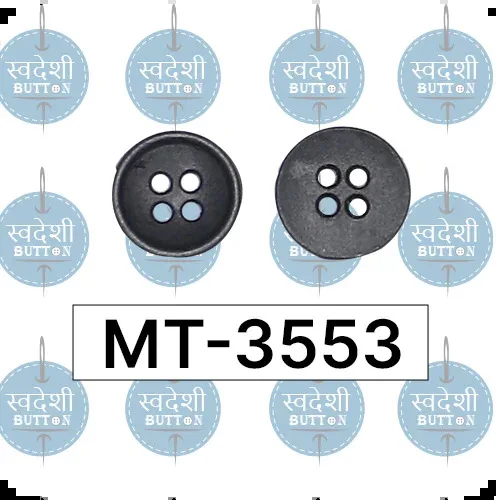
Most manufacturers offer a range of electroplated finishes, including antique brass, gold, nickel, gunmetal, matte black, and two-tone combinations. Beyond aesthetics, plating serves a functional purpose — it adds a protective layer that improves corrosion resistance and helps the button keep its shine through repeated wear and washing.
6. How do manufacturers maintain consistency across large orders?
Quality manufacturers run inspections at the end of every production batch, checking alloy composition, plating thickness, and dimensional accuracy before packaging. This step matters most on large or export orders, where even minor inconsistencies across thousands of units can cause problems during garment assembly or fail quality checks with international buyers.
7. Should I ask for samples before placing a bulk order?
Yes — always. A dependable manufacturer will provide sample buttons before committing to full production, giving you the chance to confirm size, finish, and design accuracy. Skipping this step on a large order is one of the most common (and costly) sourcing mistakes garment buyers make.
8. Does it matter if a manufacturer handles the whole process in-house?
It does. Manufacturers who manage casting, trimming, polishing, and plating under one roof tend to deliver more consistent results than those who outsource individual stages to different vendors. In-house production also usually means faster turnaround from sample approval to bulk delivery, since there's no coordination lag between multiple external parties.
9. What should international buyers check for compliance?
Buyers sourcing from India for markets like Nepal and Bangladesh should confirm the manufacturer can provide nickel-free and REACH-compliant documentation. Many international retail brands require this certification before accepting garment shipments, so it's worth confirming upfront rather than discovering a gap after production is complete.
10. Can one manufacturer supply multiple button types for a single collection?
Often, yes — and it's usually worth it. Manufacturers producing metal buttons alongside polyester buttons and brass sheet trims and rivets let brands consolidate an entire season's button sourcing with a single vendor, reducing the back-and-forth of managing multiple suppliers and keeping lead times more predictable across a full product line.
The Bottom Line
Metal button manufacturing is a precise, multi-stage craft, and the quality difference between manufacturers usually comes down to how carefully each of these stages is executed — not just the final finish you see on the button. Garment brands and export buyers who ask the right questions upfront, request samples, and confirm compliance documentation put themselves in a far better position than those who choose a supplier on price alone.
Swadeshi Button's zinc casted buttons collection is manufactured in-house from casting through electroplating, supplying tailors, garment brands, and export houses across India, Nepal, and Bangladesh with consistent, export-ready quality.