Safety and productivity are often framed as competing priorities in warehouse management — as though investing in one inevitably means compromising the other. It is a false tension, and nowhere is that clearer than in the operational data that facilities collect once they deploy camera-based forklift visibility systems. What starts as a safety investment almost always reveals itself, within a few months, to be a productivity investment as well.
This matters because the conversation around forklift camera technology in the UAE and Kuwait has largely been driven by compliance pressure and accident prevention. Those are legitimate and important drivers. But they tell only part of the story. The facilities that are extracting the most value from these systems are the ones that have learned to read the data those systems generate — and use it to make their operations measurably faster, leaner, and more predictable.

The Productivity Cost of Limited Visibility
Before examining what camera systems contribute, it is worth being precise about what limited visibility actually costs. The obvious cost is accidents — but the less visible cost is hesitation.
When forklift operators cannot clearly see their surroundings, they slow down. They take wider turns than necessary. They wait for a spotter before reversing in a busy area. They pause at blind intersections longer than the layout requires. Each of these micro-delays is individually small — two seconds here, five seconds there. But across a fleet of eight forklifts, operating across two ten-hour shifts, those delays accumulate into a meaningful drag on throughput that never appears on any incident report because nothing went wrong.
Warehouses in high-growth logistics markets like Dubai, Abu Dhabi, and Kuwait City are under constant pressure to process more volume through the same physical space. In that environment, recovering lost cycle time through better visibility is not a marginal gain — it is a genuine competitive advantage.
How a Forklift Camera Reshapes Operator Behaviour
The behavioral shift that follows camera installation is well-documented among facilities that track it. Operators who previously relied on a combination of mirrors, instinct, and physical spotters report substantially higher confidence when navigating reversals, blind corners, and high-traffic intersections. That confidence translates directly into pace.
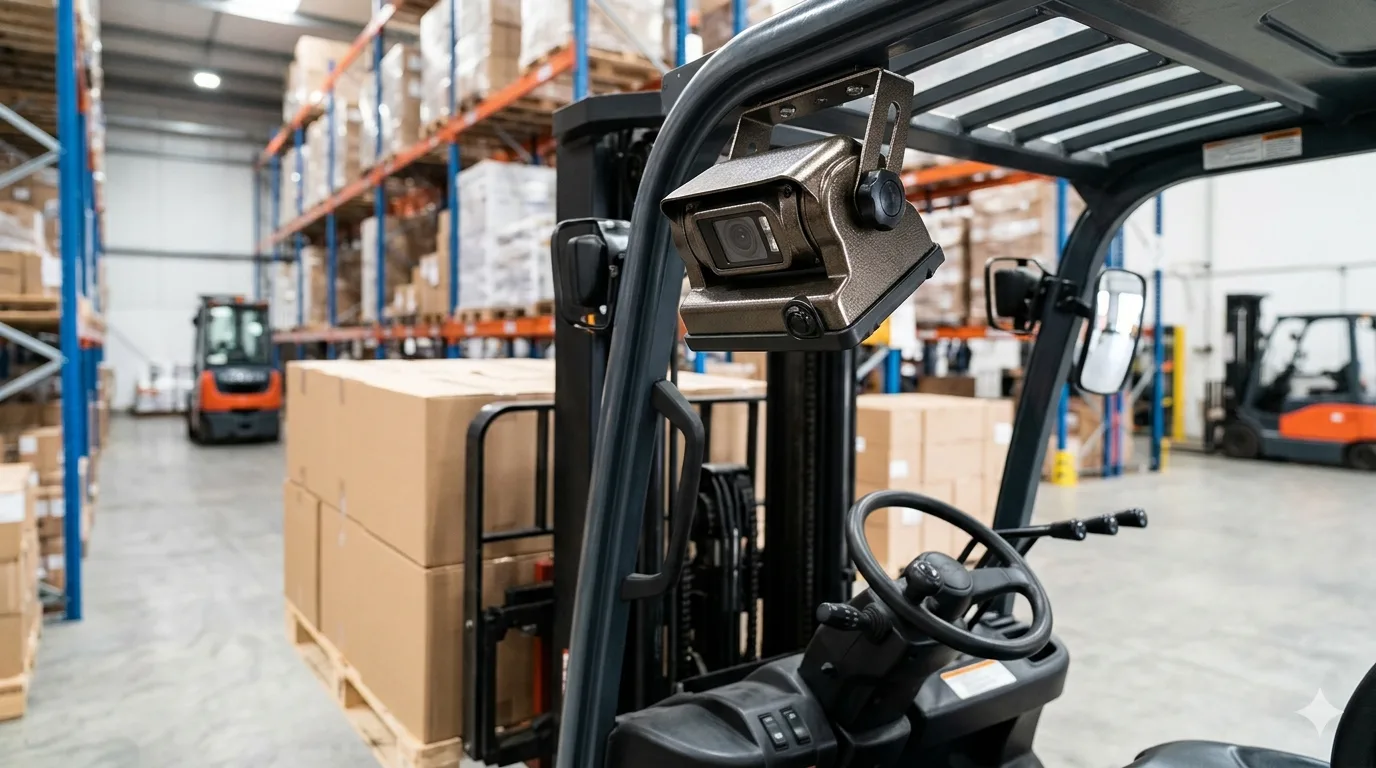
A forklift camera mounted at the rear of the truck gives the operator a clear, real-time view of what is behind them without requiring them to turn their body, interpret a distorted mirror reflection, or wait for a hand signal from a ground-level colleague. The cognitive load of the reversal manoeuvre drops, and the time taken to complete it drops with it.
This is not a theoretical claim. Facilities that have measured pre- and post-installation cycle times consistently find reductions in per-trip duration, particularly on routes that include reversals or tight turning sequences. When those gains are multiplied across the number of trips a forklift completes in a shift, the cumulative productivity improvement is significant.
What the Data from a Forklift Camera System Actually Reveals
The productivity case becomes even stronger once you consider what a modern forklift camera system can reveal about operations beyond individual trips. Camera footage, reviewed systematically, surfaces patterns that operational managers rarely see through conventional reporting.
Common findings include: specific intersections where traffic consistently bunches, creating queuing delays that slow multiple trucks simultaneously; loading zones where the approach angle adds unnecessary time to every docking sequence; and shift periods where pedestrian and forklift traffic overlap in ways that force repeated stops. None of these patterns typically appear in daily operations reports, because nothing goes wrong — they are friction, not failure.
But friction has a measurable cost. Once camera footage identifies where it lives, layout adjustments, traffic sequencing changes, and procedural modifications can eliminate it. The camera system pays for part of its cost simply by making inefficiency visible.

The Role of Recorded Footage in Continuous Improvement
A forklift safety camera system that includes recording capability goes further still. Managers who regularly review footage are not just investigating incidents — they are conducting an ongoing operational audit of how their floor actually functions versus how it is supposed to function.
A forklift camera recorder with timestamped, retrievable footage creates the raw material for structured safety and efficiency reviews. Teams can identify which operators are consistently smooth and efficient in their movements — and use that footage as a training reference for others. They can track whether a layout change made after a safety review actually improved traffic flow, or whether it created a new bottleneck elsewhere. They can demonstrate to leadership, with evidence, that safety investments are also productivity investments.
This evidence-based approach to warehouse management is increasingly expected in professionally run logistics operations across the Gulf region, where facility standards and customer expectations are both rising.
Wireless Architecture and Fleet-Wide Deployment
Scaling camera systems across a large fleet introduces practical questions about installation time, maintenance overhead, and system reliability. A wireless forklift camera architecture addresses the most common barriers to fleet-wide adoption. Without the need to route cables through each truck — a process that takes time, creates future maintenance points, and introduces wear-related failure risks — deployment is faster and more consistent across the fleet.
For operations with large numbers of trucks, or where vehicles rotate between sites, wireless systems also offer redeployment flexibility that hardwired setups cannot match. A camera unit that can be transferred to a different truck without a cabling job means that the investment follows the operational need rather than being fixed to a specific vehicle.
Translating Camera Data into Operational Decisions
For warehouse managers who want to use camera systems as a genuine productivity tool rather than simply a compliance checkbox, the following principles make the difference:
- Establish a footage review schedule — weekly or fortnightly, focused on patterns rather than incidents alone
- Track cycle times before and after installation on specific routes to quantify the productivity impact with your own data
- Use footage as a training tool by identifying high-performing operator techniques that can be shared across the team
- Map the intersections and zones where camera footage repeatedly shows hesitation or delays, and treat these as layout or process problems worth solving
- Correlate camera data with throughput metrics — volume processed per shift, trips completed per hour — to build an evidence base for future safety and productivity investments
- Review the impact of layout or procedural changes using before-and-after footage to confirm whether changes achieved their intended effect
Each of these steps turns passive recording into active management intelligence — and that is where the real productivity value of camera systems lives.
Conclusion
The warehouses and logistics facilities that treat forklift camera technology purely as a safety compliance tool are leaving value on the table. The same systems that reduce blind-spot incidents also reduce cycle times, surface operational inefficiencies, support structured training programmes, and generate the kind of objective data that good management decisions are built on. In competitive logistics markets like those across the UAE and Kuwait, that combination of safety and productivity return is not a bonus — it is the whole point. If you are ready to see what a well-specified, purpose-built system looks like in practice, start with the Product Review: SharpEagle Forklift Camera System — a detailed, real-world evaluation of a solution designed specifically for the demands that serious industrial operations place on their safety and visibility equipment.