
In today’s hyper‑connected market, a flawless customer experience (CX) isn’t just a nice‑to‑have—it’s a competitive imperative. Brands that speak the language of their customers—literally and figuratively—gain loyalty, reduce churn, and open doors to new markets. That’s where accent translation and AI voice clarity software step in, turning voice interactions into seamless, global conversations.
Why Accent Matters in CX
Even when agents and customers share the same language, regional accents can create friction. Misheard words, delayed comprehension, and the need for repeated clarifications waste time and erode trust. For multinational support centers, the problem compounds: a single call center may field calls from Brazil, Germany, India, and the United States—all in English, but each with a distinct pronunciation pattern.
The result? Longer handling times, lower satisfaction scores, and higher operational costs. Solving this isn’t about forcing customers to adopt a “neutral” accent; it’s about empowering your agents with technology that understands and converts the speech they receive.
Real‑Time Accent Conversion: The Game Changer
Enter real time accent conversion—a subset of accent translation that works on the fly, during the call. Powered by deep‑learning models trained on terabytes of multilingual speech data, the technology:
- Detects the speaker’s accent within milliseconds.
- Normalizes the audio, adjusting phonetic nuances without altering the speaker’s voice identity.
- Delivers a clear, standardized output to the receiving party—whether that’s an agent, chatbot, or transcription system.
The impact is immediate: agents hear a version of the conversation that matches their own dialect, reducing cognitive load and allowing them to focus on problem‑solving rather than decoding speech.
AI Voice Clarity Software: Beyond Simple Noise Cancellation
Traditional noise‑cancelling tools strip background sounds but do little for accent‑related ambiguity. AI voice clarity software pushes the envelope further:
- Dynamic spectral shaping enhances consonants and vowels that are often muffled in certain accents.
- Context‑aware language models preserve meaning, ensuring that “schedule” isn’t mistakenly rendered as “skid‑dle” in a heavy Southern drawl.
- Adaptive learning tailors the system to your specific agent pool, continuously improving accuracy as more calls are processed.
The combination of accent translation and voice clarity creates a feedback loop: clearer input feeds better AI analytics, while refined analytics train the system to handle new accent variations even more effectively.
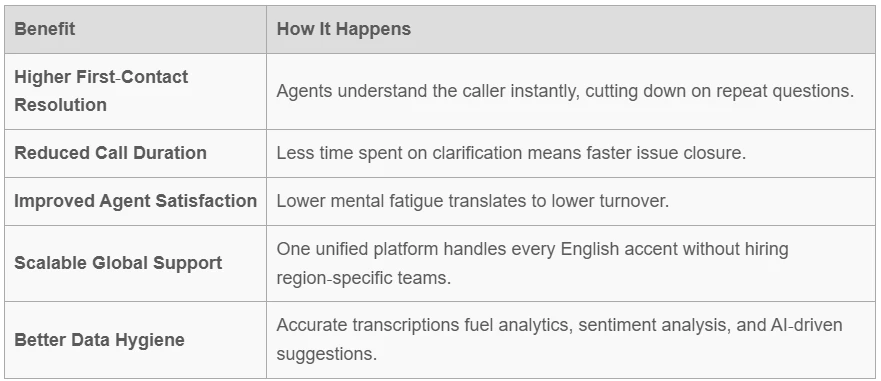
Business Benefits at a Glance
Getting Started
- Audit Your Call Data – Identify the most common accent clusters impacting your CX.
- Pilot a Real‑Time Accent Conversion Solution – Deploy it on a limited agent group and measure key metrics (handle time, CSAT, NPS).
- Integrate AI Voice Clarity Software – Layer it on top of your existing phone or VoIP system; most vendors offer API‑first integrations.
- Train Your Team – Even the best tech works best when agents understand its capabilities and limitations.
- Iterate – Use the enriched data to refine models, expand language support, and continuously improve the CX loop.
The Bottom Line
In a world where every conversation can become a brand touchpoint, accent translation and AI voice clarity software are no longer optional add‑ons—they’re a strategic necessity. By leveraging real‑time accent conversion, you turn linguistic diversity into a competitive advantage, delivering a truly global CX that feels local, personal, and unmistakably clear.
Ready to let your voice be heard—anywhere, in any accent? The technology is here; the next step is yours.