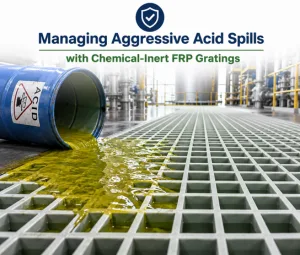
In chemical manufacturing, battery assembly, electroplating, fertiliser production, and pharmaceutical synthesis, acid spills are not exceptional events — they are a routine operational risk that facility design must account for as a baseline condition. Every plant handling sulphuric acid, hydrochloric acid, nitric acid, or phosphoric acid needs flooring, drainage, and access grating that can survive repeated acid contact without structural degradation, without corrosion-driven contamination, and without becoming a safety hazard.
The material that satisfies all of these requirements simultaneously is FRP gratings — floor grating panels manaufactured from FRP material that is chemically inert to the aggressive acid environments found in India’s growing chemical and battery manufacturing sector.
Why Acid Environments Destroy Conventional Grating
Galvanised steel, mild steel, and cast iron grating have no place in acid-handling areas. The mechanism of failure is straightforward and rapid:
- Concentrated sulphuric acid attacks steel immediately on contact, generating heat and hydrogen gas as it dissolves the metal surface.
- Hydrochloric acid vapour — even without liquid contact — corrodes steel gratings through chloride attack on the protective zinc layer of galvanised surfaces.
- Nitric acid is a powerful oxidising acid that dissolves steel and also attacks the protective oxide layer that gives stainless steel its corrosion resistance.
- Dilute acid from spills, splashes, and washdown accumulates in grating joints and beneath coatings, corroding from the inside out where it cannot be seen or treated.
The result of any of these attack mechanisms is the same: progressive structural weakening of the grating, followed by visible rust contamination of the process environment, and eventually structural failure — a grating section that collapses under foot load because its actual cross-section has been reduced by 30, 40, or 50% by corrosion that was invisible from the surface.
In acid environments, steel grating is not just a maintenance problem — it is a ticking safety liability.
What Is FRP Material? The Chemistry Behind Acid Resistance
What is FRP material and why is it chemically resistant to acids that destroy steel?
FRP — Fibre Reinforced Polymer — is a composite material consisting of glass fibres embedded in a thermosetting polymer resin. Neither component has any reactivity with the common industrial acids:
Glass Fibres
Silica-based; chemically inert to acids except hydrofluoric acid (which attacks silica directly — the one acid for which standard FRP material is not recommended without specialist modification).
Polymer Resin Matrix
Thermosetting resins — polyester, isophthalic, or vinyl ester — have no metallic components and no reactivity with sulphuric, hydrochloric, nitric, or phosphoric acid at the concentrations encountered in normal industrial spill scenarios.
The result is that FRP gratings can be submerged in, repeatedly splashed with, or exposed to the vapours of industrial acids without any degradation of structural properties or surface integrity. This is not a protective coating that can be scratched off — it is the fundamental chemistry of the material itself.
Selecting the Right FRP Gratings Resin for Your Acid Environment
Not all FRP material is created equal for acid service. The resin system determines the chemical resistance envelope:
Orthophthalic Polyester Resin
The baseline FRP material formulation. Suitable for mild acid exposure — dilute concentrations, splash and vapour contact. Not recommended for concentrated acid immersion or continuous contact.
Isophthalic Polyester Resin
Superior acid and water resistance compared to orthophthalic. The most widely specified FRP material resin for general chemical plant flooring and grating where a range of acids may be encountered.
Read More : https://fibrotechfrp.com/managing-aggressive-acid-spills-with-chemical-inert-frp-gratings/