Introduction
What if machines could improve their performance just by learning from experience, without being told exactly what to do?
In today’s digital world, systems are no longer limited to fixed instructions. They can analyze large amounts of data, identify patterns, and make decisions that continue to improve over time. This shift has changed how technology works across industries.
Machine Learning and Deep Learning are the key technologies behind this transformation. They power applications such as voice recognition, recommendation systems, fraud detection, and many other intelligent systems.
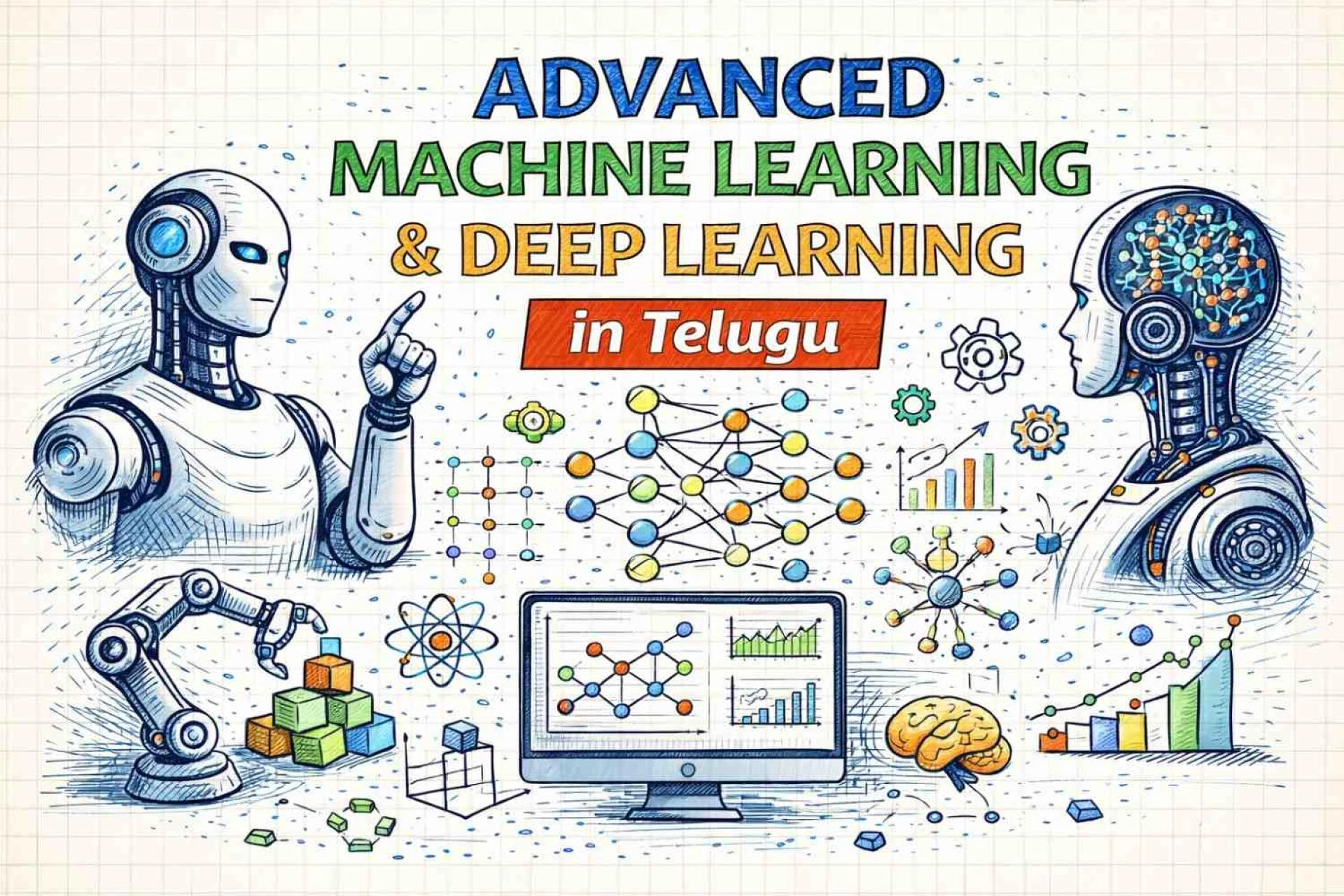
For many learners, understanding these concepts can feel difficult due to complex explanations. However, when these ideas are explained clearly and in a familiar language, they become much easier to follow. Learning Advanced Machine Learning and Deep Learning in Telugu can help simplify the learning process and make it more practical.
What is Machine Learning?
Machine Learning is a method that allows computers to learn from data and make decisions based on patterns.
Instead of writing detailed instructions for every task, you provide data, and the system learns from it.
Example
If a system is trained using past data about customer behavior, it can predict future actions such as what products a customer might buy.
This ability to learn from data makes Machine Learning useful for prediction and analysis.
What is Deep Learning?
Deep Learning is an advanced part of Machine Learning that uses neural networks with multiple layers.
It is particularly effective for handling complex data such as:
- Images
- Audio
- Text
Deep Learning models automatically extract important features from data, making them powerful for solving complex problems.
Why Learn Machine Learning and Deep Learning in Telugu?
Learning these technologies in Telugu helps simplify complex concepts, improves understanding, and allows learners to focus on practical applications without confusion caused by technical language.
How Machine Learning Works
Machine Learning systems follow a structured process.
Data Collection
Data is collected from different sources.
Data Preparation
The data is cleaned and organized for better accuracy.
Model Training
The system learns patterns from the data.
Evaluation
The model is tested to measure its performance.
Prediction
The trained model is used to make decisions or predictions.
Key Concepts in Machine Learning
Data
Data is the foundation of Machine Learning. High-quality data leads to better results.
Model
A model is a system that learns from data.
Features
Features are the inputs used to make predictions.
Accuracy
Accuracy measures how well the model performs.
Key Concepts in Deep Learning
Neural Networks
Neural networks are systems inspired by the human brain.
Layers
Each layer processes different levels of information.
Learning Process
The model improves by reducing errors over time.
Data Requirement
Deep Learning models require large datasets for better performance.
Types of Machine Learning
Supervised Learning
The system learns from labeled data.
Example:
Predicting outcomes based on past data.
Unsupervised Learning
The system identifies patterns without labeled data.
Example:
Grouping similar data.
Reinforcement Learning
The system learns through rewards and feedback.
Example:
Training systems through trial and error.
Real-World Applications
Machine Learning and Deep Learning are widely used in various industries.
Healthcare
- Disease detection
- Medical analysis
Finance
- Fraud detection
- Risk management
Retail
- Product recommendations
- Customer insights
Technology
- Voice recognition
- Image processing
What You Will Learn
A structured learning path includes:
Basics
- Introduction to Machine Learning
- Data handling
- Programming fundamentals
Intermediate Topics
- Regression and classification
- Data analysis techniques
Advanced Topics
- Neural networks
- Deep Learning models
- Optimization techniques
Skills Required
To learn these technologies, you need:
- Basic programming knowledge
- Logical thinking
- Problem-solving ability
- Consistency in learning
These skills improve with practice.
Benefits of Learning Machine Learning and Deep Learning
Career Opportunities
There is strong demand for professionals in this field.
Real-World Impact
You can build solutions for real-world problems.
Continuous Growth
The field evolves rapidly, offering ongoing learning opportunities.
Industry Relevance
These technologies are widely used across industries.
Challenges in Learning
- Understanding mathematical concepts
- Working with large datasets
- Choosing appropriate models
- Continuous learning requirement
These challenges can be managed with practice.
Step-by-Step Learning Path
Step 1: Learn Basics
Start with programming and data fundamentals.
Step 2: Understand Machine Learning
Learn algorithms and how they work.
Step 3: Practice
Work on datasets and simple problems.
Step 4: Learn Deep Learning
Understand neural networks and advanced concepts.
Step 5: Build Projects
Apply your knowledge to real-world scenarios.
Future Scope
Machine Learning and Deep Learning are rapidly evolving.
Trends
- Increased automation
- Smarter AI systems
- Expansion into new industries
- Data-driven decision-making
These technologies will continue to shape the future.
Frequently Asked Questions
Is Machine Learning difficult to learn?
It may seem challenging initially but becomes easier with practice.
Do I need coding skills?
Yes, programming is important for implementation.
Can beginners learn these technologies?
Yes, beginners can start with basic concepts.
How long does it take to learn?
Learning depends on consistency and effort.
Conclusion
Machine Learning and Deep Learning are transforming how systems learn from data and make intelligent decisions. They are becoming essential technologies in a world driven by data and automation.
Understanding these concepts step by step, especially in a familiar language like Telugu, can make even complex topics easier to grasp and apply effectively.
As these technologies continue to grow and influence industries across the world, the question is—are you ready to understand how machines learn, adapt, and use data to solve real-world problems?