Are you running a small business? What’s your real struggle? The real struggle is not getting new customers, it must be getting old customers back.
That's where a well-built loyalty system for small business owners can quietly change everything. Local cafes, retail shops, distributors, and even manufacturers are waking up to the fact that keeping a customer is far less expensive than finding a new one. And they're right.
But here's the thing: loyalty programs themselves have changed a lot.
The old "stamp your card ten times and get a free coffee" model still exists, but it's losing its grip. Nowadays customers’ expectations are high. They want only rewards that they feel relevant to them, convenience on their phones matters, and an extraordinary experience.
The numbers back this up. According to research from Open Loyalty's 2026 report, 75% of businesses are now prioritizing instant gratification as a core part of their loyalty investment. That's a pretty clear signal the market is moving fast.
So what's actually changing, and what should small businesses pay attention to in 2026? Let's get into it.
Why Loyalty Is Important in 2026 More Than Ever Before
The cost of acquiring new customers has risen consistently. With digital marketing becoming increasingly difficult, social reach having decreased, and traditional marketing demanding continual investment, consumers have many choices available to them.
In that environment, loyalty isn't a bonus feature anymore. It's a business strategy.
A thoughtfully designed loyalty system for small business growth can help you:
- Bring customers back more often without extra ad spend
- Build genuine emotional connection with your brand
- Reduce your dependence on steep discounts to drive sales
- Gather real behavioral data about your customers
- Turn satisfied buyers into people who refer others
- Create more predictable revenue month to month
According to an analysis conducted by researchers and published on arXiv over a period of nearly three decades, emotionally invested customers perform better compared to those who are attracted through discounts in terms of customer retention. This is quite consistent with the belief held by many entrepreneurs of small businesses about how customers return.
The bigger shift happening right now is that loyalty tools are becoming smarter, faster, and far more accessible for smaller businesses. You don't need a big enterprise budget to run a program that feels modern and personal.
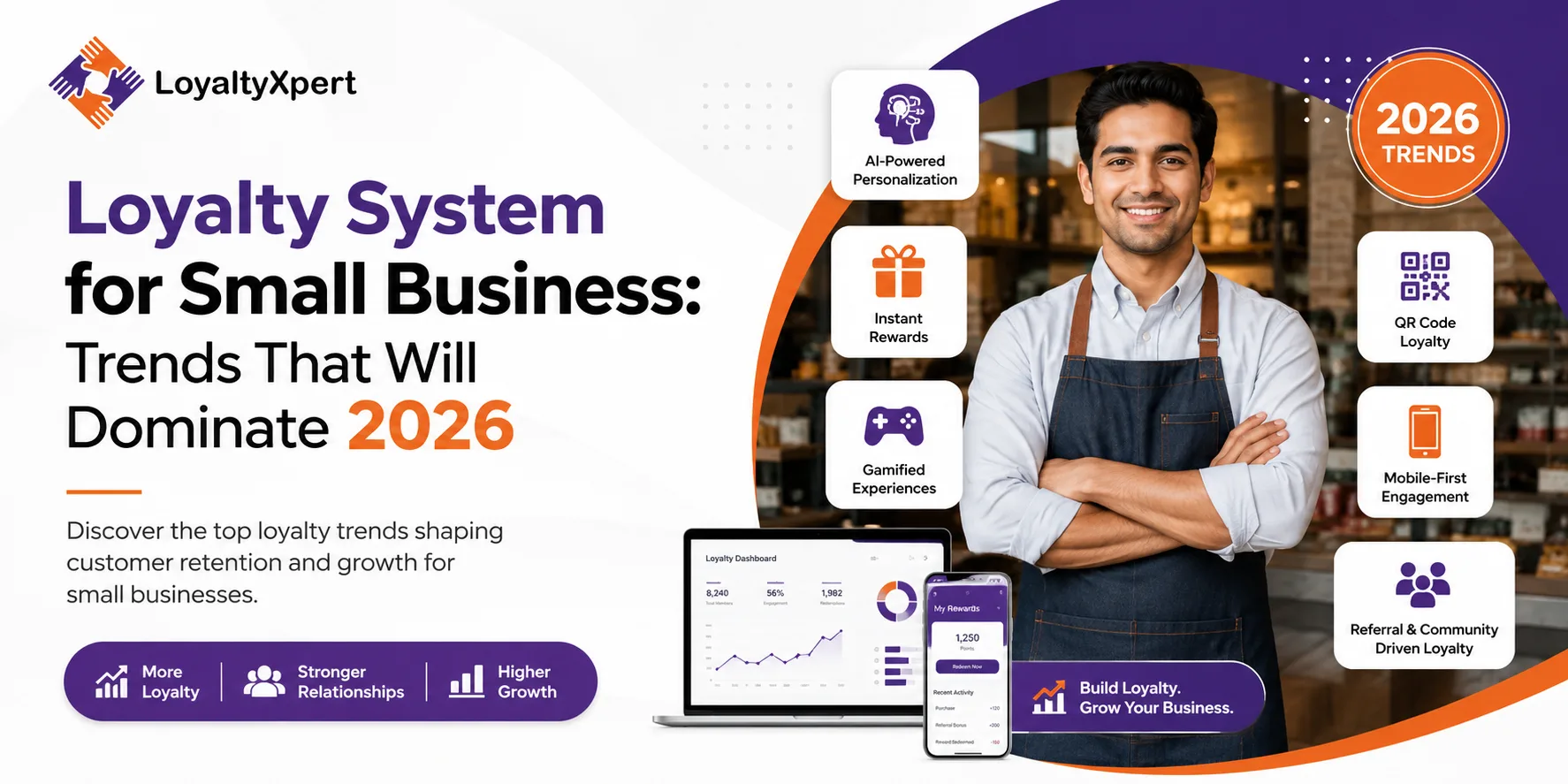
Trend #1: AI Personalization Will Become Standard
A few years ago, "AI-powered" was a buzzword. In 2026, it's just becoming how things work.
Customers don't want to receive the same offer as everyone else on your mailing list. They want to feel like you know them, what they buy, how often they visit, what they actually care about. And AI is what makes that possible at scale without a full-time marketing team.
Think about what this looks like in practice:
- A cafe automatically offers a free cold brew upgrade to the customer who orders one every Tuesday morning
- A retail store sends product-specific rewards based on a customer's purchase history rather than a generic discount code
- A distributor rewards high-volume channel partners differently from occasional buyers
Loyalty tools such as LoyaltyXpert are already incorporating AI-powered automation, live tracking, and personalization straight into their platforms. The importance of automation for small enterprises lies in the fact that it not only decreases manual effort but also creates a more meaningful experience for customers.
According to Forrester data cited in Zoho's loyalty statistics report, 24% of consumers say they're more loyal to brands that offer personalized deals. That's not a small number ; nearly one in four of your customers will choose you over a competitor simply because you made the experience feel relevant to them.
Trend #2: Instant Rewards Will Replace Delayed Gratification
Here's a truth most loyalty programs ignore: the longer customers wait for a reward, the less they care about it.
The old model of collecting points for months and eventually redeeming them for something decent doesn't create the emotional response businesses are hoping for. People forget, lose interest, or just stop participating.
What works better? Giving people something they can use immediately.
In 2026, businesses that are seeing strong loyalty program engagement are offering things like:
- Instant cashback applied at the point of purchase
- Scratch-and-win style digital rewards
- Same-visit discount triggers
- Real-time notifications when a reward is earned
- Immediate points that can be used on the very next transaction
The psychology behind this isn't complicated. When people get something right away, it feels good, and that good feeling gets attached to your brand. CX Dive reported that younger consumers in particular are accustomed to micro-transaction redemptions, pointing to programs like Starbucks Rewards where benefits kick in quickly and feel tangible.
For small businesses, even a simple "earn and use today" structure can improve participation rates more than a complicated tiered system that pays out six months later.
Trend #3: Gamification Is Becoming a Powerful Retention Tool
One honest reason loyalty programs stop working is that they become boring. People enroll, forget about it, and move on. Gamification is the antidote to that.
When you turn a loyalty program into something that feels interactive and rewarding to engage with not just at checkout, but between purchases too you create a habit. And habits are what build long-term customers.
In 2026, more small businesses are experimenting with:
- spin-the-wheel reward mechanics after a purchase
- milestone badges for reaching spending thresholds
- tier progressions that unlock better perks
- referral challenges or leaderboards
- reward streaks for consecutive visits
- surprise unlocks for customers who hit certain behaviors
Talon.One's 2026 loyalty report points out that gamification isn't just a gimmick the most successful examples build non-transactional touchpoints with customers that deepen the relationship beyond just buying and receiving a discount. McDonald's Monopoly and Sephora's Beauty Insider challenges are enterprise examples, but the principle scales down.
LoyaltyXpert includes gamification features like Spin the Wheel directly inside their platform, meaning small businesses don't need to build anything custom to get this running.
The idea is not to make your loyalty program like a video game. It's to make participation feel worthy between purchase moments, not just during them.
Trend #4: QR Code Loyalty Systems Will Continue Growing
Friction kills loyalty programs. If signing up takes five minutes, most people won't bother. If redeeming a reward requires a phone call or a printed coupon, customers just won't do it.
QR-based loyalty systems solve this problem cleanly. One scan and the customer is earning points, checking their balance, or redeeming a reward.
This trend is particularly strong in:
- Cafes and restaurants where speed matters
- Retail stores managing both walk-in and online customers
- Manufacturing and distribution businesses tracking channel partner activity
- Any setting where you want offline and online engagement to connect smoothly
LoyaltyXpert's small business loyalty platform already supports QR-based reward systems and real-time product tracking, which makes it practical for businesses that operate across different environments.
From a customer's perspective, QR loyalty is appealing because it meets them where they already are: on their phone, in the moment, without any extra steps. From a business perspective, it means faster adoption and less time spent explaining how the program works.
Trend #5: Mobile-First Loyalty Experiences Will Dominate
In case you have a loyalty program which does not function properly on the phone, then there are high chances that you'll face problems in 2026. This may sound like an exaggeration but it is actually true. Now customers want to do all things related to points, rewards, referrals etc. from the comfort of their phones.
Zoho's 2026 loyalty data shows that 58% of retail brands are now offering omnichannel loyalty programs, and 78% support enrollment at both checkout and online. That kind of accessibility is becoming the baseline, not a competitive advantage.
Small businesses building mobile-first loyalty experiences are able to stay connected with customers even when they're not actively shopping. Push notifications, personalized offers timed to previous behavior, and reward reminders keep the brand visible without being intrusive.
You don't necessarily need a standalone app to achieve this. Mobile wallet integrations and well-designed mobile web experiences can cover a lot of ground for smaller operations.
Trend #6: Loyalty Beyond Discounts
Discounts work. Nobody is going to pretend otherwise. But running a loyalty program entirely on discounts creates two problems: it trains customers to expect reduced prices, and it chips away at your margins every single time.
The businesses building the most durable customer loyalty in 2026 are the ones offering value that isn't purely financial. Things like:
- Early access to new products before they're available to everyone
- VIP treatment or exclusive experiences
- Recognition moments that make customers feel genuinely seen
- Community belonging through a brand that shares their values
- Personalized perks that feel curated, not cookie-cutter
BLOY Loyalty's 2026 analysis put it well: the programs succeeding right now treat loyalty as a system that influences behavior before, during, and between purchases not just a discount engine that fires at checkout.
Talon.One's research with Harvard Business Review found that approximately 70% of brand preference decisions are driven by emotional factors. That's a compelling case for investing in how your program makes customers feel, not just what it saves them.
For small businesses, this is actually good news. You don't need massive discounts to build an emotional connection. Remembering a regular customer's usual order, surprising someone with an upgrade, making a customer feel like a VIP without them spending a fortune these things are accessible regardless of budget.
Trend #7: Referral-Based Loyalty Will Grow Rapidly
Word of mouth has always been powerful. Referral-based loyalty programs are just a structured way to make it happen more reliably.
When your existing customers bring in new ones, you get a lead that already has some trust baked in. They've heard about you from someone they know. Conversion rates on referred customers are typically higher, and they tend to stick around longer.
Modern loyalty systems are building referral mechanics directly into the program. Customers earn rewards for:
- Referring friends or family members
- Onboarding new distributors or channel partners
- Sharing products on social media
- Writing reviews or testimonials
- Bringing in other businesses to a wholesale or trade program
For small businesses with limited marketing budgets, referral-driven growth is particularly attractive. You're essentially paying for acquisition only when it works, and you're paying with loyalty rewards rather than upfront ad spend.
LoyaltyXpert integrates referral rewards directly into their platform, which makes it practical rather than something you'd need to manage separately through another tool.
What Small Businesses Should Focus On Before Choosing a Loyalty Platform
There are a lot of loyalty tools available right now, and the feature lists can get overwhelming fast. Before getting lost in the details, it helps to step back and think about what actually matters for your specific situation.
The best loyalty system for small business operations generally ticks these boxes:
- Easy enough for customers to join without a tutorial
- Mobile-accessible from day one
- Supports QR or invoice-based tracking for your type of business
- Gives you real-time data you can actually act on
- Allows for personalized rewards, not just one-size-fits-all offers
- Includes referral capabilities
- Automates the routine stuff so you're not managing it manually
- Has some gamification to keep engagement up between purchases
- Makes redemption simple for customers and for your team
That last point deserves emphasis. The most sophisticated loyalty platform in the world won't help you if customers find it confusing. Simplicity on the front end matters as much as the features running behind it.
Businesses moving away from spreadsheets and manual stamp cards toward centralized platforms are seeing real improvements not because the technology is flashy, but because it removes the friction that causes loyalty programs to quietly die.
Final Thoughts
Customer loyalty in 2026 isn't about giving the most points or running the biggest discounts. It's about making customers feel like your business actually knows them and values their continued relationship.
The trends shaping this year AI personalization, instant rewards, gamified engagement, mobile convenience, QR-based simplicity, emotional value, and referral growth all point toward the same thing: customers want experiences that feel built for them, not mass-produced for everyone.
The good news for small businesses is that the technology making all of this possible has become far more affordable and accessible than it was even two or three years ago. A well-planned loyalty system for small business owners doesn't require an enterprise IT team or a six-figure budget. It requires choosing the right platform, keeping the experience simple for customers, and staying consistent.
The businesses that build these habits now while competitors are still relying on blanket discounts and generic email campaigns are the ones that will have the strongest customer relationships heading into 2027 and beyond. That's worth investing in.