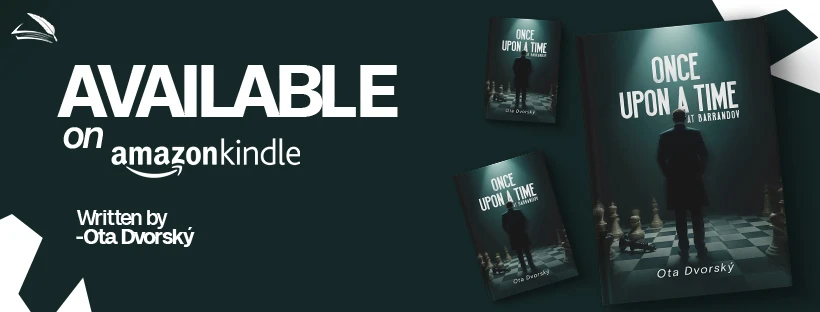
Some revolutions are fought with guns, others with cameras.
In Once Upon a Time at Barrandov, Ota Dvorský transforms the film studios of 1960s Prague into a stage where courage and creativity defy an empire. Set during the Prague Spring and the subsequent Soviet occupation, the novel illuminates how artists, writers, and dreamers risked everything to keep storytelling alive under censorship.
This is not merely a work of historical fiction; it’s a testament to the endurance of art as a language of truth when words are forbidden.
A City Between Hope and Repression
Prague, 1968. The air hums with optimism. The brief political thaw of the Prague Spring promises freedom, freedom of speech, freedom of art, and a freer future for Czechoslovakia. Yet this fragile hope is soon crushed beneath Soviet tanks, and with it, the illusion that art could exist untouched by politics.
Dvorský captures this moment of tension with stunning emotional depth. The novel doesn’t just describe the invasion, it places readers inside the heart of those who lived it. Through the corridors of Barrandov Studios, the beating heart of Czech cinema, we see artists confronting impossible choices: obey or resist, conform or create.
The Filmmakers Who Fought with Film
The characters who inhabit Once Upon a Time at Barrandov are composites of real figures and imagined heroes. Directors who once told fairy tales now face the nightmare of censorship. Writers who believed in words as magic now find their scripts edited by government bureaucrats. Yet, even under surveillance, they find ways to speak, through metaphor, allegory, and the quiet rebellion of beauty.
Dvorský’s portrayal of these filmmakers is both affectionate and reverent. They are not martyrs, but makers, flawed, passionate, and human. Their defiance isn’t loud, but persistent. Each frame of film they save, each scene they smuggle past censors, becomes an act of resistance.
The book reveals that during repression, creativity is not silenced; it adapts. It hides in symbols, it survives in folklore, and it resurfaces when the world is ready to listen.
Censorship, Courage, and the Cost of Expression
Dvorský’s writing reminds us that censorship doesn’t only erase ideas, it reshapes souls. The novel explores the emotional toll of suppression: friendships strained by fear, art reduced to propaganda, and dreams deferred by authority.
Yet amid the despair, there is an undercurrent of quiet triumph. The artists at Barrandov Studios refuse to abandon their vision. They smuggle hope into their films the way others smuggle contraband across borders. Their resistance becomes art itself, subtle, poetic, enduring.
Through them, Dvorský invites readers to see that the human spirit’s hunger for expression is stronger than any regime’s attempt to suppress it.
A Love Letter to Czech Cinema
Once Upon a Time at Barrandov is also a tribute, a cinematic love letter to an era when film meant survival. Dvorský weaves history and emotion with the precision of a director behind the lens. The novel celebrates the legendary Barrandov Studios not as a relic of the past, but as a living symbol of artistic endurance.
Even as tanks rolled through the cobblestone streets of Prague, stories continued to be told. The fairy tales born in those studios, whimsical on the surface, revolutionary underneath, carried coded messages of freedom to audiences desperate for hope.
Dvorský honours these hidden heroes by giving them voice and depth, transforming historical memory into timeless storytelling.
Imagination as Defiance
In the end, Once Upon a Time at Barrandov is about more than politics or history. It’s about the resilience of the imagination. It’s about artists who believed that stories could outlast dictatorships, and that the truth could be smuggled through fiction.
Ota Dvorský doesn’t just recount the past, he resurrects it, reminding readers that creativity itself is an act of resistance. His novel captures what totalitarian regimes always forget: you can silence a person, but never the idea they stand for.
Like the filmmakers who dared to dream under occupation, Once Upon a Time at Barrandov endures, a story not of despair, but of defiant hope.
Amazon Link: Once Upon a Time at Barrandov